


Silencing of a BAHD acyltransferase in sugarcane increases biomass digestibility
- PMID: 31080518
- PMCID: PMC6501328
- DOI: 10.1186/s13068-019-1450-7
Silencing of a BAHD acyltransferase in sugarcane increases biomass digestibility
Erratum in
-
Correction to: Silencing of a BAHD acyltransferase in sugarcane increases biomass digestibility.Biotechnol Biofuels. 2019 Jun 8;12:142. doi: 10.1186/s13068-019-1482-z. eCollection 2019. Biotechnol Biofuels. 2019. PMID: 31198439 Free PMC article.
Abstract
Background: Sugarcane (Saccharum spp.) covers vast areas of land (around 25 million ha worldwide), and its processing is already linked into infrastructure for producing bioethanol in many countries. This makes it an ideal candidate for improving composition of its residues (mostly cell walls), making them more suitable for cellulosic ethanol production. In this paper, we report an approach to improving saccharification of sugarcane straw by RNAi silencing of the recently discovered BAHD01 gene responsible for feruloylation of grass cell walls.
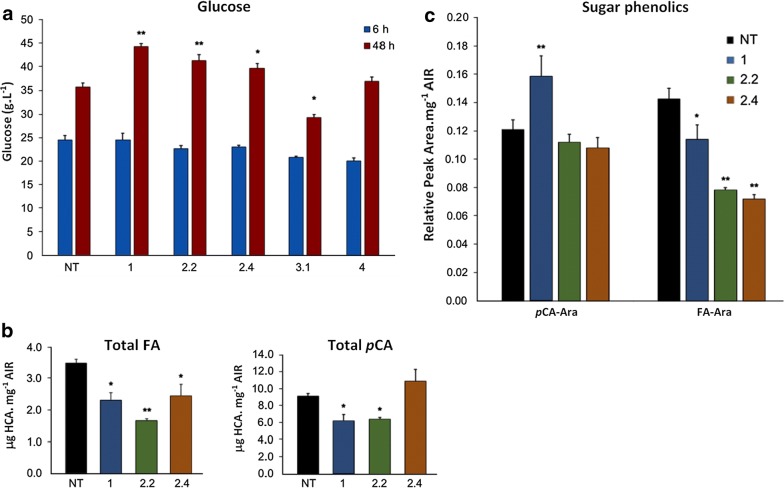
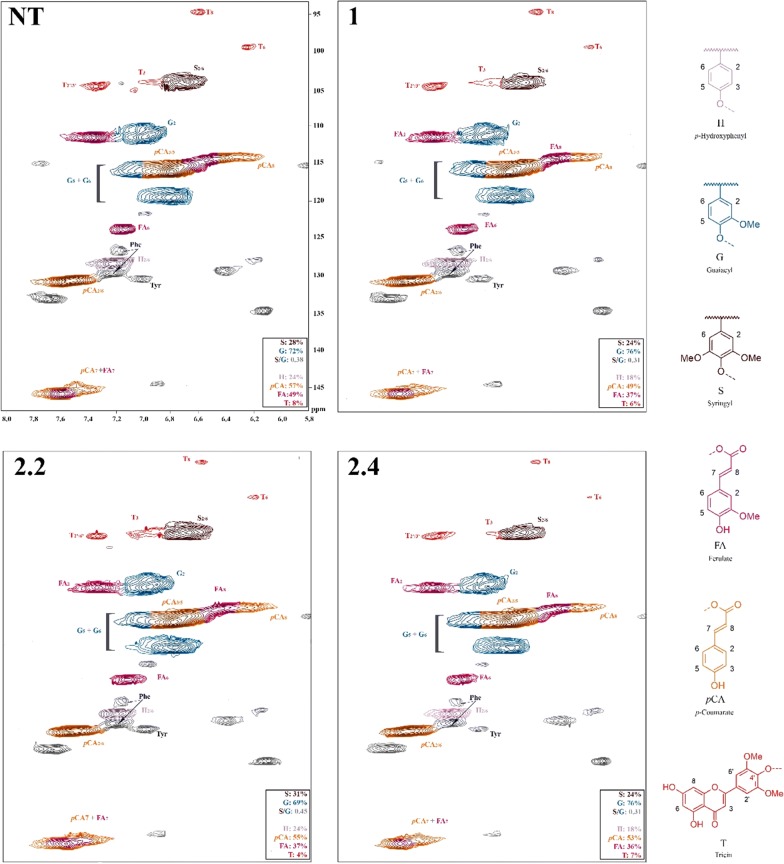
Results: We identified six BAHD genes in the sugarcane genome (SacBAHDs) and generated five lines with substantially decreased SacBAHD01 expression. To find optimal conditions for determining saccharification of sugarcane straw, we tried multiple combinations of solvent and temperature pretreatment conditions, devising a predictive model for finding their effects on glucose release. Under optimal conditions, demonstrated by Organosolv pretreatment using 30% ethanol for 240 min, transgenic lines showed increases in saccharification efficiency of up to 24%. The three lines with improved saccharification efficiency had lower cell-wall ferulate content but unchanged monosaccharide and lignin compositions.
Conclusions: The silencing of SacBAHD01 gene and subsequent decrease of cell-wall ferulate contents indicate a promising novel biotechnological approach for improving the suitability of sugarcane residues for cellulosic ethanol production. In addition, the Organosolv pretreatment of the genetically modified biomass and the optimal conditions for the enzymatic hydrolysis presented here might be incorporated in the sugarcane industry for bioethanol production.
Keywords: Biofuels; Biomass; Cell-wall acylation; Lignocellulosic feedstock; Sugarcane.
Conflict of interest statement
Not applicable.The authors have consented for publication.The authors declare that they have no competing interests.
Figures

References
-
- de Souza WR, Martins PK, Freeman J, Pellny TK, Michaelson LV, Sampaio BL, et al. Suppression of a single BAHD gene in Setaria viridis causes large, stable decreases in cell wall feruloylation and increases biomass digestibility. New Phytol. 2018;218:81–93. doi: 10.1111/nph.14970. - DOI - PMC - PubMed
-
- Menandro LMS, Cantarella H, Franco HCJ, Kölln OT, Pimenta MTB, Sanches GM, et al. Comprehensive assessment of sugarcane straw: implications for biomass and bioenergy production. Biofuels Bioprod Bioref. 2017;11:488–504. doi: 10.1002/bbb.1760. - DOI
-
- Sindhu R, Gnansounou E, Binod P, Pandey A. Bioconversion of sugarcane crop residue for value added products—an overview. Renew Energ. 2016;98:203–215. doi: 10.1016/j.renene.2016.02.057. - DOI
-
- Vitti AC, Franco HCJ, Trivelin PCO, Ferreira DA, Otto R, Fortes C, et al. Nitrogênio proveniente da adubação nitrogenada e de resíduos culturais na nutrição da cana-planta. Pesq Agropec Bras. 2011;46:287–293. doi: 10.1590/S0100-204X2011000300009. - DOI
-
- Carvalho JLN, Otto R, Franco HCJ, Trivelin PCO. Input of sugarcane post-harvest residues into the soil. Sci Agric. 2013;70:336–344. doi: 10.1590/S0103-90162013000500008. - DOI
LinkOut - more resources
Full Text Sources
Miscellaneous
