. 2019 Jun 25;13(6):6383-6395.
doi: 10.1021/acsnano.8b06542. Epub 2019 May 17.

Biocompatible Nanoclusters with High Heating Efficiency for Systemically Delivered Magnetic Hyperthermia

Affiliations

Biocompatible Nanoclusters with High Heating Efficiency for Systemically Delivered Magnetic Hyperthermia

Hassan A Albarqi et al. ACS Nano. .

Abstract

Despite its promising therapeutic potential, nanoparticle-mediated magnetic hyperthermia is currently limited to the treatment of localized and relatively accessible cancer tumors because the required therapeutic temperatures above 40 °C can only be achieved by direct intratumoral injection of conventional iron oxide nanoparticles. To realize the true potential of magnetic hyperthermia for cancer treatment, there is an unmet need for nanoparticles with high heating capacity that can efficiently accumulate at tumor sites following systemic administration and generate desirable intratumoral temperatures upon exposure to an alternating magnetic field (AMF). Although there have been many attempts to develop the desired nanoparticles, reported animal studies reveal the challenges associated with reaching therapeutically relevant intratumoral temperatures following systemic administration at clinically relevant doses. Therefore, we developed efficient magnetic nanoclusters with enhanced heating efficiency for systemically delivered magnetic hyperthermia that are composed of cobalt- and manganese-doped, hexagon-shaped iron oxide nanoparticles (CoMn-IONP) encapsulated in biocompatible PEG-PCL (poly(ethylene glycol)- b-poly(ε-caprolactone))-based nanocarriers. Animal studies validated that the developed nanoclusters are nontoxic, efficiently accumulate in ovarian cancer tumors following a single intravenous injection, and elevate intratumoral temperature up to 44 °C upon exposure to safe and tolerable AMF. Moreover, the obtained results confirmed the efficiency of the nanoclusters to generate the required intratumoral temperature after repeated injections and demonstrated that nanocluster-mediated magnetic hyperthermia significantly inhibits cancer growth. In summary, this nanoplatform is a milestone in the development of systemically delivered magnetic hyperthermia for the treatment of cancer tumors that are difficult to access for intratumoral injection.

Keywords: magnetic hyperthermia; magnetic nanoparticles; nanoclusters; systemic delivery.


Figures
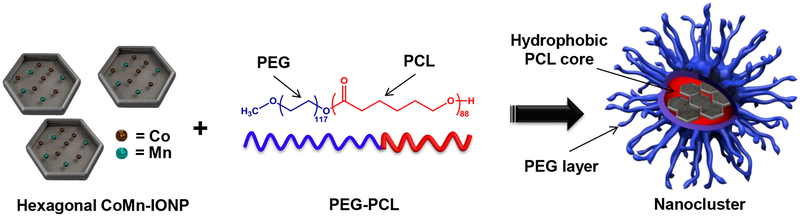
Figure 1.
Figure 1.
Schematic illustration of the nanoclusters for magnetic hyperthermia. The nanoclusters are prepared by encapsulation of hexagon-shaped cobalt- and manganese-doped iron oxide nanoparticles (CoMn-IONP) into the hydrophobic core of PEG-PCL-based nanocarriers.
Figure 2.
Figure 2.
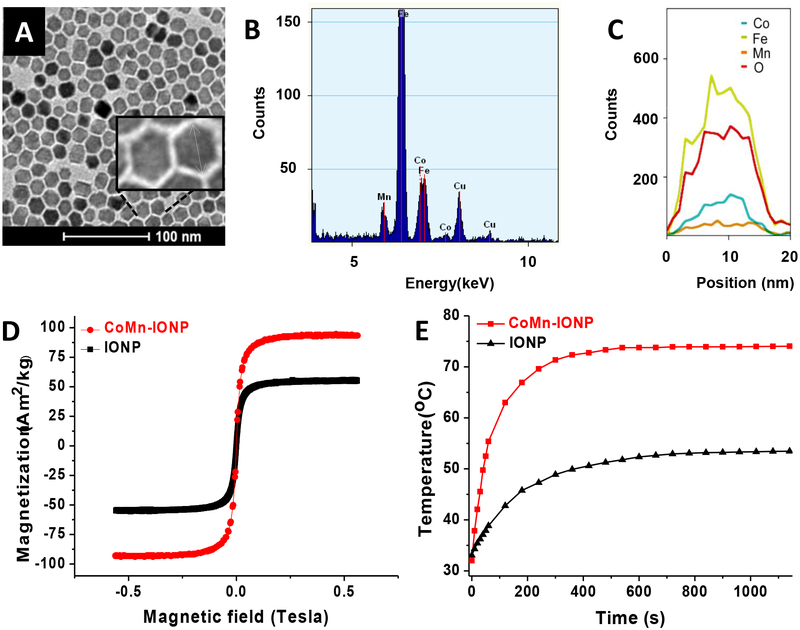
(A) Representative TEM image of hexagonal iron oxide nanoparticles doped with Co and Mn (CoMn-IONP). (B) Representative EDX spectrum of CoMn-IONP demonstrating the presence of Co, Mn, and Fe in CoMn-IONPs. (C) Co, Fe, Mn and oxygen (O) EDX line scanning profile of a single CoMn-IONP confirms that Co and Mn are distributed throughout the nanoparticle. (D) Magnetization curves of CoMn-IONP (red) and spherical IONP (black) at room temperature. The magnetization values were normalized by the total weight of nanoparticles. (E) Heating profiles of CoMn-IONP and IONP dispersed in THF (1 mg Fe/mL) and subjected to AMF (420 kHz, 26.9 kA/m).
Figure 3.
Figure 3.
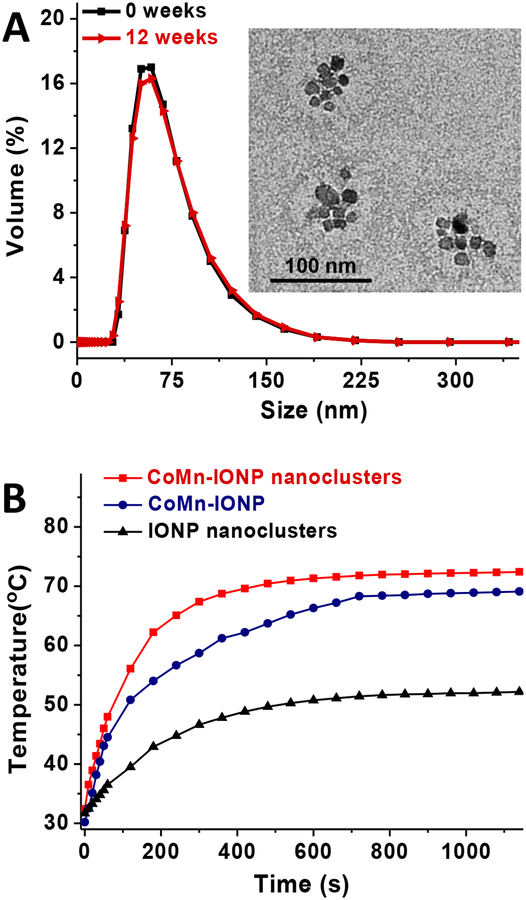
(A) Size distribution of CoMn-IONP nanoclusters tested by DLS before and after storage for 12 weeks at room temperature. Inset: TEM image of CoMn-IONP nanoclusters. (B) Heating profiles of CoMn-IONP nanoclusters, individual CoMn-IONP and IONP nanoclusters in water (1 mg Fe/mL) subjected to AMF (420 kHz, 26.9 kA/m).
Figure 4.
Figure 4.
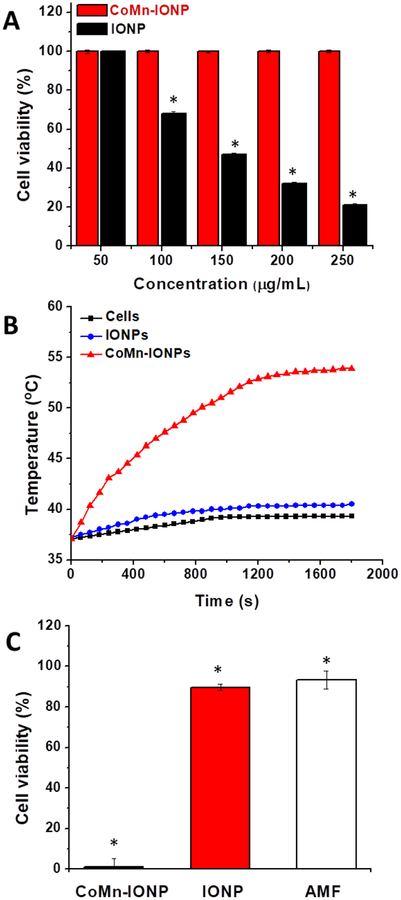
(A) Viability of ES-2 cells incubated for 24 h with different concentrations of CoMn-IONP and IONP nanoclusters (50–250 μg Fe/mL). *p < 0.05 when compared with non-treated cells. (B) Representative heating profiles of ES-2 cells incubated with media only (cells only), CoMn-IONP and IONP nanoclusters (50 μg Fe/mL) for 24 h, and subjected to AMF (420 kHz, 26.9 kA/m). (C) The viability of ES-2 cells incubated with CoMn-IONP nanoclusters, IONP nanoclusters (50 μg Fe/mL), and medium (AMF) for 24 h and exposed to AMF (420 kHz, 26.9 kA/m) for 30 min. *p < 0.05 when compared with untreated cells.
Figure 5.
Figure 5.
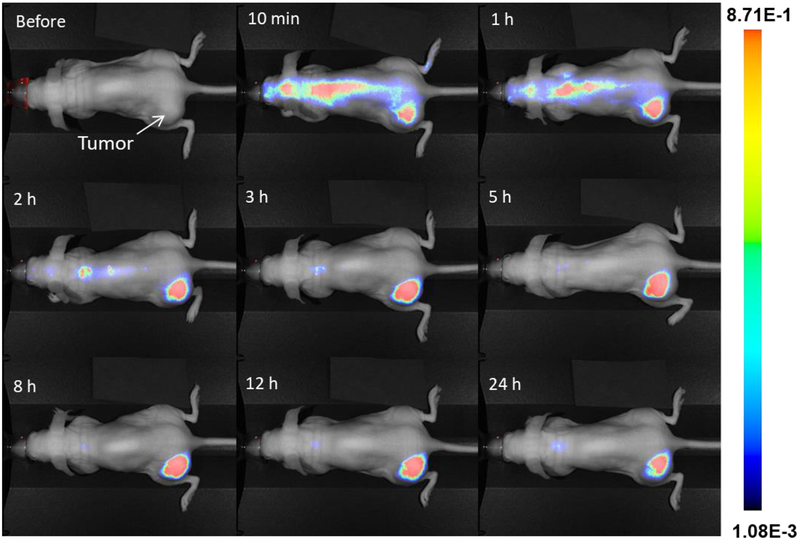
Representative NIR fluorescence images of a live anesthetized mouse with an ES-2 subcutaneous tumor at various time points after i.v. injection of CoMn-IONP nanoclusters loaded with a hydrophobic NIR dye (silicon 2,3-naphthalocyanine bis(trihexylsilyloxide), SiNc).
Figure 6.
Figure 6.
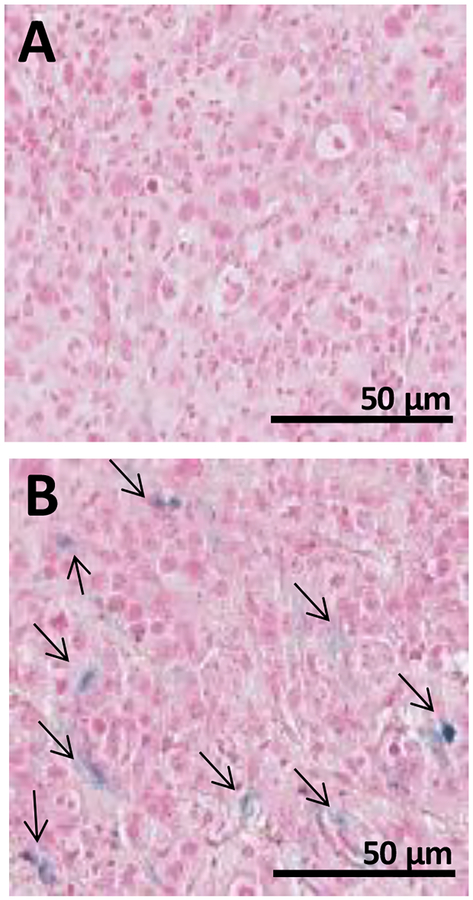
Prussian blue staining of tumor slices harvested from mice 12 h after i.v. injection with (A) 5% Dextrose and (B) CoMn-IONP nanoclusters (6 mg Fe/kg). Black arrows indicate Prussian blue staining of iron. Scale bar = 50 μm.
Figure 7.
Figure 7.
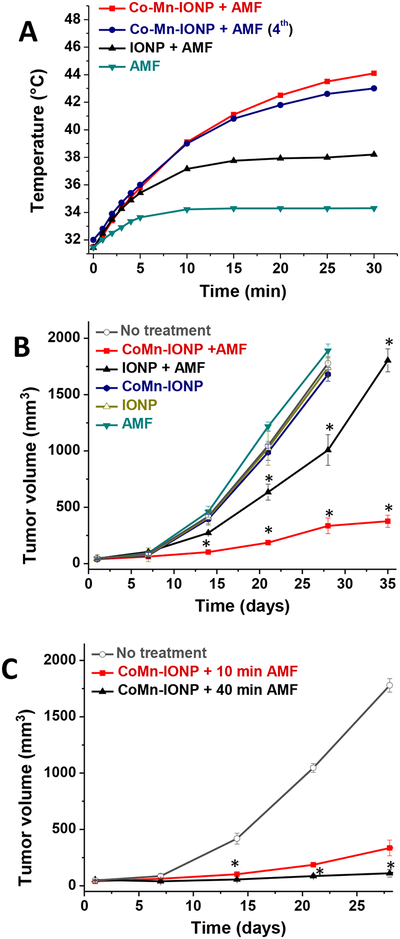
(A) Representative intratumoral temperature profiles during AMF (420 kHz, 26.9 kA/m) exposure of mice injected with a single dose of 5% dextrose (AMF), CoMn-IONP nanoclusters (6 mg Fe/kg) and IONP nanoclusters (6 mg Fe/kg). The navy curve shows the intratumoral temperature during the 4th cycle in a mouse that was treated with CoMn-IONP nanoclusters (6 mg Fe/kg) and AMF once a week for 4 weeks. (B) Tumor growth profiles of mice with ES-2 xenografts after 4 cycles of the following treatments: (i) no treatment; (ii) CoMn-IONP + AMF, mice injected with CoMn-IONP nanoclusters (6 mg Fe/kg) and exposed to AMF for 30 min; (iii) IONP + AMF, mice injected i.v. with IONP nanoclusters (6 mg Fe/kg) and exposed to AMF for 30 min; (iv) CoMn-IONP, mice injected i.v. with CoMn-IONP nanoclusters (6 mg Fe/kg); (v) IONP, mice injected with IONP nanoclusters (6 mg Fe/kg); and (vi) AMF, mice injected with 5% dextrose and exposed to AMF. *p < 0.05 when compared with non-treated animals. (C) Tumor growth profiles of mice with ES-2 xenografts after the following treatments: (i) no treatment; (ii) CoMn-IONP + 10 min AMF, mice injected with CoMn-IONP nanoclusters (6 mg Fe/kg) and exposed to AMF for 10 min when intratumoral temperatures reached 42 °C (total exposure time to AMF 30 min) once a week during four weeks (4 cycles); (iii) CoMn-IONP + 40 min AMF, mice injected with CoMn-IONP nanoclusters (6 mg Fe/kg) and exposed once to AMF for 40 min when intratumoral temperatures reached 42 °C (total exposure time AMF 60 min). *p < 0.05 when compared with CoMn-IONP + 10 min AMF.
Figure 8.
Figure 8.
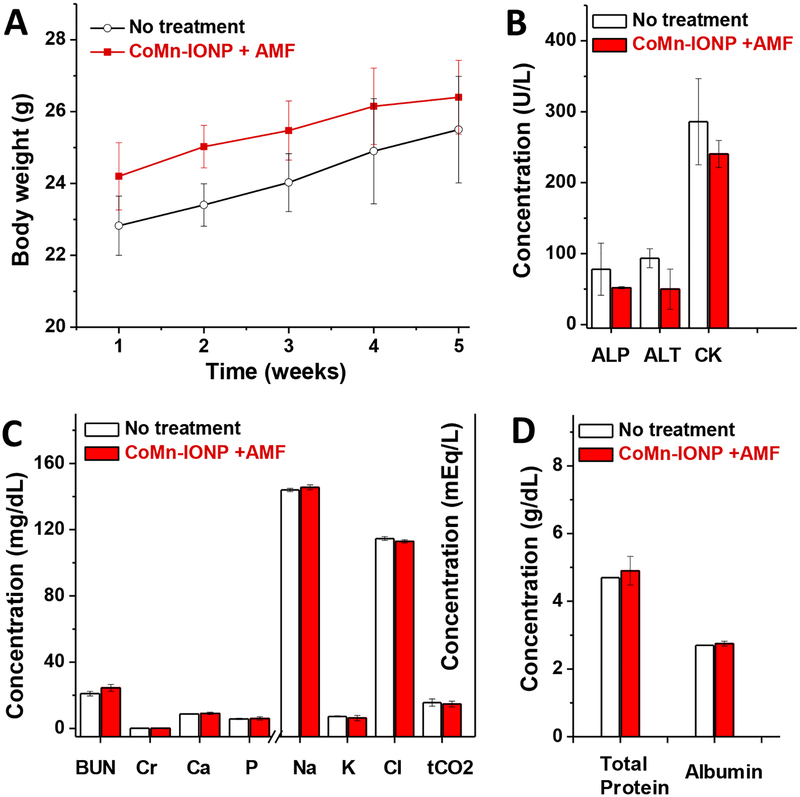
(A) Changes in body weights of untreated mice and mice treated with 4 cycles of CoMn-IONP nanocluster-mediated hyperthermia. (B-D) Blood levels of biomarkers (alkaline phosphatase (ALP), aminotransferase (ALT), creatine kinase (CK), blood urea nitrogen (BUN) and creatinine (Cr)), blood electrolytes, and proteins in non- and hyperthermia-treated mice.

References

    1. Luo S; Wang LF; Ding WJ; Zhou MJ; Jin HK; Su SF; Ouyang WW Clinical Trials of Magnetic Induction Hyperthermia for Treatment of Tumours. OA Cancer 2014, 2, 2.
    1. Torres-Lugo M; Rinaldi C Thermal Potentiation of Chemotherapy by Magnetic Nanoparticles. Nanomedicine 2013, 8, 1689–1707. - PMC - PubMed
    1. Deatsch AE; Evans BA Heating Efficiency Efficiency In Magnetic Nanoparticle Hyperthermia. J. Magn. Magn. Mater 2014, 354, 163–172.
    1. Kumar CS; Mohammad F Magnetic Nanomaterials for Hyperthermia-Based Therapy and Controlled Drug Delivery. Adv. Drug Delivery Rev 2011, 63, 789–808. - PMC - PubMed
    1. Sato I; Umemura M; Mitsudo K; Fukumura H; Kim JH; Hoshino Y; Nakashima H; Kioi M; Nakakaji R; Sato M; Fujita T; Yokoyama U; Okumura S; Oshiro H; Eguchi H; Tohnai I; Ishikawa Y Simultaneous Hyperthermia-Chemotherapy with Controlled Drug Delivery Using Single-Drug Nanoparticles. Sci. Rep 2016, 6, 24629. - PMC - PubMed

Publication types