Review
. 2019 Oct:69:93-106.
doi: 10.1016/j.mam.2019.05.001. Epub 2019 May 24.

Microbiome and colorectal cancer: Roles in carcinogenesis and clinical potential

Affiliations
Review

Microbiome and colorectal cancer: Roles in carcinogenesis and clinical potential

Ester Saus et al. Mol Aspects Med. 2019 Oct.

Abstract

The gastrointestinal tract harbors most of the microbiota associated with humans. In recent years, there has been a surge of interest in assessing the relationships between the gut microbiota and several gut alterations, including colorectal cancer. Changes in the gut microbiota in patients suffering colorectal cancer suggest a possible role of host-microbe interactions in the origin and development of this malignancy and, at the same time, open the door for novel ways of preventing, diagnosing, or treating this disease. In this review we survey current knowledge on the healthy microbiome of the gut and how it is altered in colorectal cancer and other related disease conditions. In describing past studies we will critically assess technical limitations of different approaches and point to existing challenges in microbiome research. We will have a special focus on host-microbiome interaction mechanisms that may be important to explain how dysbiosis can lead to chronic inflammation and drive processes that influence carcinogenesis and tumor progression in colon cancer. Finally, we will discuss the potential of recent developments of novel microbiota-based therapeutics and diagnostic tools for colorectal cancer.

Keywords: Colon; Colorectal cancer; Gut microbiome; Microbiota.


Figures

Fig. 1
Fig. 1
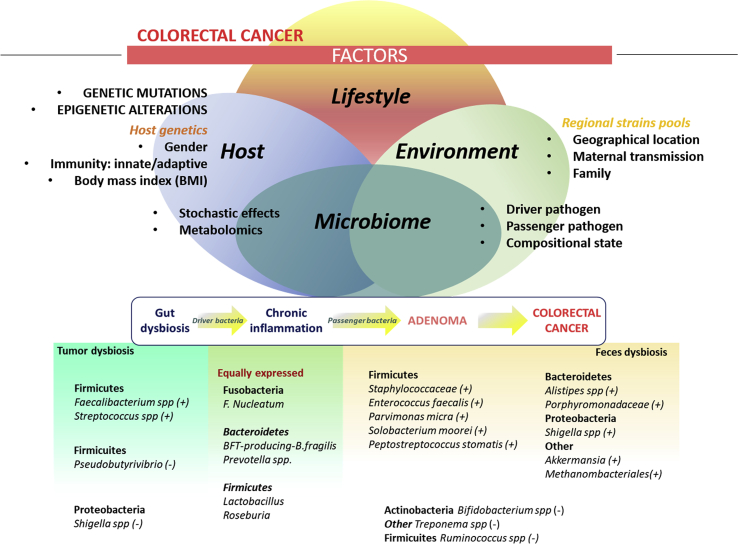
Microbiome dysbiosis in CRC. This figure summarizes factors influencing the gut microbiome, a model for dysbiosis in carcinogenesis process of CRC, and a description of the bacteria species accounting for dysbiosis in CRC. Upper part: factors shaping the gut microbiome: host (genetics and non-genetics), lifestyle (diet, exercise, sleeping time, etc), and environmental (pool of colonizing strains) factors. All those factors may have an influence in the microbiome, which in turn may influence the state of health/disease of individuals. Other factors influencing the state of gut microbiome include stochastic effects, presence of driver/passenger species, its compositional state and metabolomics. Middle part: The multi-step process of carcinogenesis and the influence of the microbiome. As suggested by several authors, imbalances in the normal content of the gut microbiome (gut dysbiosis) lead to colonization of driver bacteria that induce a chronic inflammation of the gut epithelia. This inflammation changes the microenvironment and biofilm and allow a new colonization by passenger bacteria, which may contribute to carcinogenesis process from adenomatosis to tumor formation. Bottom: Bacterial species enriched/depleted in CRC both tumor and feces samples as compared to control samples.

References

    1. Aguiar-Pulido V., Huang W., Suarez-Ulloa V., Cickovski T., Mathee K., Narasimhan G. Metagenomics, metatranscriptomics, and metabolomics approaches for microbiome analysis. Evol. Bioinform. Online. 2016;12:5–16. doi: 10.4137/EBO.S36436. - DOI - PMC - PubMed
    1. Ahn J., Sinha R., Pei Z., Dominianni C., Wu J., Shi J., Goedert J.J., Hayes R.B., Yang L. Human gut microbiome and risk for colorectal cancer. J. Natl. Cancer Inst. 2013;105:1907–1911. doi: 10.1093/jnci/djt300. - DOI - PMC - PubMed
    1. Ai L., Tian H., Chen Z., Chen H., Xu J., Fang J.-Y. Systematic evaluation of supervised classifiers for fecal microbiota-based prediction of colorectal cancer. Oncotarget. 2017;8:9546–9556. doi: 10.18632/oncotarget.14488. - DOI - PMC - PubMed
    1. Alang N., Kelly C.R. Weight gain after fecal microbiota transplantation. Open Forum Infect Dis. 2015;2:ofv004. doi: 10.1093/ofid/ofv004. - DOI - PMC - PubMed
    1. Allali I., Delgado S., Marron P.I., Astudillo A., Yeh J.J., Ghazal H., Amzazi S., Keku T., Azcarate-Peril M.A. Gut microbiome compositional and functional differences between tumor and non-tumor adjacent tissues from cohorts from the US and Spain. Gut Microb. 2015;6:161–172. doi: 10.1080/19490976.2015.1039223. - DOI - PMC - PubMed

Publication types