


Brain education-based meditation for patients with hypertension and/or type 2 diabetes: A pilot randomized controlled trial
- PMID: 31083232
- PMCID: PMC6531095
- DOI: 10.1097/MD.0000000000015574
Brain education-based meditation for patients with hypertension and/or type 2 diabetes: A pilot randomized controlled trial
Abstract
Background: Hypertension and type 2 diabetes are chronic diseases, which generally require lifetime care. Meditation and yoga can be complementary to pharmacological therapies according to the scientific evidences so far. Brain education-based meditation (BEM) is a technique, which has been known to change brain structure, psychology, and physiology of healthy adult participants. This randomized, nonblinded pilot trial aimed to examine whether BEM affects the conditions of patients with hypertension and/or type 2 diabetes compared with health education classes.
Methods: We randomly allocated 48 patients with hypertension and/or type 2 diabetes to BEM (n = 24) or health education (n = 24) classes in the Ulsan Junggu Public Health Center in Korea, where the classes were run during the same period and explored the impact of 8-week practice on the serum glutamic-oxaloacetic transaminase, serum glutamic pyruvic transaminase, gamma glutamyl transpeptidase, creatinine, high-density lipoprotein cholesterol, and low-density lipoprotein (LDL) cholesterol. Total RNA was extracted to examine inflammatory gene expressions from the whole blood using PAXgene blood RNA System. In addition, self-reports on mental/physical health were evaluated. The Student's t test, chi-squared test, and analysis of covariance were used for statistical analysis.
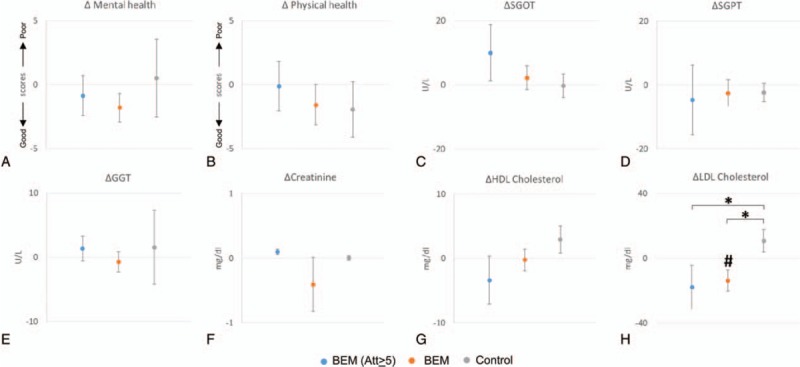
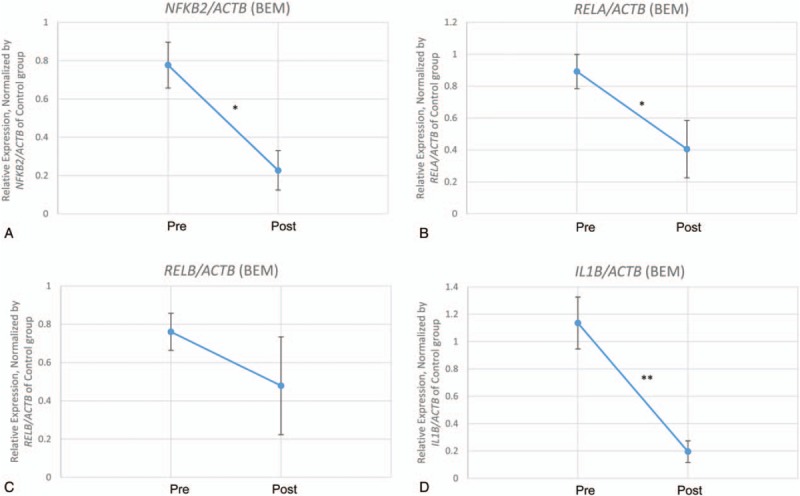
Results: The number of people who participated until the completion of the study was 14 in the control and 21 in the BEM group. After 8 weeks, LDL cholesterol level was significantly decreased in the BEM group after the intervention (13.82 mg/dL reduction, P < .05), while it was not significantly altered in the control group. The expression of inflammatory genes was significantly reduced after 8 weeks of the BEM training (0.3-, 0.5-, and 0.2-fold change for NFKB2, RELA, and IL1B, respectively, all P < .05). In the item analysis of mental/physical health self-reports, a significant improvement was confirmed as follows: increases in focus, confidence, relaxation, and happiness; decreases in fatigue, anger, and loneliness (all P < .05). There were no important adverse events or side-effects by BEM intervention.
Conclusion: Compared to health education, BEM helps lower LDL cholesterol level and the inflammatory gene expression in the patients with hypertension and/or type 2 diabetes. Moreover, BEM induces positive effects on the self-reported mental/physical states, warranting further study.
Conflict of interest statement
The authors have no funding and conflicts of interest to disclose.
Figures
References
-
- System USRD. 2014 USRDS annual data report: epidemiology of kidney disease in the United States. National Institutes of Health, National Institute of Diabetes and Digestive and Kidney Diseases; 2014.
-
- Sparrenberger F, Cichelero FT, Ascoli AM, et al. Does psychosocial stress cause hypertension? A systematic review of observational studies. J Hum Hypertens 2009;23:12–9. - PubMed
Publication types
MeSH terms
Substances
LinkOut - more resources
Full Text Sources
Medical
Miscellaneous
