Review
. 2019 May 11;8(2):63.
doi: 10.3390/pathogens8020063.

Hepatitis B Virus Molecular Epidemiology, Host-Virus Interaction, Coinfection, and Laboratory Diagnosis in the MENA Region: An Update

Affiliations
Review

Hepatitis B Virus Molecular Epidemiology, Host-Virus Interaction, Coinfection, and Laboratory Diagnosis in the MENA Region: An Update

Duaa W Al-Sadeq et al. Pathogens. .

Abstract

Hepatitis B virus (HBV) is an enveloped partial double-stranded DNA virus that can cause acute and chronic hepatitis. According to the World Health Organization (WHO) and the Centers for Disease Control and Prevention (CDC), 257 million people are living with HBV. Moreover, 20,900 acute hepatitis B cases were reported in 2016. Hepatitis B is highly prevalent in the African, Western Pacific, Eastern Mediterranean, South-East Asia, and European regions, respectively. Due to the high mutational rate of HBV and lack of reverse transcriptase proofreading activity, ten different genotypes with different geographical distributions have been identified. HBV pathogenesis and severity of infection depend on several host and viral factors, particularly, the genetic variability of both the host and virus. Although HBV infection is a global health concern, there is a lack of adequate studies and reports in the Middle East and North Africa (MENA) region. Here, we provide a review on HBV epidemiology, pathogenesis, host-pathogen interactions, coinfection with selected viruses, and laboratory diagnosis, focusing on studies conducted in the MENA region to determine the current situation of the HBV infection and outline the future study areas.

Keywords: HBV; genotypes; pathogenesis; seroprevalence; transfusion; viremia.


Conflict of interest statement

The authors have no competing interest.

Figures
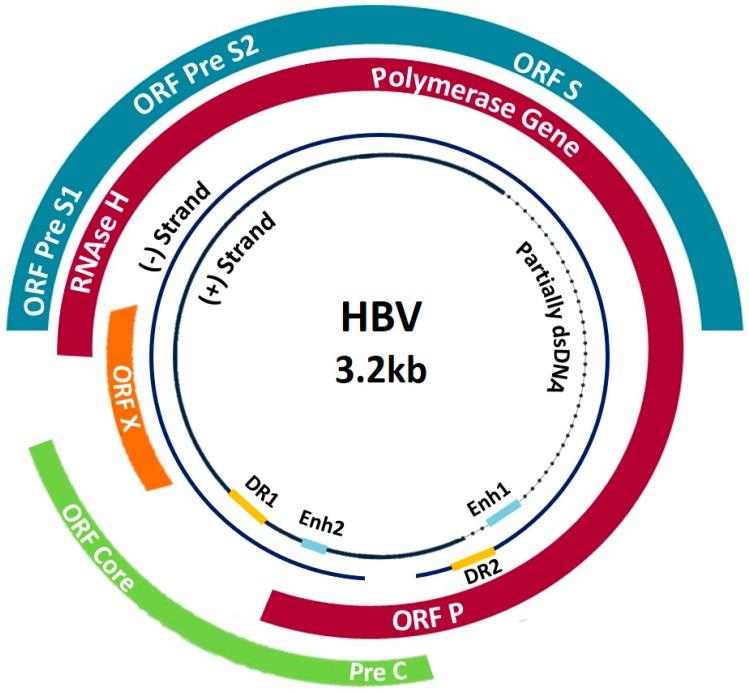
Figure 1
Figure 1
Schematic representation of the HBV genome. The genome is approximately 3020 nucleotides long and consists of partially double-stranded DNA. There are four overlapping open reading frames, four promoters, and two enhancer elements to regulate the transcription of viral RNA. The gene S encodes for the HBsAg, and it is a long open reading frame containing three start codons. Thus, the gene is divided into three sections, pre-S1, pre-S2, and S. The core gene consists of the pre-core and core regions, which encode for the HBV e antigen (HBeAg) and core protein, respectively. The polymerase (P) gene overlaps the entire S gene and encodes the viral DNA polymerase. Hepatitis B x antigen (HBxAg) is the smallest gene and is associated with the activation of transcription. The negative-sense strand is complementary to the viral mRNA. Using covalently closed circular DNA (cccDNA) as a template; the viral genes are transcribed by the cellular RNA polymerase II in the nucleus. DR1 and DR2 are 11-base-pair direct repeats that are required for strand-specific DNA synthesis during the HBV replication. Two enhancers (Enh1 and Enh2) exhibit activity in regulating the expression of the complete viral transcripts.
Figure 2
Figure 2
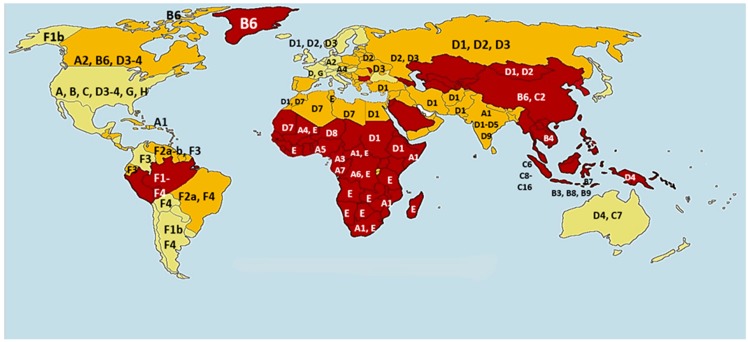
Worldwide geographic distribution of HBV genotypes. HBV has ten established genotypes that have different global and epidemiological distribution. Red color represents countries with high HBV prevalence, orange represents countries with moderate HBV prevalence, and yellow are countries with low HBV prevalence. Letters represent genotype and sub-genotype prevalent in each country.
Figure 3
Figure 3
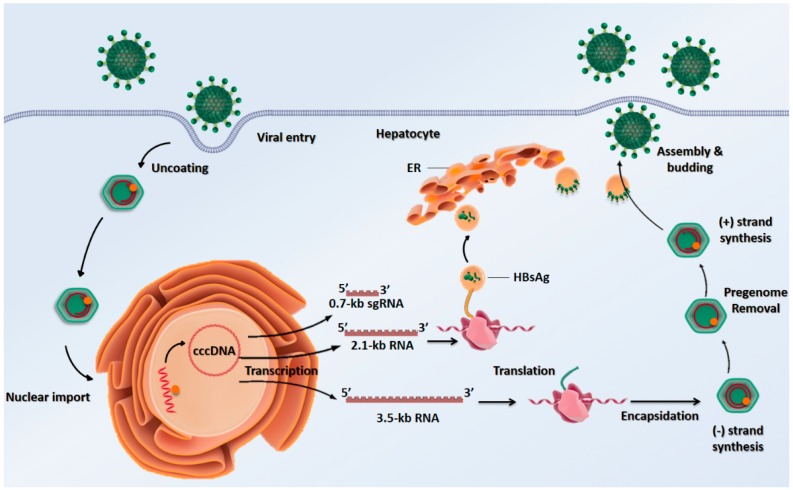
Schematic representation of the HBV life cycle. HBV attaches to the host hepatocyte cell membrane through its envelope proteins. When the viral membrane fuses with the cell membrane, it will result in releasing the viral genome into the cell cytoplasm. After the viral genome reaches the nucleus, the viral polymerase enzyme will convert the partially double-stranded DNA genome into cccDNA. This is followed by transcription and nuclear export of all viral mRNA to the cytoplasm for translation. The surface protein enveloping process occurs in the endoplasmic reticulum and then assembled in the cytoplasm. These proteins are transported to the post-endoplasmic reticulum and Golgi compartments for the budding of the nucleocapsid. The different viral components will assemble into new virions that will be released out of the host and infect new hepatocyte.
Figure 4
Figure 4
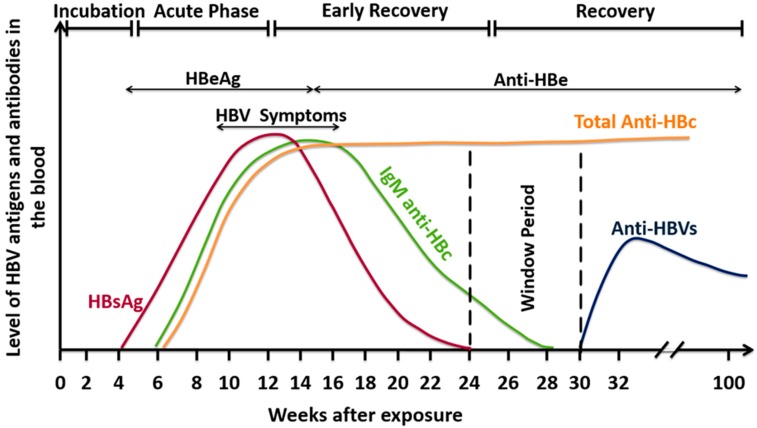
A graph is illustrating the pathogenic events throughout HBV infection. HBsAg can be detected very early in the acute course of infection and starts declining in serum to undetectable levels within 23–24 weeks post infection. The HbeAg is next and indicates the ability to infect others. The first HBV antibody produced is HBc IgM, and it may persist until 28 months post infection. Hence, detection of IgM represents an acute HBV infection. However, in the chronic infection phase, IgG becomes detectable and persists for a more extended period than IgM. During the recovery period, anti-HBs will not appear for a few weeks after HBsAg has been cleared. It is possible for both HBsAg and anti-HBs to be negative during recovery. This is called the window period in acute infection. Later, anti-HBs will be developed, and the immune system develops immunity as a result of an actual infection.

References

    1. Al-Sadeq D.W., Majdalawieh A.F., Nasrallah G.K. Seroprevalence and incidence of hepatitis E virus among blood donors: A review. Rev. Med. Virol. 2017;27:e1937. doi: 10.1002/rmv.1937. - DOI - PubMed
    1. CDC Hepatitis B. [(accessed on 1 January 2019)]; Available online: https://www.cdc.gov/hepatitis/hbv/bfaq.htm#overview.
    1. Shen T., Yan X.-M. Hepatitis B virus genetic mutations and evolution in liver diseases. World J. Gastroenterol. WJG. 2014;20:5435. doi: 10.3748/wjg.v20.i18.5435. - DOI - PMC - PubMed
    1. World Health Organization Hepatitis B. [(accessed on 1 January 2019)]; Available online: www.who.int/news-room/fact-sheets/detail/hepatitis-b.
    1. Gasim G.I. Hepatitis B virus in the Arab world: Where do we stand? Arab J. Gastroenterol. 2013;14:35–43. doi: 10.1016/j.ajg.2013.04.002. - DOI - PubMed