Review
. 2019 May 11;20(9):2345.
doi: 10.3390/ijms20092345.

Divergent Approaches to Virulence in C. albicans and C. glabrata: Two Sides of the Same Coin

Affiliations
Review

Divergent Approaches to Virulence in C. albicans and C. glabrata: Two Sides of the Same Coin

Mónica Galocha et al. Int J Mol Sci. .

Abstract

Candida albicans and Candida glabrata are the two most prevalent etiologic agents of candidiasis worldwide. Although both are recognized as pathogenic, their choice of virulence traits is highly divergent. Indeed, it appears that these different approaches to fungal virulence may be equally successful in causing human candidiasis. In this review, the virulence mechanisms employed by C. albicans and C. glabrata are analyzed, with emphasis on the differences between the two systems. Pathogenesis features considered in this paper include dimorphic growth, secreted enzymes and signaling molecules, and stress resistance mechanisms. The consequences of these traits in tissue invasion, biofilm formation, immune system evasion, and macrophage escape, in a species dependent manner, are discussed. This review highlights the observation that C. albicans and C. glabrata follow different paths leading to a similar outcome. It also highlights the lack of knowledge on some of the specific mechanisms underlying C. glabrata pathogenesis, which deserve future scrutiny.

Keywords: Candida; biofilm formation; host-pathogen interaction; immune evasion; morphology; virulence.


Conflict of interest statement

The authors declare no conflict of interest.

Figures
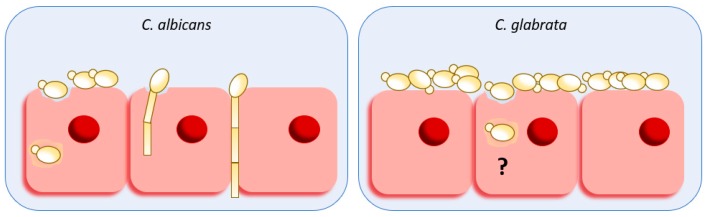
Figure 1
Figure 1
Schematic representation of C. albicans and C. glabrata host damage and invasion. C. albicans enter host cells through induced endocytosis or by active penetration (inter- and intra-cellular) of hyphal forms associated with the release of hydrolytic enzymes, resulting in the damage of cells and loss of epithelial integrity. Induced endocytosis of host cells is thought to be the mechanism behind C. glabrata tissue invasion.
Figure 2
Figure 2
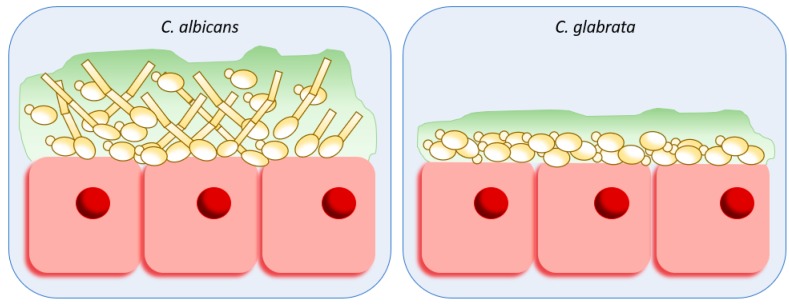
Schematic representation of C. albicans and C. glabrata biofilm formation. C. albicans forms thicker biofilms, with much more biomass in the end of biofilm formation and produces more extracellular matrix than C. glabrata. C. albicans mature biofilms are composed by a dense network of pseudohyphae, hyphae, and yeast cells, whereas C. glabrata biofilms are composed by compact yeast cells only, forming a thin but dense biofilm.
Figure 3
Figure 3
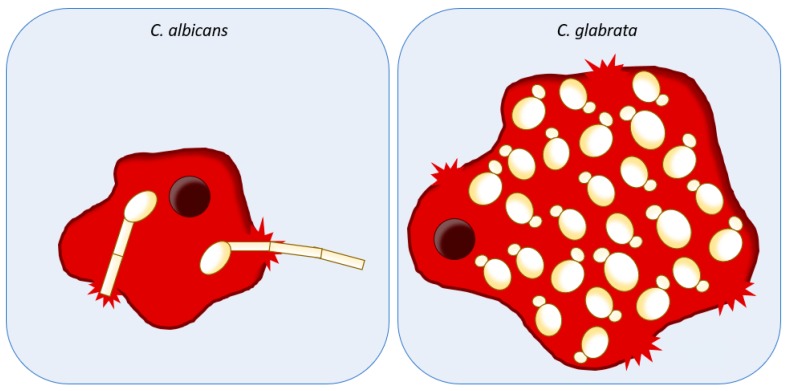
Schematic representation of C. albicans and C. glabrata host immune system evasion. C. albicans actively escape from host immune system cells through hyphal growth and phagocyte piercing. C. glabrata is most known for a persistence strategy, surviving and thriving inside macrophages, ultimately leading to immune cells lysis due to fungal load.

References

    1. Brown G.D., Denning D.W., Gow N.A.R., Levitz S.M., Netea M.G., White T.C. Hidden Killers: Human Fungal Infections. Sci. Transl. Med. 2012;4:165rv13. doi: 10.1126/scitranslmed.3004404. - DOI - PubMed
    1. Bassetti M., Peghin M., Timsit J.-F. The current treatment landscape: Candidiasis. J. Antimicrob. Chemother. 2016;71:ii13–ii22. doi: 10.1093/jac/dkw392. - DOI - PubMed
    1. Olson M.L., Jayaraman A., Kao K.C. Relative Abundances of Candida albicans and Candida glabrata in In Vitro Coculture Biofilms Impact Biofilm Structure and Formation. Appl. Environ. Microbiol. 2018;84:e02769-17. doi: 10.1128/AEM.02769-17. - DOI - PMC - PubMed
    1. Cho I., Blaser M.J. The human microbiome: At the interface of health and disease. Nat. Rev. Genet. 2012;13:260–270. doi: 10.1038/nrg3182. - DOI - PMC - PubMed
    1. Underhill D.M., Iliev I.D. The mycobiota: Interactions between commensal fungi and the host immune system. Nat. Rev. Immunol. 2014;14:405–416. doi: 10.1038/nri3684. - DOI - PMC - PubMed

LinkOut - more resources