. 2019 May 12;7(2):39.
doi: 10.3390/vaccines7020039.

Combating Vaccine Hesitancy with Vaccine-Preventable Disease Familiarization: An Interview and Curriculum Intervention for College Students

Affiliations

Combating Vaccine Hesitancy with Vaccine-Preventable Disease Familiarization: An Interview and Curriculum Intervention for College Students

Deborah K Johnson et al. Vaccines (Basel). .

Abstract

In 2019, the World Health Organization (WHO) listed vaccine hesitancy in its top ten threats to global health. Vaccine hesitancy is a "delay in acceptance or refusal to vaccinate despite availability of vaccination services". Urban areas with large amounts of vaccine hesitancy are at risk for the resurgence of vaccine-preventable diseases (VPDs). Many vaccine-hesitant (VH) parents may be unfamiliar with the consequences of VPDs, and thus might be swayed when confronted with the symptoms and dangers of VPDs. As such, we sought to educate college students (future parents) in an urban vaccine-hesitant hotspot by assigning them to interview family or community members who had experienced a VPD. Student vaccine attitudes were assessed by surveys before and after the interviews. Vaccine-hesitant students who conducted a VPD interview but received no additional vaccine educational materials were significantly more likely (interaction term p < 0.001) to become pro-vaccine (PV) (68%) than students who conducted an autoimmune interview and received no additional educational materials. Additionally, students whose interviewees experienced intense physical suffering or physical limitations or students who were enrolled in a course with intensive VPD and vaccine curriculum had significantly increased vaccine attitudes. This suggests that introducing students to VPDs can decrease vaccine hesitancy.

Keywords: college student; interview intervention; vaccine; vaccine curriculum; vaccine hesitancy.


Conflict of interest statement

The authors declare no conflict of interest.

Figures
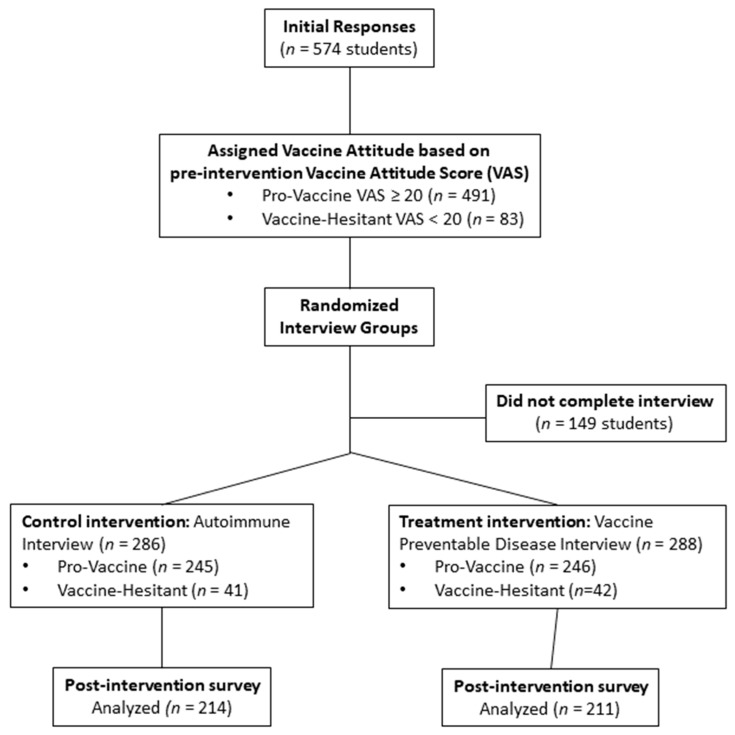
Figure 1
Figure 1
Participant flow through the randomized treatment.
Figure 2
Figure 2
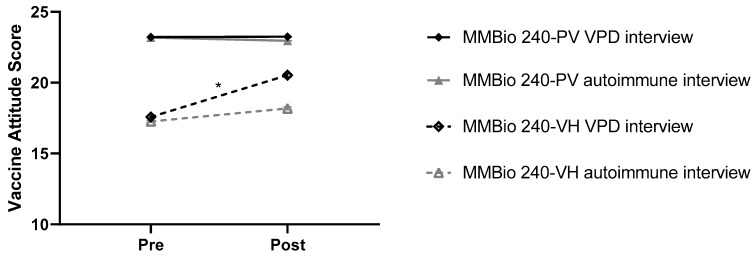
Vaccine-preventable disease interview significantly improves attitudes towards vaccines. Treatment makes a significant difference (interaction term p < 0.001) for vaccine-hesitant (VH) students in MMBio 240.
Figure 3
Figure 3
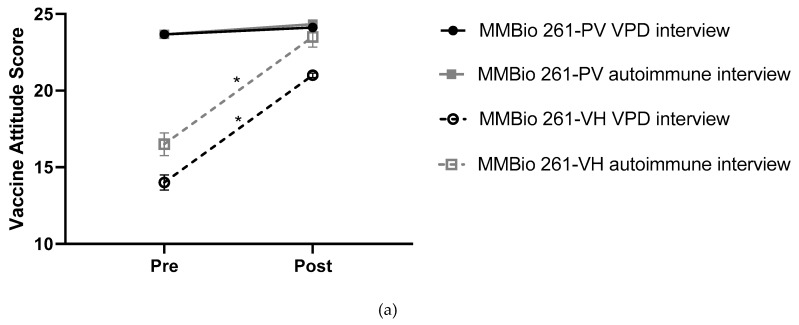
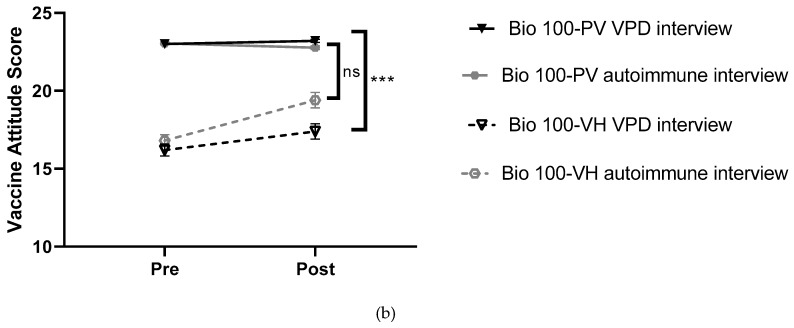
Education can significantly increase vaccine attitude. (a) Vaccine attitude scores (VASs) of MMBio 261 vaccine-hesitant students significantly increased regardless of survey intervention (p < 0.001), Difference between pre-control group VH and pre-intervention group MMBio 261 VH students is not significant (CI diff 95% 4.72–9.71; p = 0.35). (b) While there is an upward VAS trend for all Bio 100 VH students, it is not significant, suggesting that education has more influence than intervention.
Figure 3
Figure 3
Education can significantly increase vaccine attitude. (a) Vaccine attitude scores (VASs) of MMBio 261 vaccine-hesitant students significantly increased regardless of survey intervention (p < 0.001), Difference between pre-control group VH and pre-intervention group MMBio 261 VH students is not significant (CI diff 95% 4.72–9.71; p = 0.35). (b) While there is an upward VAS trend for all Bio 100 VH students, it is not significant, suggesting that education has more influence than intervention.
Figure 4
Figure 4
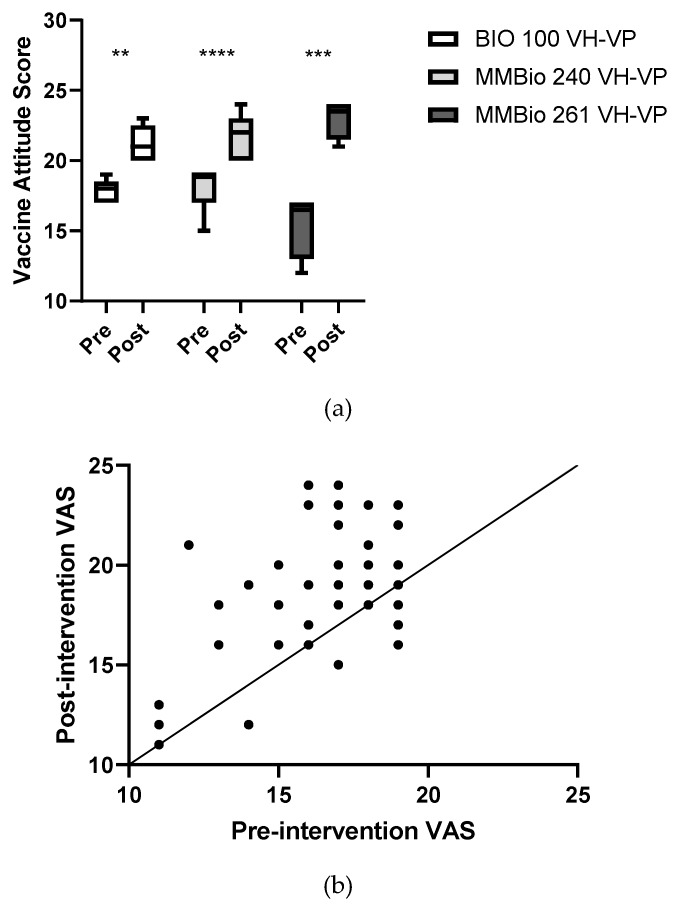
Vaccine-hesitant students make varying gains based on starting score and class attended. (a) VAS changes for VH students with PV post-intervention VASs. VH to PV students in MMBio 261 had an average VAS increase of 7.5 ± 1.0 points, whereas students in Bio 100 and MMBio 240 gained an average of 3.4 ± 1.5 and 3.5 ± 2.0 points, respectively. (b) VH students’ gains are determined by pre-intervention VASs. Plotting pre-intervention VASs against post-intervention VASs for VH students shows student responsiveness is dependent on pre-intervention VASs. The line indicates no change between pre-and post-intervention scores, so the farther away from the line the larger the change.
Figure 5
Figure 5
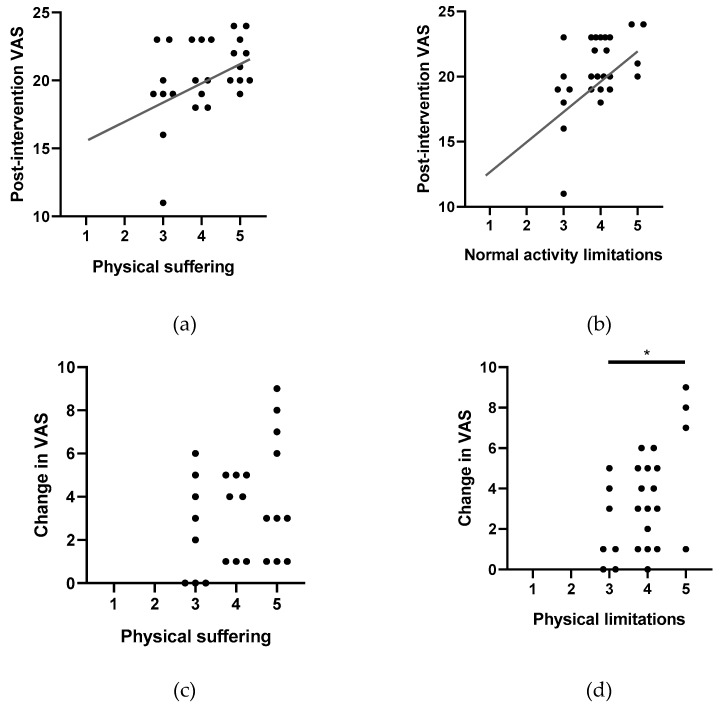
Post-intervention VAS and positive pre- to post-intervention VAS changes are influenced by (a,c) physical suffering and (b,d) physical activity limitations. (a) Post-intervention VAS is predicted by physical suffering (r2 = 0.405, p = 0.04) and (b) physical limitations (r2 = 0.518, p = 0.007). (c) While the student’s perception of physical suffering did not predict the amount of VAS change (p = 0.3089), (d) the student’s perception of normal activity limitations is significantly predicted (p = 0.0206). * p < 0.05.

References

    1. Orenstein W.A., Douglas R.G., Rodewald L.E., Hinman A.R. Immunizations in the United States: Success, Structure, and Stress. Health Aff. 2005;24:599–610. doi: 10.1377/hlthaff.24.3.599. - DOI - PubMed
    1. Omer S.B., Pan W.K., Halsey N.A., Stokley S., Moulton L.H., Navar A.M., Pierce M., Salmon D.A. Nonmedical exemptions to school immunization requirements: Secular trends and association of state policies with pertussis incidence. JAMA. 2006;296:1757–1763. doi: 10.1001/jama.296.14.1757. - DOI - PubMed
    1. Freed G.L., Clark S.J., Butchart A.T., Singer D.C., Davis M.M. Parental Vaccine Safety Concerns in 2009. Pediatrics. 2010;125:654–659. doi: 10.1542/peds.2009-1962. - DOI - PubMed
    1. Gellin B.G., Maibach E.W., Marcuse E.K. Do Parents Understand Immunizations? A National Telephone Survey. Pediatrics. 2000;106:1097–1102. doi: 10.1542/peds.106.5.1097. - DOI - PubMed
    1. Kempe A., Daley M.F., McCauley M.M., Crane L.A., Suh C.A., Kennedy A.M., Basket M.M., Stokley S.K., Dong F., Babbel C.I., et al. Prevalence of parental concerns about childhood vaccines: The experience of primary care physicians. Am. J. Prev. Med. 2011;40:548–555. doi: 10.1016/j.amepre.2010.12.025. - DOI - PubMed