. 2019 May 28;116(22):10905-10910.
doi: 10.1073/pnas.1902840116. Epub 2019 May 13.

Low ambient humidity impairs barrier function and innate resistance against influenza infection

Affiliations

Low ambient humidity impairs barrier function and innate resistance against influenza infection

Eriko Kudo et al. Proc Natl Acad Sci U S A. .

Abstract

In the temperate regions, seasonal influenza virus outbreaks correlate closely with decreases in humidity. While low ambient humidity is known to enhance viral transmission, its impact on host response to influenza virus infection and disease outcome remains unclear. Here, we showed that housing Mx1 congenic mice in low relative humidity makes mice more susceptible to severe disease following respiratory challenge with influenza A virus. We find that inhalation of dry air impairs mucociliary clearance, innate antiviral defense, and tissue repair. Moreover, disease exacerbated by low relative humidity was ameliorated in caspase-1/11-deficient Mx1 mice, independent of viral burden. Single-cell RNA sequencing revealed that induction of IFN-stimulated genes in response to viral infection was diminished in multiple cell types in the lung of mice housed in low humidity condition. These results indicate that exposure to dry air impairs host defense against influenza infection, reduces tissue repair, and inflicts caspase-dependent disease pathology.

Keywords: disease tolerance; flu season; interferon; mucosal immunity; respiratory tract.


Conflict of interest statement

Conflict of interest statement: This work was in part supported by a gift from the Condair Group.

Figures
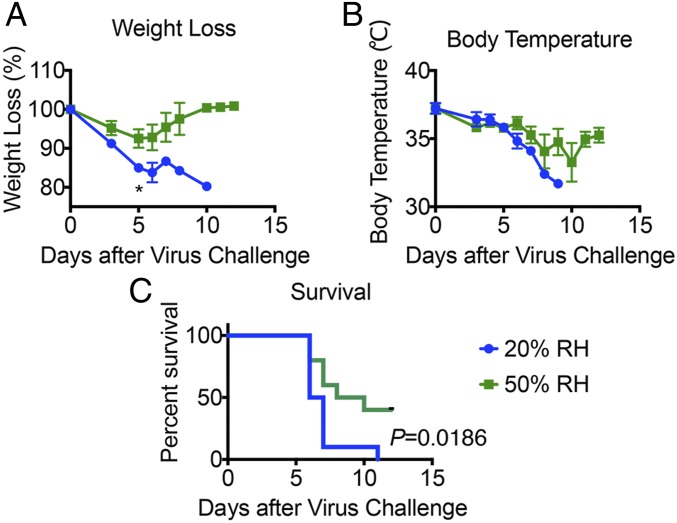
Fig. 1.
Fig. 1.
Low relative humidity predisposes Mx1 congenic mice to influenza disease. Mx1 congenic mice were preconditioned at 20% and 50% RH for 5 d and then challenged with aerosolized hvPR8 at 2 × 10⁵ pfu/mL. (A) Weight loss, (B) core body temperature, and (C) survival were monitored for 11 d (n = 10 mice per group, pooled from two independent experiments). Data are representative of five experiments and means ± SEM *P < 0.05; one-way ANOVA; log-rank (Mantel–Cox).
Fig. 2.
Fig. 2.
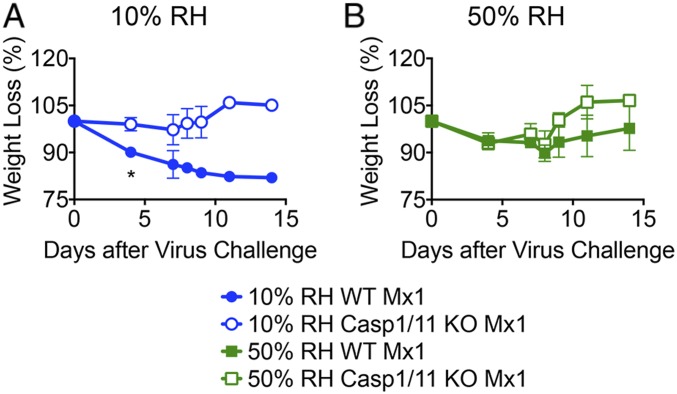
Low humidity increases influenza disease through caspase-1/11 activation. WT Mx1 mice or caspase-1/11 KO Mx1 mice were preconditioned at 10% and 50% RH for 5 d and challenged with aerosolized hvPR8 at 2 × 10⁵ pfu/mL for 15 min (n = 6 mice per group). (A and B) Weight loss was monitored for 14 d. Data are representative of four experiments and means ± SEM *P < 0.05; one-way ANOVA; Student’s t test.
Fig. 3.
Fig. 3.
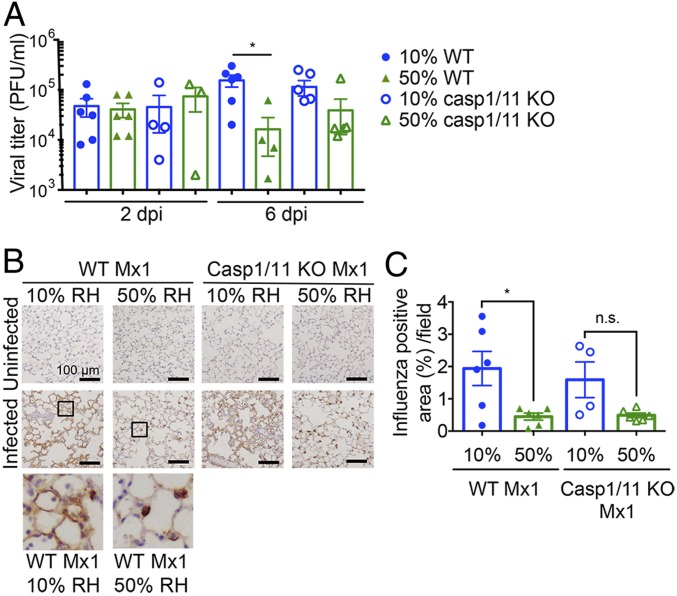
Low humidity impairs viral clearance independent of the adaptive immune response. Mx1 congenic WT mice or caspase-1/11 KO Mx1 mice were preconditioned at 10% and 50% RH for 5 d and challenged with aerosolized hvPR8 at 2 × 10⁵ pfu/mL for 15 min (n = 4–6 mice per group). (A) Bronchoalveolar lavage collected at 2 and 6 d.p.i. Data are representative of four experiments and means ± SEM. There are not significant differences except between 10% WT and 50% WT. (B and C) Mice were killed on day 6 and lung sections from each group were subjected to immunohistochemistry with an antiinfluenza A antibody (B). Percentage of influenza positive area was assessed by image analysis (C). Data are means ± SEM *P < 0.05; one-way ANOVA. n.s., not significant.
Fig. 4.
Fig. 4.
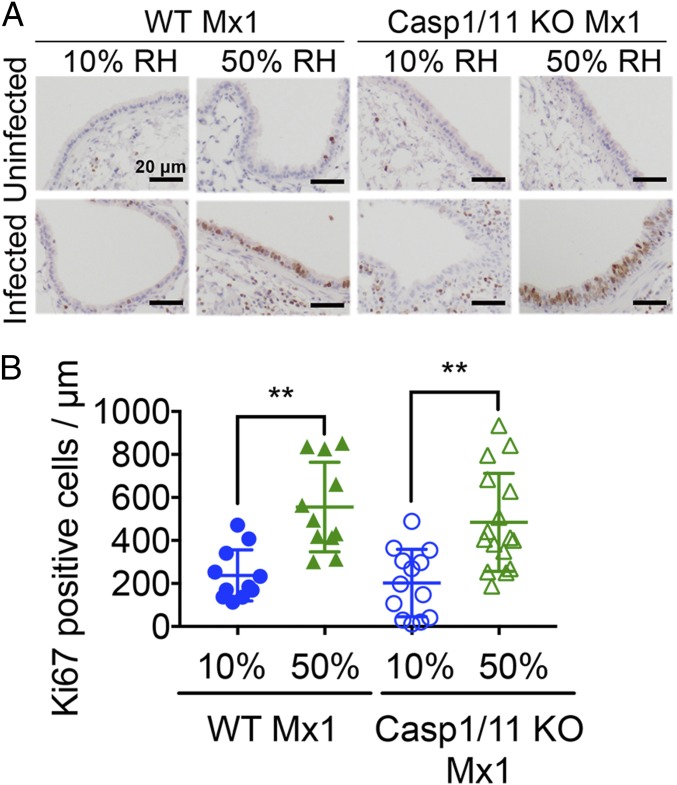
Low humidity impairs tissue repair of airway epithelial cells. (A and B) WT Mx1 and caspase-1/11 KO Mx1 mice were preconditioned at 10% and 50% RH for 5 d and challenged with aerosolized hvPR8 at 2 × 10⁵ pfu/mL for 15 min (n = 4–6 mice per group). Mice were killed on day 6 and lung sections from each group were subjected to immunohistochemistry with an anti-Ki67 antibody (A). Ki67+ cells were assessed by image analysis (B). Data are means ± SEM **P < 0.01; one-way ANOVA.
Fig. 5.
Fig. 5.
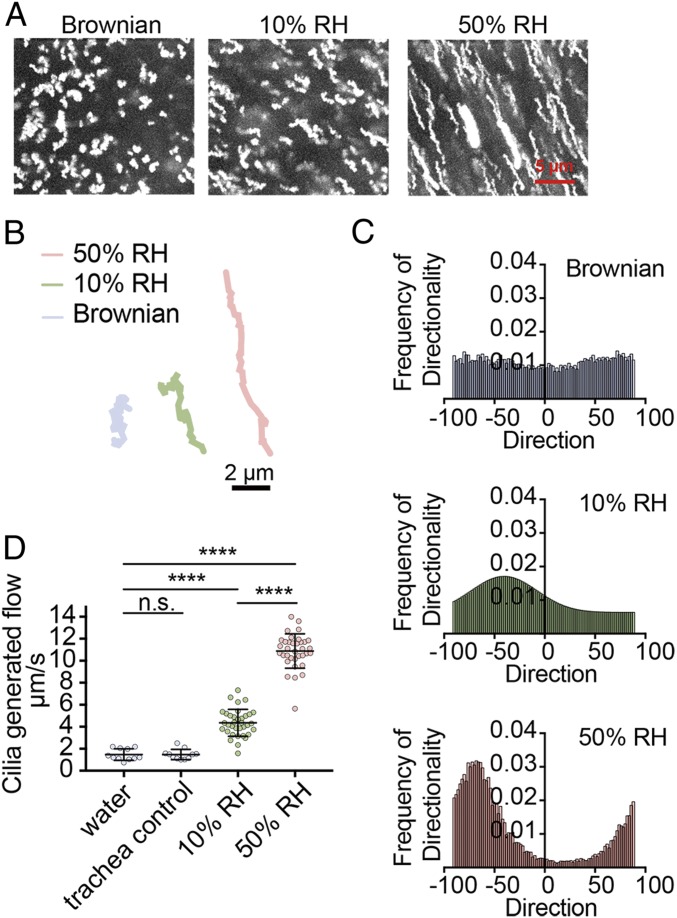
Low humidity decreases MCC. (AD) WT Mx1 mice were preconditioned at 10% and 50% RH for 7 d, and tracheas were collected for MCC assay (n = 3 mice per group). Frequency of directionality and cilia-generated flow rate were measured by microscopy. (A) Maximum projected images of particle diffusion over a span of 1 s. (B) Representative particle trajectory over a span of 1 s. (C) Frequency chart of the directionality of particles in tracheas of Mx1 mice preconditioned at different humidity. (D) Cilia-generated flow was measured by multiple particle tracking. Water control was measured by diluting particles in water and loading them onto slides to simulate Brownian motion. Trachea control represents tracheas from WT mice that were collected and imaged 1 h later to ensure no flow was generated by dead tissue. The 10% and 50% RH tracheas were imaged within 5 min of being excised from mice. Data are means ± SEM ****P < 0.0001; one-way ANOVA. n.s., not significant.
Fig. 6.
Fig. 6.
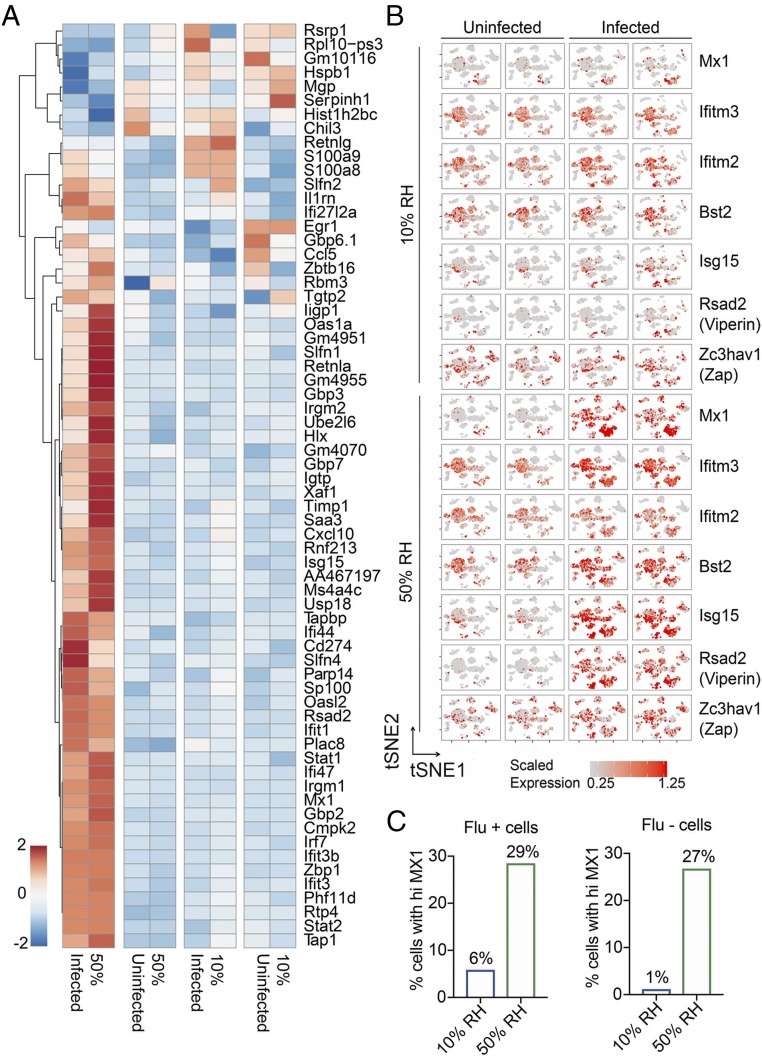
Analysis of low humidity impact by scRNA-seq. WT Mx1 mice were preconditioned at 10% and 50% RH for 7 d, and challenged intranasally with 750 pfu/mL of hvPR8. Uninfected and infected mice were killed on day 2 and lung tissue was subjected to scRNA-seq. (A) Differentially expressed genes in alveolar macrophages before and after infection. (B) Heatmap tSNE of flu-associated ISGs in different biological conditions. (C) Percentage of cells with Mx1 expression among the cells that are either positive or negative for influenza viral RNA.

References

    1. Wong GH, Goeddel DV (1986) Tumour necrosis factors alpha and beta inhibit virus replication and synergize with interferons. Nature 323:819–822. - PubMed
    1. Johnson NB, et al. ; Centers for Disease Control and Prevention (CDC) (2014) CDC National Health Report: Leading causes of morbidity and mortality and associated behavioral risk and protective factors–United States, 2005-2013. MMWR Suppl 63:3–27. - PubMed
    1. Tamerius JD, et al. (2013) Environmental predictors of seasonal influenza epidemics across temperate and tropical climates. PLoS Pathog 9:e1003194, and erratum 2013 Nov;9(11). - PMC - PubMed
    1. Alonso WJ, et al. (2015) A global map of hemispheric influenza vaccine recommendations based on local patterns of viral circulation. Sci Rep 5:1–6. - PMC - PubMed
    1. Tamerius J, et al. (2011) Global influenza seasonality: Reconciling patterns across temperate and tropical regions. Environ Health Perspect 119:439–445. - PMC - PubMed

Publication types

Associated data