


Direct Ties to a Faculty Mentor Related to Positive Outcomes for Undergraduate Researchers
- PMID: 31086422
- PMCID: PMC6506343
- DOI: 10.1093/biosci/biz039
Direct Ties to a Faculty Mentor Related to Positive Outcomes for Undergraduate Researchers
Abstract
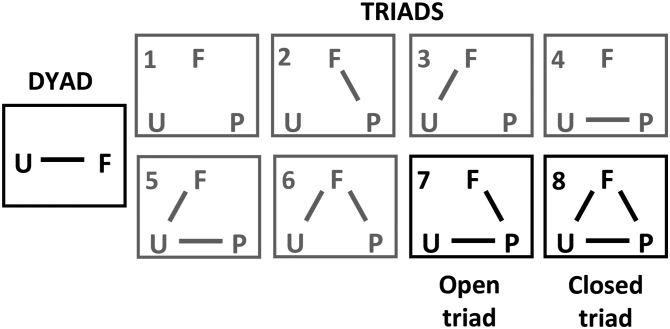
Mentored research is critical for integrating undergraduates into the scientific community. Undergraduate researchers experience a variety of mentoring structures, including dyads (i.e., direct mentorship by faculty) and triads (i.e., mentorship by graduate or postdoctoral researchers [postgraduates] and faculty). Social capital theory suggests that these structures may offer different resources that differentially benefit undergraduates. To test this, we collected data from a national sample of more than 1,000 undergraduate life science researchers and used structural equation modeling to identify relationships between mentoring structures and indicators of integration into the scientific community. Undergraduates in dyads and triads with direct faculty interactions reported similar levels of science self-efficacy, scientific identity, and scholarly productivity, and higher levels of these outcomes than students in triads lacking faculty interactions. Undergraduates' career intentions were unrelated to their mentoring structure, and their gains in thinking and working like scientists were higher if they interacted with both postgraduates and faculty.
Keywords: Undergraduate research; mentoring; science self-efficacy; scientific identity; social capital.
Figures
References
-
- Bandura A. 1997. Self-Efficacy: The Exercise of Control. Freeman.
-
- Bourdieu P. 1997. The forms of capital. Pages 46–58 in Halsey AH, Lauder H, Brown P, Stuart Wells A, eds. Education: Culture, Economy, and Society. Oxford University Press.
-
- Burgin SR, Sadler TD.. 2013. Consistency of practical and formal epistemologies of science held by participants of a research apprenticeship. Research in Science Education 43: 2179–2206.
