


Effects of intensity of electroacupuncture on chronic pain in patients with knee osteoarthritis: a randomized controlled trial
- PMID: 31088511
- PMCID: PMC6518678
- DOI: 10.1186/s13075-019-1899-6
Effects of intensity of electroacupuncture on chronic pain in patients with knee osteoarthritis: a randomized controlled trial
Abstract
Background: Conditioned pain modulation (CPM) is impaired in people with chronic pain such as knee osteoarthritis (KOA). The purpose of this randomized, controlled clinical trial was to investigate whether strong electroacupuncture (EA) was more effective on chronic pain by strengthening the CPM function than weak EA or sham EA in patients with KOA.
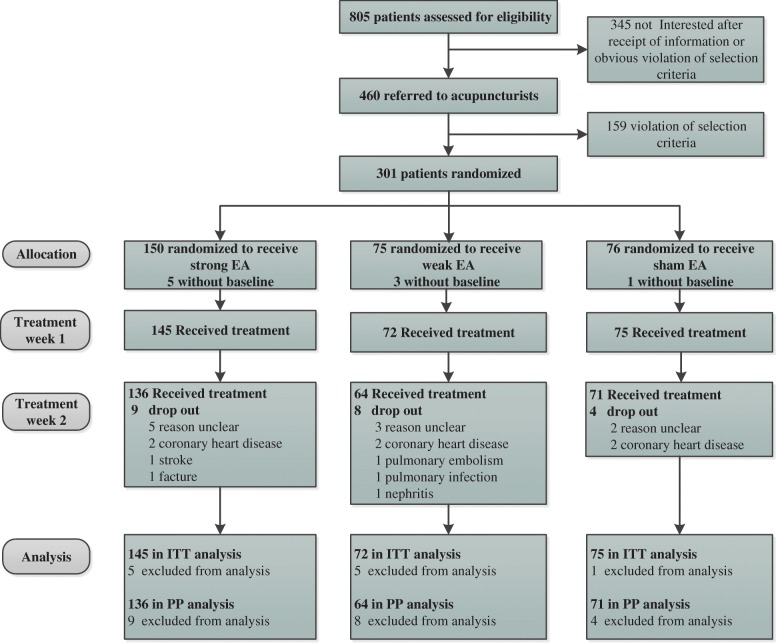
Methods: In this multicenter, three-arm parallel, single-blind randomized controlled trial, 301 patients with KOA were randomly assigned. Patients were randomized into three groups based on EA current intensity: strong EA (> 2 mA), weak EA (< 0.5 mA), and sham EA (non-acupoint). Treatments consisted of five sessions per week, for 2 weeks. Primary outcome measures were visual analog scale (VAS), CPM function, and Western Ontario and McMaster Universities Osteoarthritis Index (WOMAC).
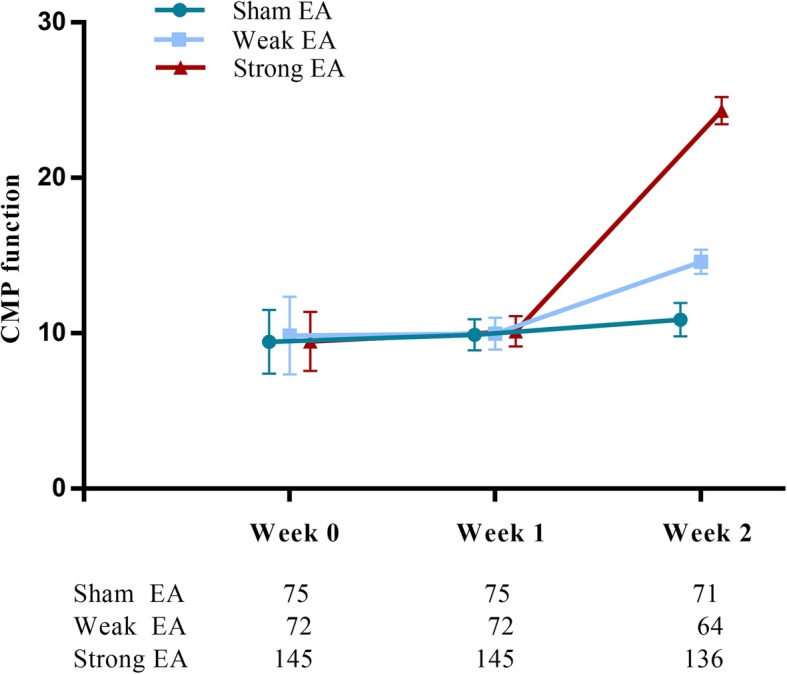
Results: Three hundred one patients with KOA were randomly assigned, among which 271 (90.0%) completed the study (mean age 63.93 years old). One week of EA had a clinically important improvement in VAS and WOMAC but not in CPM function. After 2 weeks treatment, EA improved VAS, CPM, and WOMAC compared with baseline. Compared with sham EA, weak EA (3.8; 95% CI 3.45, 4.15; P < .01) and strong EA (13.54; 95% CI 13.23, 13.85; P < .01) were better in improving CPM function. Compared with weak EA, strong EA was better in enhancing CPM function (9.73; 95% CI 9.44, 10.02; P < .01), as well as in reducing VAS and total WOMAC score.
Conclusion: EA should be administered for at least 2 weeks to exert a clinically important effect on improving CPM function of KOA patients. Strong EA is better than weak or sham EA in alleviating pain intensity and inhibiting chronic pain.
Trial registration: This study was registered with the Chinese Clinical Trial Registry ( ChiCTR-ICR-14005411 ), registered on 31 October 2014.
Keywords: Diffuse noxious inhibitory control; Electroacupuncture; Knee osteoarthritis; Pain; Randomized controlled trial.
Conflict of interest statement
Ethics approval and consent to participate
This study was approved by the Chinese Ethics Committee of Registering Clinical Trials (reference: ChiECRCT-20140035).
Consent for publication
Not applicable
Competing interests
The authors declare that they have no competing interests.
Publisher’s Note
Springer Nature remains neutral with regard to jurisdictional claims in published maps and institutional affiliations.
Figures
References
-
- Witt C, Brinkhaus B, Jena S, Linde K, Streng A, Wagenpfeil S, Hummelsberger J, Walther HU, Melchart D, Willich SN. Acupuncture in patients with osteoarthritis of the knee: a randomised trial. Lancet. 2005;366(9480):136–143. - PubMed
-
- Zhao L, Chen J, Li Y, Sun X, Chang X, Zheng H, Gong B, Huang Y, Yang M, Wu X, et al. The long-term effect of acupuncture for migraine prophylaxis: a randomized clinical trial. JAMA Intern Med. 2017;177(4):508–515. - PubMed
-
- Chassot M, Dussan-Sarria JA, Sehn FC, Deitos A, de Souza A, Vercelino R, Torres IL, Fregni F, Caumo W. Electroacupuncture analgesia is associated with increased serum brain-derived neurotrophic factor in chronic tension-type headache: a randomized, sham controlled, crossover trial. BMC Complement Altern Med. 2015;15:144. - PMC - PubMed
-
- Chong OT, Critchley HO, Horne AW, Elton R, Haraldsdottir E, Fallon M. The BMEA study: the impact of meridian balanced method electroacupuncture on women with chronic pelvic pain-a three-arm randomised controlled pilot study using a mixed-methods approach. BMJ Open. 2015;5(11):e008621. - PMC - PubMed
Publication types
MeSH terms
Grants and funding
LinkOut - more resources
Full Text Sources
Molecular Biology Databases
