Breast cancer risk in transgender people receiving hormone treatment: nationwide cohort study in the Netherlands
- PMID: 31088823
- PMCID: PMC6515308
- DOI: 10.1136/bmj.l1652
Breast cancer risk in transgender people receiving hormone treatment: nationwide cohort study in the Netherlands
Abstract
Objective: To investigate the incidence and characteristics of breast cancer in transgender people in the Netherlands compared with the general Dutch population.
Design: Retrospective, nationwide cohort study.
Setting: Specialised tertiary gender clinic in Amsterdam, the Netherlands.
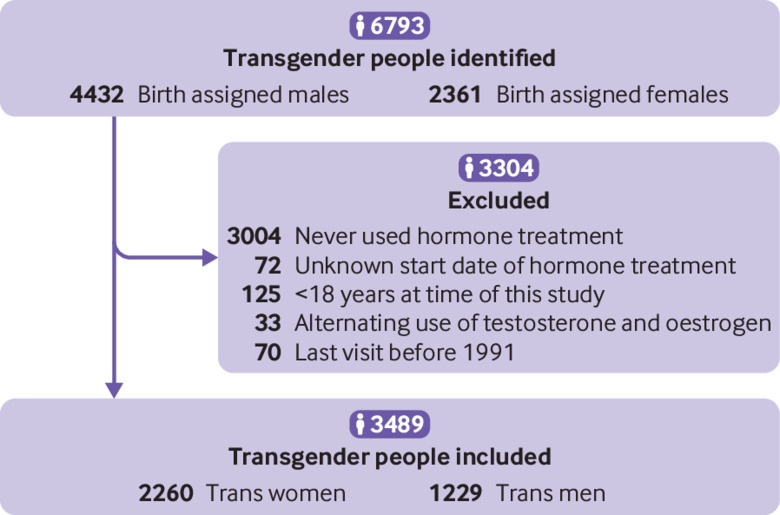
Participants: 2260 adult trans women (male sex assigned at birth, female gender identity) and 1229 adult trans men (female sex assigned at birth, male gender identity) who received gender affirming hormone treatment.
Main outcome measures: Incidence and characteristics (eg, histology, hormone receptor status) of breast cancer in transgender people.
Results: The total person time in this cohort was 33 991 years for trans women and 14 883 years for trans men. In the 2260 trans women in the cohort, 15 cases of invasive breast cancer were identified (median duration of hormone treatment 18 years, range 7-37 years). This was 46-fold higher than in cisgender men (standardised incidence ratio 46.7, 95% confidence interval 27.2 to 75.4) but lower than in cisgender women (0.3, 0.2 to 0.4). Most tumours were of ductal origin and oestrogen and progesterone receptor positive, and 8.3% were human epidermal growth factor 2 (HER2) positive. In 1229 trans men, four cases of invasive breast cancer were identified (median duration of hormone treatment 15 years, range 2-17 years). This was lower than expected compared with cisgender women (standardised incidence ratio 0.2, 95% confidence interval 0.1 to 0.5).
Conclusions: This study showed an increased risk of breast cancer in trans women compared with cisgender men, and a lower risk in trans men compared with cisgender women. In trans women, the risk of breast cancer increased during a relatively short duration of hormone treatment and the characteristics of the breast cancer resembled a more female pattern. These results suggest that breast cancer screening guidelines for cisgender people are sufficient for transgender people using hormone treatment.
Published by the BMJ Publishing Group Limited. For permission to use (where not already granted under a licence) please go to http://group.bmj.com/group/rights-licensing/permissions.
Conflict of interest statement
Competing interests: All authors have completed the ICMJE uniform disclosure form at www.icmje.org/coi_disclosure.pdf and declare: no support from any organisation for the submitted work; no financial relationships with any organisations that might have an interest in the submitted work in the previous three years; no other relationships or activities that could appear to have influenced the submitted work.
References
MeSH terms
Substances
LinkOut - more resources
Full Text Sources
Medical
Research Materials
Miscellaneous