. 2019 Sep;13(9):2306-2318.
doi: 10.1038/s41396-019-0435-7. Epub 2019 May 14.

Rethinking gut microbiome residency and the Enterobacteriaceae in healthy human adults

Affiliations

Rethinking gut microbiome residency and the Enterobacteriaceae in healthy human adults

Jonathan N V Martinson et al. ISME J. 2019 Sep.

Abstract

Longitudinal human gut microbiome datasets generated using community-level, sequence-based approaches often report a sub-set of long-lived "resident" taxa that rarely, if ever, are lost. This result contrasts with population-level turnover of resident clones on the order of months to years. We hypothesized that the disconnect between these results is due to a relative lack of simultaneous discrimination of the human gut microbiome at both the community and population-levels. Here, we present results of a small, longitudinal cohort study (n = 8 participants) of healthy human adults that identifies static and dynamic members of the gut microbiome at the clone level based on cultivation/genetic discrimination and at the operational taxonomic unit/amplified sequence variant levels based on 16S rRNA sequencing. We provide evidence that there is little "stability" within resident clonal populations of the common gut microbiome bacterial family, Enterobacteriaceae. Given that clones can vary substantially in genome content and that evolutionary processes operate on the population level, these results question the biological relevance of apparent stability at higher taxonomic levels.


Conflict of interest statement

The authors declare that they have no conflict of interest.

Figures
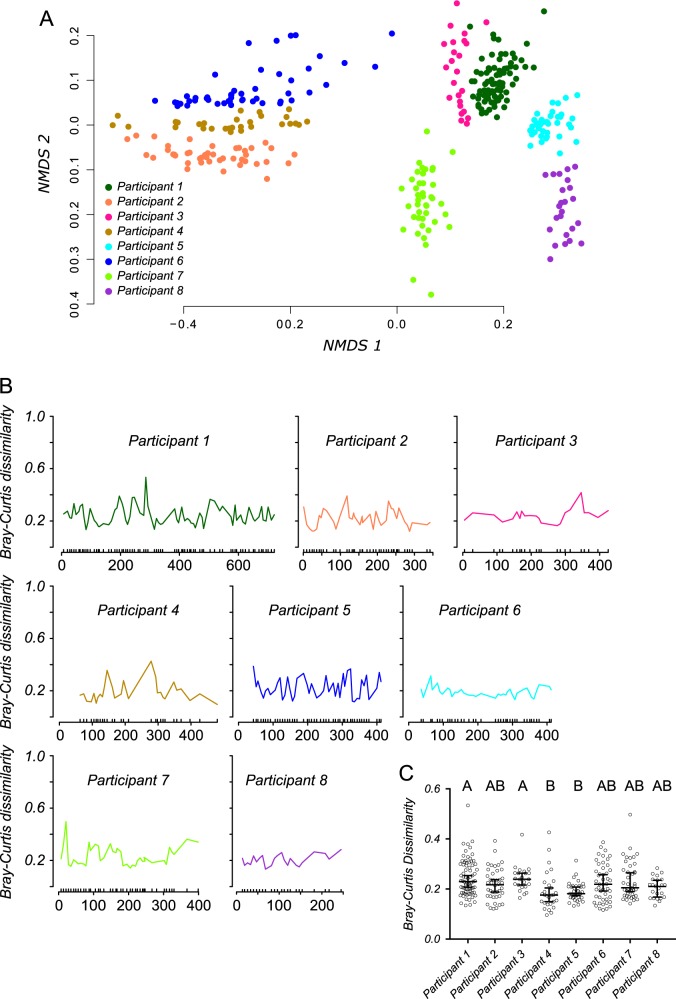
Fig. 1
Fig. 1
16S rRNA sequencing-based OTU analysis. Non-metric multidimensional scaling (NMDS) of microbiomes from different participants (a). Each sample is represented by a dot and colors correspond to participants. Bray-Curtis dissimilarity between consecutive samples was plotted through time (b). Differences in Bray-Curtis dissimilarities shown in panel B were tested for significant participant-wise differences (c; Kruskal-Wallis test; p < 0.0001; error bars represent median and 95% confidence limits). Significant differences (p < 0.05) following correction for multiple comparisons (p < 0.05; Dunn’s test) between groups are summarized above plots by letters. Participants that share letters were not significantly different
Fig. 2
Fig. 2
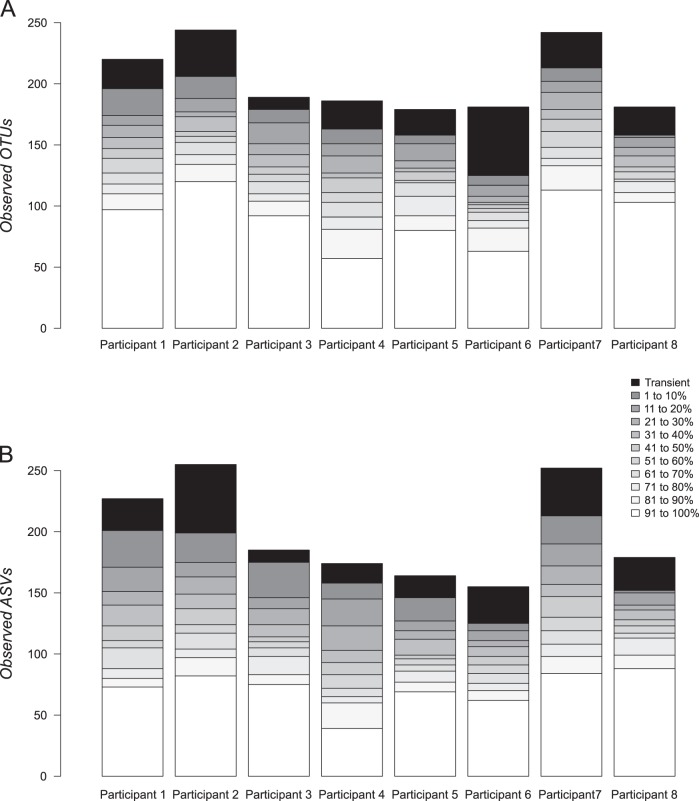
Stacked bar charts of microbiome residency using the average estimate. The number of observed OTUs (a) and ASVs (b) are shown with respect to percentile rank according to the percentage of time present in each participant using the average residency estimate. Black stacks in each bar correspond to transient OTUs and ASVs (i.e., never resident)
Fig. 3
Fig. 3
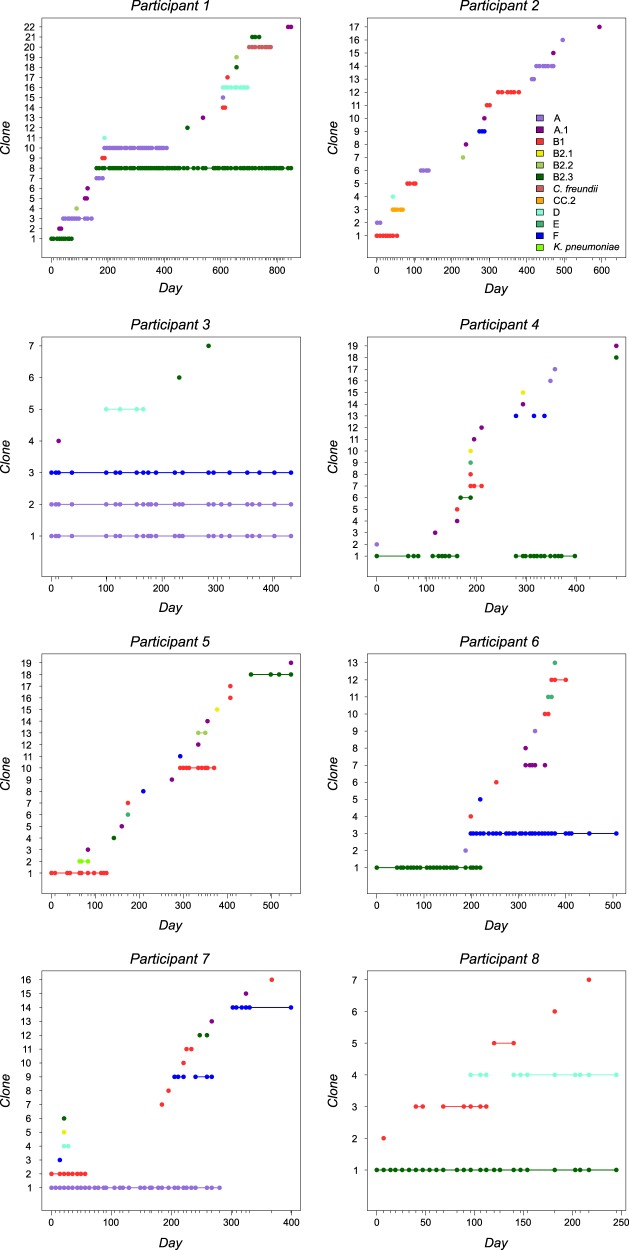
Presence of Enterobacteriaceae clones. Unique Enterobacteriaceae clones defined by PCR-based discriminatory assays (see Methods) where plotted according the day(s) observed. Day 0 in each panel corresponds to the first stool sample collected from both participants and ticks along the x-axis represent samples. Clones are ordered by order of appearance along the y-axis and colored according to either their phylogroup membership (E. coli) or species as defined by biochemical testing. The legend shown for Participant 2 is the same for all panels. No clones were shared between any participant (e.g., “Clone 1” in Participant 1 is not the same as “Clone 1” for any other participant)
Fig. 4
Fig. 4
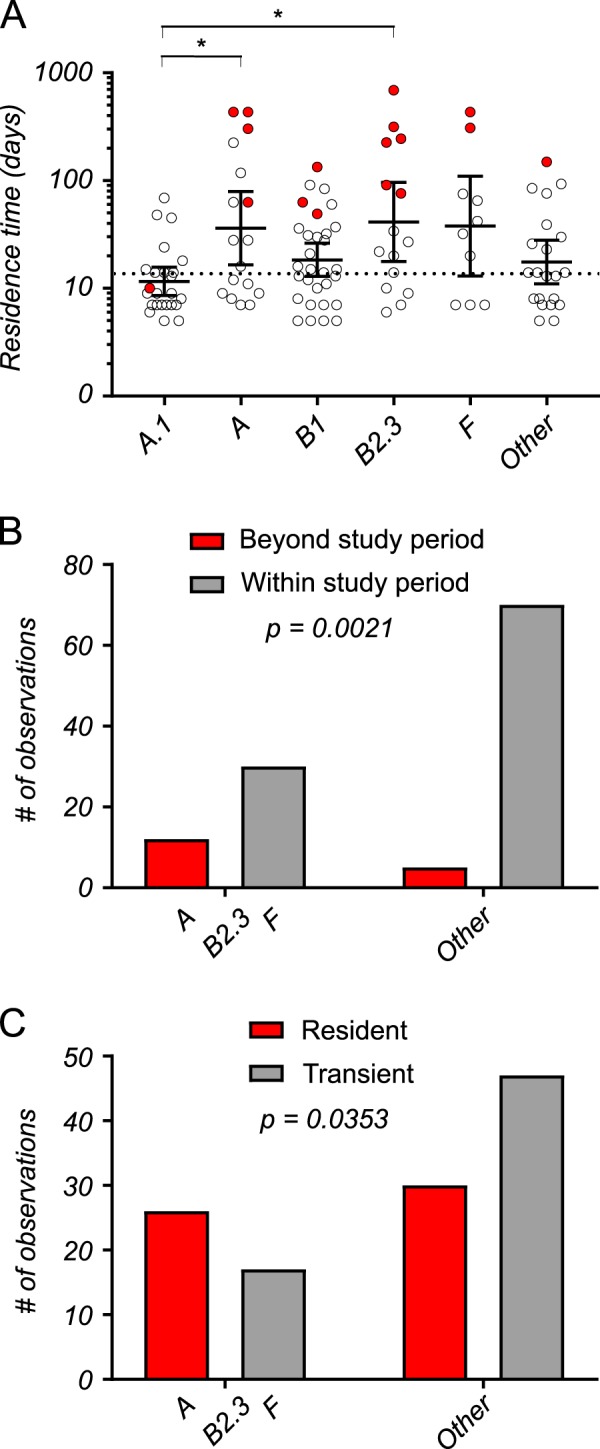
Enterobacteriaceae clone residency using the average estimate. All Enterobacteriaceae clones were plotted according to their log 10 transformed residence time in days (a). Clones were grouped according their phylogroup (E. coli) or into an “Other” category if ≤6 representative isolates were observed (Other = B2.1, n = 4; B2.2, n = 4; D, n = 6; E, n = 4; Cryptic Escherichia clade IV, n = 1; C. freundii, n = 1; K. pneumoniae, n = 1). Groups had significantly different residence time (ANOVA, F = 3.729, p = 0.0037) and following correction for multiple comparisons (Holm-Sidak’s test), groups A and B2.3 resided significantly longer than A.1 (p = 0.0338, p = 0.0171, respectively). Red dots identify clones that were present at the outset of the study, throughout the entire study period, or at the end of the study. These clones were presumed to have colonized participants beyond the study period. Contingency table analysis (Chi-square test) was used to test whether significantly more clones were observed beyond the study period in some groups versus others (b) or whether significantly more resident clones were present (c) among the longest lived phylogroups (A, B2.3, and F) compared to other groups. Both comparisons were significant and p-values are shown in each panel

Comment in

References

    1. Caugant DA, Levin BR, Selander RK. Genetic diversity and temporal variation in the E. Coli population of a human host. Genetics. 1981;98:467–90. - PMC - PubMed
    1. Jernberg C, Lofmark S, Edlund C, Jansson JK. Long-term ecological impacts of antibiotic administration on the human intestinal microbiota. ISME J. 2007;1:56–66. doi: 10.1038/ismej.2007.3. - DOI - PubMed
    1. Johnson JR, Clabots C, Kuskowski MA. Multiple-host sharing, long-term persistence, and virulence of Escherichia coli clones from human and animal household members. J Clin Microbiol. 2008;46:4078–82. doi: 10.1128/JCM.00980-08. - DOI - PMC - PubMed
    1. Zitomersky NL, Coyne MJ, Comstock LE. Longitudinal analysis of the prevalence, maintenance, and IgA response to species of the order Bacteroidales in the human gut. Infect Immun. 2011;79:2012–20. doi: 10.1128/IAI.01348-10. - DOI - PMC - PubMed
    1. Welch RA, Burland V, Plunkett G, 3rd, Redford P, Roesch P, Rasko D, et al. Extensive mosaic structure revealed by the complete genome sequence of uropathogenic Escherichia coli. Proc Natl Acad Sci U S A. 2002;99:17020–4. doi: 10.1073/pnas.252529799. - DOI - PMC - PubMed

Publication types

Substances