Review
. 2019 Apr 7:2019:9757201.
doi: 10.1155/2019/9757201. eCollection 2019.

Mitochondrial Dynamics: Biogenesis, Fission, Fusion, and Mitophagy in the Regulation of Stem Cell Behaviors

Affiliations
Review

Mitochondrial Dynamics: Biogenesis, Fission, Fusion, and Mitophagy in the Regulation of Stem Cell Behaviors

Wenyan Fu et al. Stem Cells Int. .

Abstract

Stem cells have the unique capacity to differentiate into many cell types during embryonic development and postnatal growth. Through coordinated cellular behaviors (self-renewal, proliferation, and differentiation), stem cells are also pivotal to the homeostasis, repair, and regeneration of many adult tissues/organs and thus of great importance in regenerative medicine. Emerging evidence indicates that mitochondria are actively involved in the regulation of stem cell behaviors. Mitochondria undergo specific dynamics (biogenesis, fission, fusion, and mitophagy) during stem cell self-renewal, proliferation, and differentiation. The alteration of mitochondrial dynamics, fine-tuned by stem cell niche factors and stress signaling, has considerable impacts on stem cell behaviors. Here, we summarize the recent research progress on (1) how mitochondrial dynamics controls stem cell behaviors, (2) intrinsic and extrinsic factors that regulate mitochondrial dynamics, and (3) pharmacological regulators of mitochondrial dynamics and their therapeutic potential. This review emphasizes the metabolic control of stemness and differentiation and may shed light on potential new applications in stem cell-based therapy.


Figures
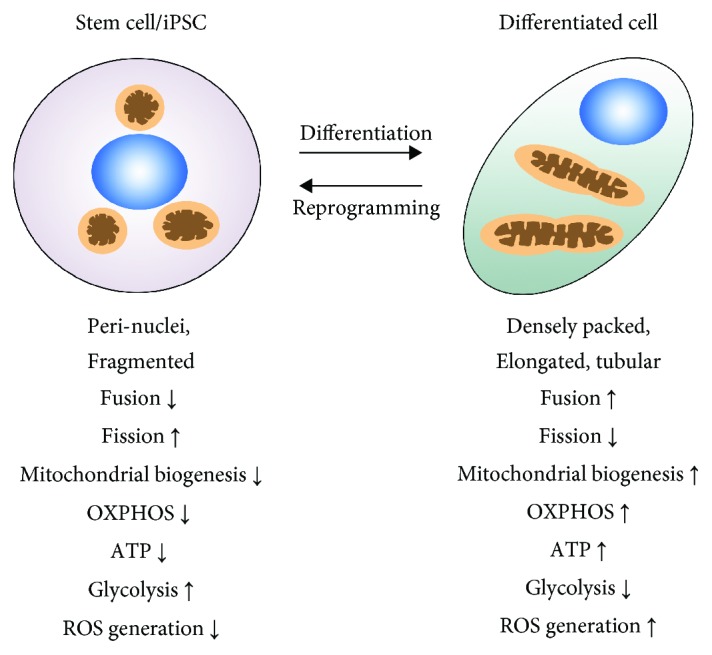
Figure 1
Figure 1
A simplified common scheme of mitochondrial dynamics in stem cells and differentiated cells. In most types of stem cells and reprogrammed iPSCs, mitochondria are usually localized in the nuclear periphery and characterized by sphere, fragmented, and punctate morphologies with fewer cristae (immature morphology). Correspondingly, mito-fission is high whereas mitochondrial biogenesis is low, which maintains low mitochondrial mass. Stem cells generally rely on glycolysis as the major energy source and have low levels of ATP, OXPHOS, and ROS levels. In differentiated cells, mitochondria change to more enlarged and elongated tubular morphology. Correspondingly, mito-fusion and biogenesis increase with the accumulation of mitochondria. Comparably, differentiated cells have higher ATP, ROS, and OXPHOS levels.
Figure 2
Figure 2
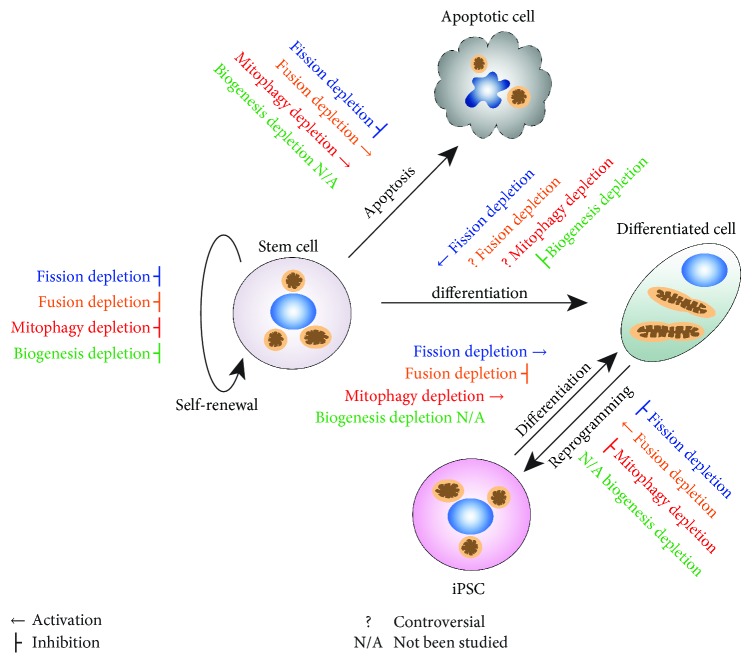
Modulating mitochondrial dynamics impacts on stem cell behaviors. Blockades of mitochondrial dynamics, fission (blue), fusion (orange), mitophagy (red), and biogenesis (green), affect stem cell differentiation, self-renewal, apoptosis, differentiation, and reprogramming. Downregulation of mito-fission usually leads to impaired self-renewal and the loss of stemness in stem cells, while increasing differentiation. Stem cells are often protected from apoptosis. Fission blockade also decreases the reprogramming efficiency. Downregulation of mito-fusion impairs stem cell self-renewal and may have diverse effects on stem cell differentiation. In general, mito-fusion protects stem cells from apoptosis, and the mito-fusion blockade often results in increased vulnerability to stress. Downregulation of mito-fusion improves the reprogramming efficiency. The blockade of mitophagy also impairs stem cell self-renewal as well as decreases reprogramming efficiency. The function of mitophagy in stem cell differentiation has not been understood clearly enough and may be stem cell type-specific and lineage-specific. Mitochondrial biogenesis is generally pivotal for stem cell maintenance. Downregulation of biogenesis impairs stem cell self-renewal and differentiation. More detailed information on stem cell behaviors and their regulation by mitochondrial dynamics are listed in Table 1.
Figure 3
Figure 3
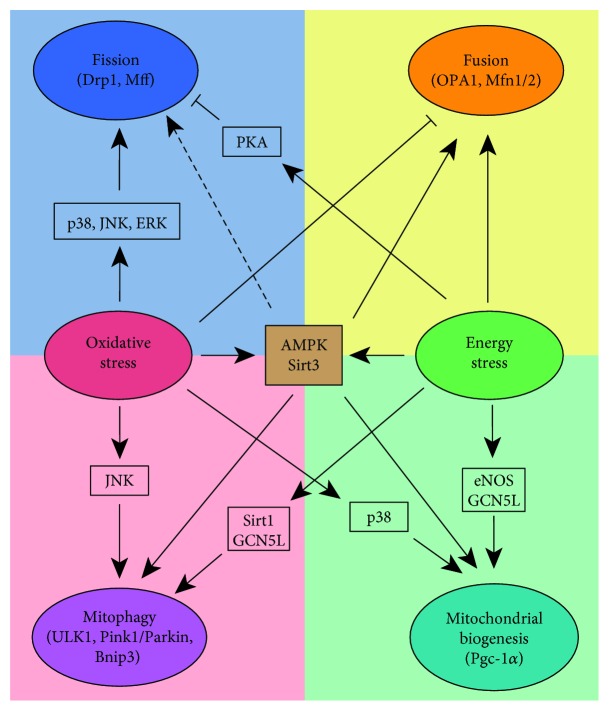
Mitochondrial dynamics is regulated through multiple pathways. Oxidative stress and energy stress have distinct impacts on mito-fission (blue), mito-fusion (orange), mitophagy (pink), and mito-biogenesis (green) via distinct signaling pathways. The dash line denotes that the results from multiple studies are conflicting.

References

    1. Zon L. I. Intrinsic and extrinsic control of haematopoietic stem-cell self-renewal. Nature. 2008;453(7193):306–313. doi: 10.1038/nature07038. - DOI - PubMed
    1. Morrison S. J., Kimble J. Asymmetric and symmetric stem-cell divisions in development and cancer. Nature. 2006;441(7097):1068–1074. doi: 10.1038/nature04956. - DOI - PubMed
    1. Pazhanisamy S. K. Stem cells, DNA damage, ageing and cancer. Hematology/Oncology and Stem Cell Therapy. 2009;2(3):375–384. doi: 10.1016/S1658-3876(09)50005-2. - DOI - PubMed
    1. Noguchi M., Kasahara A. Mitochondrial dynamics coordinate cell differentiation. Biochemical and Biophysical Research Communications. 2018;500(1):59–64. doi: 10.1016/j.bbrc.2017.06.094. - DOI - PubMed
    1. Wai T., Langer T. Mitochondrial dynamics and metabolic regulation. Trends in Endocrinology and Metabolism. 2016;27(2):105–117. doi: 10.1016/j.tem.2015.12.001. - DOI - PubMed

LinkOut - more resources