Review
. 2017 Dec 30;26(4):243-250.
doi: 10.7570/jomes.2017.26.4.243.

Growth and Puberty in Obese Children and Implications of Body Composition

Affiliations
Review

Growth and Puberty in Obese Children and Implications of Body Composition

Sochung Chung. J Obes Metab Syndr. .

Abstract

Childhood obesity is a major public health concern throughout the world. Nutrition, energy balance and hormones interplay in growth and pubertal development regulation. Frequently overweight and obese children are taller for their age and sex and tend to mature earlier than lean children. The increased leptin and sex hormone levels seen in obese children with excessive adiposity may be implicated in accelerated pubertal growth and accelerated epiphyseal growth plate maturation. Efforts to detect the impact of obesity in children are needed to prevent metabolic and cardiovascular disease in later life. This review aims to cover the process of growth in obese children and implications of body composition on growth and pubertal development and introduce the use of body composition charts in clinical practice.

Keywords: Body composition; Growth; Obesity; Puberty.


Conflict of interest statement

CONFLICTS OF INTEREST The author declares no conflict of interest.

Figures
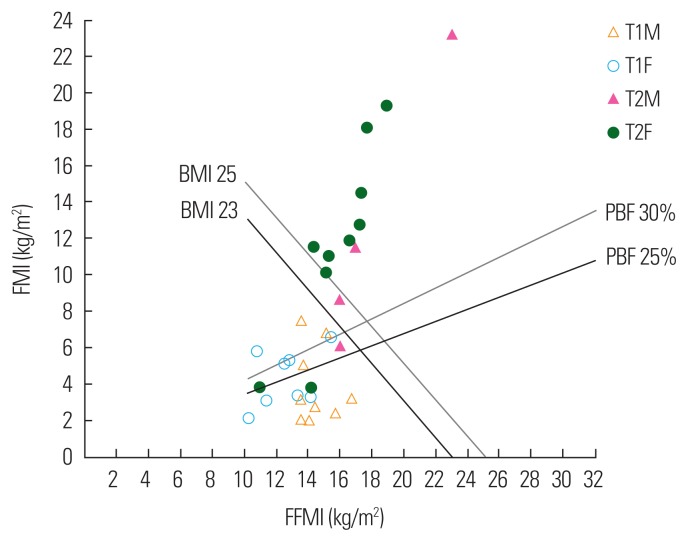
Figure 1
Figure 1
Plotting FFMI and FMI in adolescents with diabetes on a body composition chart. The X-axis represents FFMI, and the Y-axis depicts individual FMI. The lines for BMI and PBF were added to same plane. FMI, fat mass index; BMI, body mass index; PBF, percentage of body fat; FFMI, fat free mass index; T1M, type 1 diabetic boy; T1F, type 1 diabetic girl; T2M, type 2 diabetic boy; T2F, type 2 diabetic girl. Reprinted from Park et al. J Korean Med Sci 2012;27:1385–90.
Figure 2
Figure 2
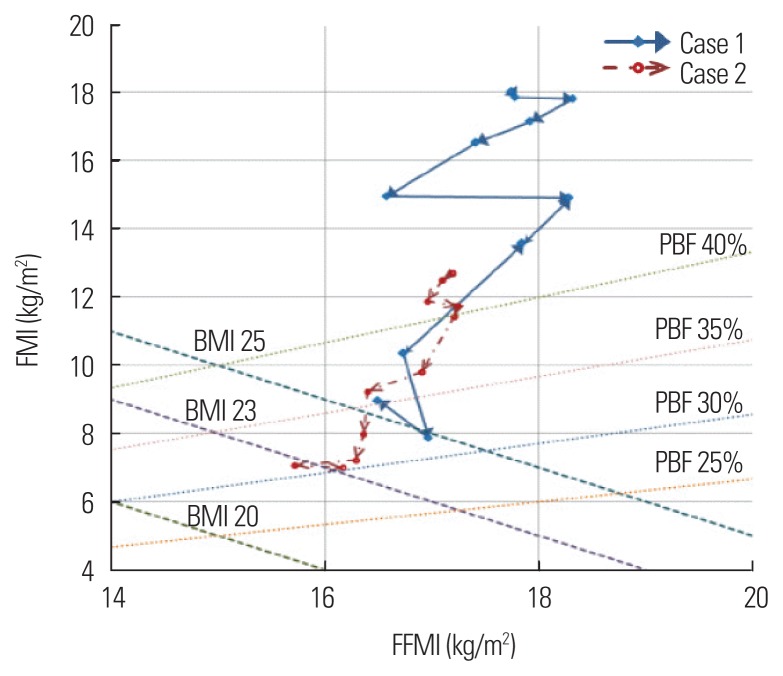
Plot of changes in FFMI and FMI in two adolescent girls with T2DM who achieved remission. FMI, fat mass index; BMI, body mass index; PBF, percentage of body fat; FFMI, fat free mass index; T2DM, type 2 diabetes. Reprinted from Lee et al. J Obes Metab Syndr 2017;26:71–5.

References

    1. Cali AM, Caprio S. Ectopic fat deposition and the metabolic syndrome in obese children and adolescents. Horm Res. 2009;71( Suppl 1):2–7. - PubMed
    1. Bennett B, Larson-Meyer DE, Ravussin E, Volaufova J, Soros A, Cefalu WT, et al. Impaired insulin sensitivity and elevated ectopic fat in healthy obese vs. nonobese prepubertal children. Obesity (Silver Spring) 2012;20:371–5. doi: 10.1038/oby.2011.264. - DOI - PMC - PubMed
    1. Thibault R, Pichard C. The evaluation of body composition: a useful tool for clinical practice. Ann Nutr Metab. 2012;60:6–16. doi: 10.1159/000334879. - DOI - PubMed
    1. Whitaker RC, Wright JA, Pepe MS, Seidel KD, Dietz WH. Predicting obesity in young adulthood from childhood and parental obesity. N Engl J Med. 1997;337:869–73. doi: 10.1056/NEJM199709253371301. - DOI - PubMed
    1. Styne DM, Arslanian SA, Connor EL, Farooqi IS, Murad MH, Silverstein JH, et al. Pediatric obesity-assessment, treatment, and prevention: an Endocrine Society Clinical Practice Guideline. J Clin Endocrinol Metab. 2017;102:709–57. doi: 10.1210/jc.2017-00561. - DOI - PMC - PubMed

LinkOut - more resources