


Association Between Dairy Product Consumption and Colorectal Cancer Risk in Adults: A Systematic Review and Meta-Analysis of Epidemiologic Studies
- PMID: 31089733
- PMCID: PMC6518136
- DOI: 10.1093/advances/nmy114
Association Between Dairy Product Consumption and Colorectal Cancer Risk in Adults: A Systematic Review and Meta-Analysis of Epidemiologic Studies
Erratum in
-
Association Between Dairy Product Consumption and Colorectal Cancer Risk in Adults: A Systematic Review and Meta-Analysis of Epidemiologic Studies.Adv Nutr. 2020 Jul 1;11(4):1055-1057. doi: 10.1093/advances/nmaa071. Adv Nutr. 2020. PMID: 32666108 Free PMC article. No abstract available.
Abstract
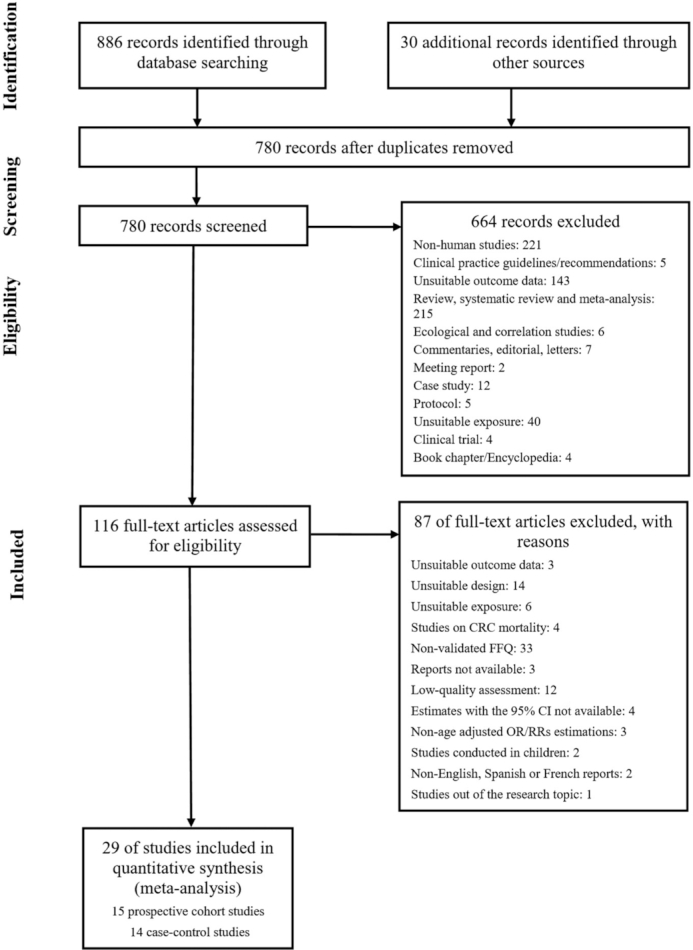
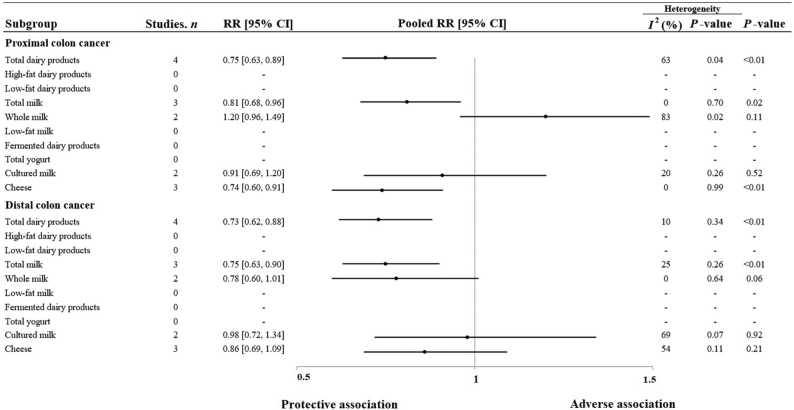
Dairy product consumption may decrease colorectal cancer (CRC) risk, but very few studies have evaluated the association between different types of dairy products and CRC location. The aim of this systematic review and meta-analysis was to examine the associations between dairy product consumption and CRC incidence. Summary RRs and ORs with 95% CIs were estimated. A total of 15 cohort studies and 14 case-control studies comprising a total of >22,000 cases were included in the quantitative synthesis. The cohort studies showed a consistent significant decrease in CRC risk associated with higher consumption of total dairy products (RR: 0.80; 95% CI: 0.70, 0.91) and total milk (RR: 0.82; 95% CI: 0.76, 0.88) compared with the CRC risk associated with lower consumption. These studies also showed a significant protective association between low-fat milk consumption and CRC (RR: 0.76; 95% CI: 0.66, 0.88), but only for colon cancer (RR: 0.73; 95% CI: 0.61, 0.87). Cheese consumption was inversely associated with the risk of CRC (RR: 0.85; 95% CI: 0.76, 0.96) and proximal colon cancer (RR: 0.74; 95% CI: 0.60, 0.91). No significant associations with CRC were found for the consumption of low-fat dairy products, whole milk, fermented dairy products, or cultured milk. Most of these associations were not supported by the case-control studies. In conclusion, high consumption of total dairy products and total milk was associated with a lower risk of developing CRC at any anatomic location, including the proximal and distal colon and the rectum. Low-fat milk consumption was associated with a lower risk of CRC, but this association was restricted to colon cancer. Cheese consumption was associated with the prevention of CRC, specifically proximal colon cancer. Further studies on larger samples and with longer follow-up periods, along with appropriately designed and executed clinical trials, are warranted to determine whether dairy product consumption affects CRC development.
Keywords: adults; case-control studies; cheese; colorectal cancer; dairy; meta-analysis; milk; prospective studies; systematic review; yogurt.
Copyright © American Society for Nutrition 2019.
Figures



References
-
- Fitzmaurice C, Akinyemiju TF, Al Lami FH, Alam T, Alizadeh-Navaei R, Allen C, Alsharif U, Alvis-Guzman N, Amini E, Anderson BO et al.. Global, regional, and national cancer incidence, mortality, years of life lost, years lived with disability, and disability-adjusted life-years for 29 cancer groups, 1990 to 2016. JAMA Oncol. 2018;4(11):1553–68. - PMC - PubMed
-
- Arnold M, Sierra MS, Laversanne M, Soerjomataram I, Jemal A, Bray F. Global patterns and trends in colorectal cancer incidence and mortality. Gut. 2017;66:683–91. - PubMed
-
- World Cancer Research Fund/American Institute for Cancer Research. Diet, nutrition, physical activity and cancer: a global perspective. Continuous Update Project Expert Report. 2018.
-
- Feng Y-L, Shu L, Zheng P-F, Zhang X-Y, Si C-J, Yu X-L, Gao W, Zhang L. Dietary patterns and colorectal cancer risk. Eur J Cancer Prev. 2017;26:201–11. - PubMed
Publication types
MeSH terms
Substances
LinkOut - more resources
Full Text Sources
Medical
