


Effects of Milk and Dairy Product Consumption on Type 2 Diabetes: Overview of Systematic Reviews and Meta-Analyses
- PMID: 31089734
- PMCID: PMC6518137
- DOI: 10.1093/advances/nmy107
Effects of Milk and Dairy Product Consumption on Type 2 Diabetes: Overview of Systematic Reviews and Meta-Analyses
Abstract
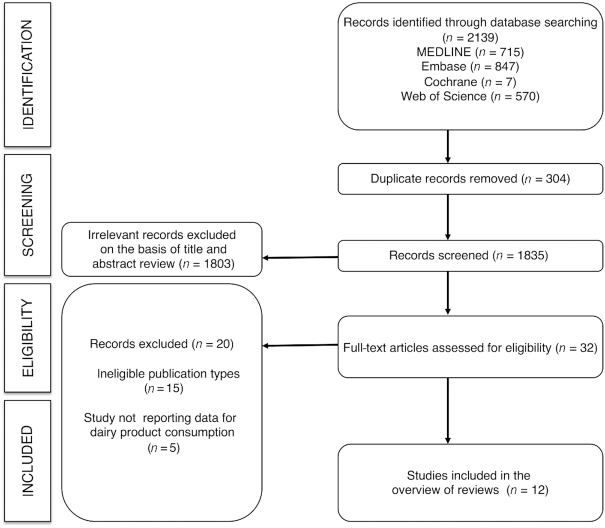
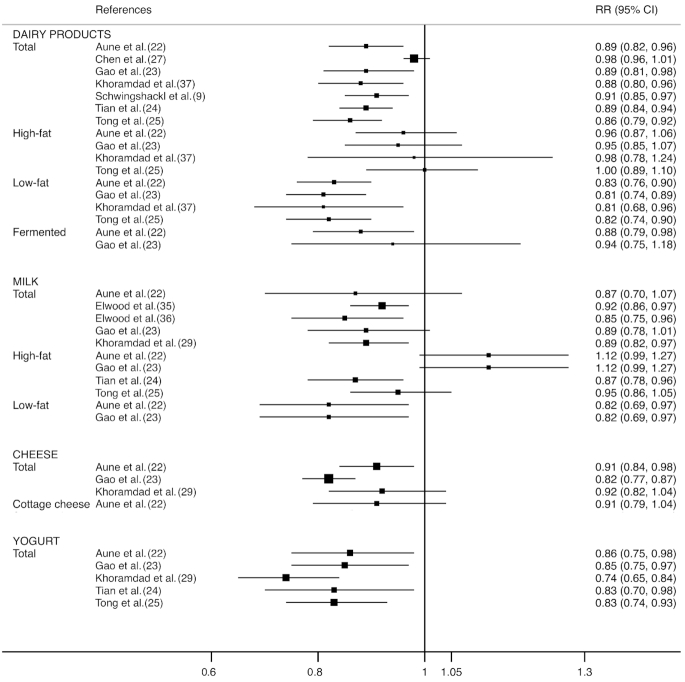
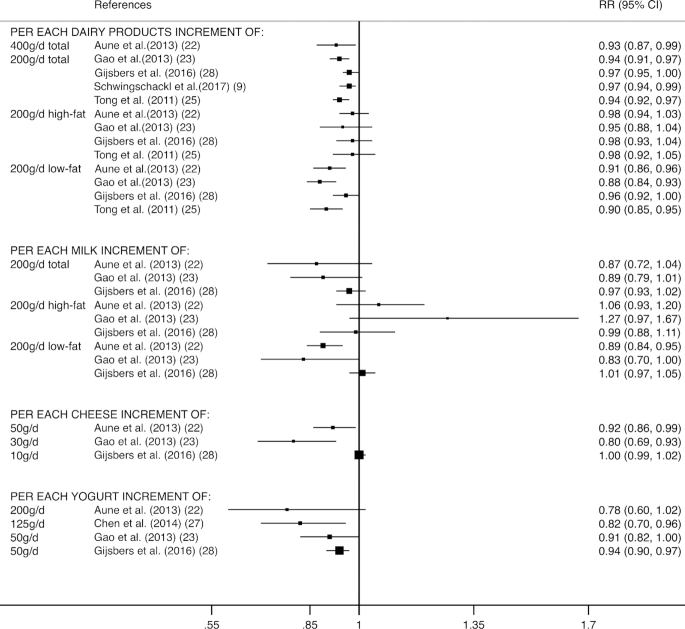
Dairy product consumption has been related to type 2 diabetes (T2D) incidence, although data from epidemiological studies have shown mixed results regarding the association of dairy products and T2D risk. This overview of systematic reviews and meta-analyses aimed to examine the scientific literature available on the association between dairy product consumption and T2D risk. A literature search was conducted in the MEDLINE (via PubMed), EMBASE, Cochrane Central Database of Systematic Reviews, and Web of Science databases from their inception to April, 2018. Forest plots summarized the risk ratios (RRs) reported by meta-analyses on high compared with low and dose-response dairy product consumption. The risk of bias was assessed using the AMSTAR2 tool. We included 12 meta-analyses, reporting data from 4-22 cohort studies and from 4-23 populations. The participants' ages ranged from 20 to 88 y, and participants were followed up for from 4 to 30 y. Studies included 64,227-566,875 participants and reported 4810-44,474 cases of T2D. Most studies reported an inverse association between T2D incidence and dairy product consumption, especially for 1) total dairy products (range: 0.86-0.91), 2) low-fat dairy products (range: 0.81-0.83), 3) low-fat milk (RR: 0.82), and 4) yogurt (range: 0.74-0.86). Dose-response analyses showed a decreased T2D risk for 1) 200-400 g/d of total dairy products (range: 0.93-0.97) and 2) 200 g/d of low-fat dairy products (range: 0.88-0.91). Total dairy product consumption is associated with a lower risk of T2D, especially for yogurt and low-fat dairy consumption. The association with cheese is moderate. Moreover, dose-response analyses showed that the risk of T2D decreased by each unit increase in consumption of total dairy products and low-fat dairy products.
Keywords: cheese; dairy products; diabetes mellitus; meta-analysis; milk; review; type 2 diabetes; yogurt.
Copyright © American Society for Nutrition 2019.
Figures
References
-
- Shaw JE, Sicree RA, Zimmet PZ. Global estimates of the prevalence of diabetes for 2010 and 2030. Diabetes Res Clin Pract. 2010;87:4–14. - PubMed
-
- Stevens JW, Khunti K, Harvey R, Johnson M, Preston L, Woods HB, Davies M, Goyder E. Preventing the progression to type 2 diabetes mellitus in adults at high risk: a systematic review and network meta-analysis of lifestyle, pharmacological and surgical interventions. Diabetes Res Clin Pract. 2015;107:320–31. - PubMed
-
- Whiting DR, Guariguata L, Weil C, Shaw J. IDF diabetes atlas: global estimates of the prevalence of diabetes for 2011 and 2030. Diabetes Res Clin Pract. 2011;94:311–21. - PubMed
-
- World Health Organization. Global Report on Diabetes. Geneva: World Health Organization; 2016.
-
- Centers for Disease Control and Prevention. Incidence of diagnosed diabetes. [Internet] Atlanta, GA: National Center for Chronic Disease Prevention and Health Promotion, Division of Diabetes Translation; 2018; [cited 20 Sep, 2018]. Available from: https://www.cdc.gov/diabetes/data/statistics-report/incidence-diabetes.html.
