Review
. 2019 May 14;19(6):33.
doi: 10.1007/s11910-019-0942-y.

Genetic Disorders of Manganese Metabolism

Affiliations
Review

Genetic Disorders of Manganese Metabolism

S Anagianni et al. Curr Neurol Neurosci Rep. .

Abstract

Purpose of review: This article provides an overview of the pathogenesis, clinical presentation and treatment of inherited manganese transporter defects.

Recent findings: Identification of a new group of manganese transportopathies has greatly advanced our understanding of how manganese homeostasis is regulated in vivo. While the manganese efflux transporter SLC30A10 and the uptake transporter SLC39A14 work synergistically to reduce the manganese load, SLC39A8 has an opposing function facilitating manganese uptake into the organism. Bi-allelic mutations in any of these transporter proteins disrupt the manganese equilibrium and lead to neurological disease: Hypermanganesaemia with dystonia 1 (SLC30A10 deficiency) and hypermanganesaemia with dystonia 2 (SLC39A14 deficiency) are characterised by manganese neurotoxicity while SLC39A8 mutations cause a congenital disorder of glycosylation type IIn due to Mn deficiency. Inherited manganese transporter defects are an important differential diagnosis of paediatric movement disorders. Manganese blood levels and MRI brain are diagnostic and allow early diagnosis to avoid treatment delay.

Keywords: HMNDYT1; HMNDYT2; Manganese; SLC30A10; SLC39A14; SLC39A8.


Conflict of interest statement

The authors declare that they have no conflicts of interest.

Figures
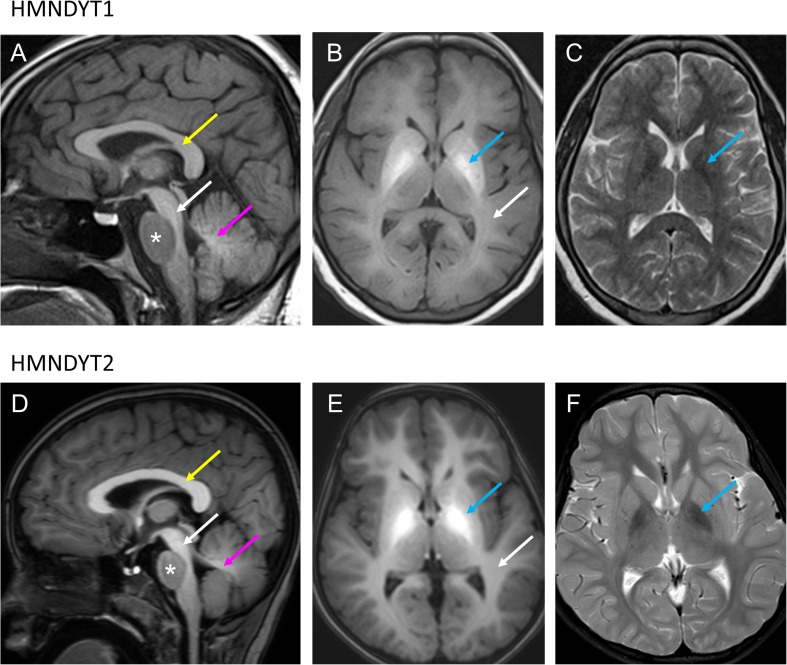
Fig. 1
Fig. 1
Characteristic appearances of Mn deposition in HMNDYT1 and HMNDYT2 on brain MRI. ac Individual with HMNDYT1. df. Individual with HMNDYT2. a, d T1-weighted sagittal imaging showing hyperintensity of the white matter of the corpus callosum (yellow arrow), cerebellum (pink arrow) and the dorsal pons (white arrow) with characteristic sparing of the ventral pons (*). b, e T1-weighted transverse imaging showing hyperintensity of the globus pallidus (blue arrow) and cerebral white matter (white arrow) bilaterally. c, f T2-weighted transverse imaging showing hypointensity of the globus pallidus (blue arrow) bilaterally corresponding to T1-hyperintensities [••, ••]. (Reprinted from: Tuschl, K. et al. Syndrome of Hepatic Cirrhosis, Dystonia, Polycythemia, and Hypermanganesemia Caused by Mutations in SLC30A10, a Manganese Transporter in Man, Am. J. Hum. Genet, 90 (2012) 457–466; with permission from Elsevier) [••]. (Reproduced from Tuschl, K. et al. Mutations in SLC39A14 Disrupt Manganese Homeostasis and Cause Childhood-Onset Parkinsonism-Dystonia, Nat Commun, 7: 11601 doi: 10.1038/ncomms11601 (2016); Creative Commons user license http://creativecommons.org/licenses/by/4.0/) [••]

References

    1. Clayton PT. Inherited disorders of transition metal metabolism: an update. J Inherit Metab Dis. 2017;40:519–529. doi: 10.1007/s10545-017-0030-x. - DOI - PubMed
    1. Li L, Yang X. The essential element manganese, oxidative stress, and metabolic diseases: links and interactions. Oxidative Med Cell Longev. 2018:7580707. - PMC - PubMed
    1. Peres TV, Schettinger MR, Chen P, Carvalho F, Avila DS, Bowman AB, Aschner M. Manganese-induced neurotoxicity: a review of its behavioral consequences and neuroprotective strategies. BMC Pharmacol Toxicol. 2016;17:57. doi: 10.1186/s40360-016-0099-0. - DOI - PMC - PubMed
    1. Baker MG, Simpson CD, Stover B, Sheppard L, Checkoway H, Racette BA, Seixas NS. Blood manganese as an exposure biomarker: state of the evidence. J Occup Environ Hyg. 2014;11:210–217. doi: 10.1080/15459624.2013.852280. - DOI - PMC - PubMed
    1. Shallcross L, Ritchie S, Harberts E, Tammaro A, Gaitens J, Gaspari AA. Manganese oxidation state as a cause of irritant patch test reactions. Dermatitis. 2014;25:66–71. doi: 10.1097/DER.0000000000000032. - DOI - PMC - PubMed

Publication types
