. 2019 Jun;9(6):e01289.
doi: 10.1002/brb3.1289. Epub 2019 May 14.

The neural and genetic correlates of satisfying sexual activity in heterosexual pair-bonds

Affiliations

The neural and genetic correlates of satisfying sexual activity in heterosexual pair-bonds

Bianca P Acevedo et al. Brain Behav. 2019 Jun.

Abstract

Introduction: In humans, satisfying sexual activity within a pair-bond plays a significant role in relationship quality and maintenance, beyond reproduction. However, the neural and genetic correlates for this basic species-supporting function, in response to a pair-bonded partner, are unknown.

Methods: We examined the neural correlates of oxytocin- (Oxtr rs53576) and vasopressin- (Avpr1a rs3) receptor genotypes with sexual satisfaction and frequency, among a group of individuals in pair-bonds (M relationship length = 4.1 years). Participants were scanned twice (with functional MRI), about 1-year apart, while viewing face images of their spouse and a familiar, neutral acquaintance.

Results: Sex satisfaction scores showed significant interactions with Oxtr and Avpr variants associated with social behaviors in a broad network of regions involved in reward and motivation (ventral tegmental area, substantia nigra [SN], and caudate), social bonding (ventral pallidum), emotion and memory (amygdala/hippocampus), hormone control (hypothalamus); and somatosensory and self-other processing (SII, frontal, and temporal lobe). Sexual frequency interactions also showed activations in the SN and paraventricular hypothalamus for Avpr, and the prefrontal cortex for Oxtr.

Conclusions: Satisfying sexual activity in pair-bonds is associated with activation of subcortical structures that support basic motivational and physiological processes; as well as cortical regions that mediate complex thinking, empathy, and self-other processes highlighting the multifaceted role of sex in pair-bonds. Oxtr and Avpr gene variants may further amplify both basic and complex neural processes for pair-bond conservation and well-being.

Keywords: fMRI; oxytocin; pair-bonding; prefrontal cortex; sexual frequency; sexual satisfaction; vasopressin.


Conflict of interest statement

The authors report no competing interests or conflict of interest to report.

Figures
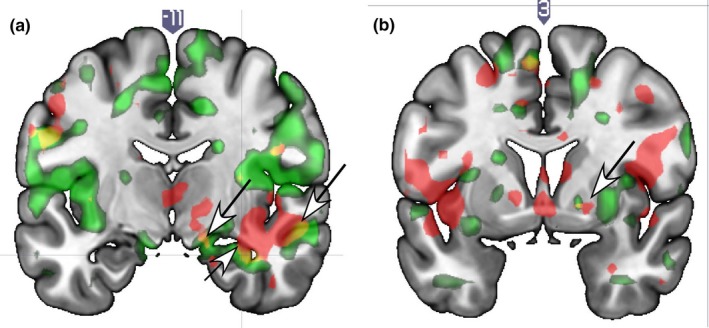
Figure 1
Figure 1
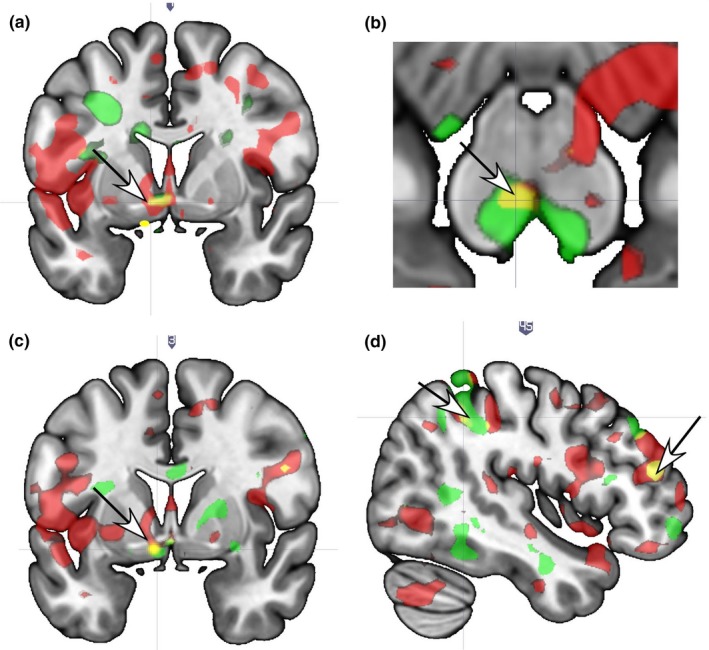
Brain localizations showing positive correlations with sexual satisfaction scores in response to viewing face images of a romantic partner versus a familiar acquaintance at T1 and T2. (a) The lateral substantia nigra (top left arrow), hippocampal region (lower middle arrow) and superior/inferior temporal sulcus (top right arrow) shown for at both T1 and T2. (b) The right globus pallidus shows a correlation for sexual satisfaction at both time points (arrow) and there is an overlapping region. Legend. Red = T1 only; Green = T2 only; Yellow = overlap of T1 and T2
Figure 2
Figure 2
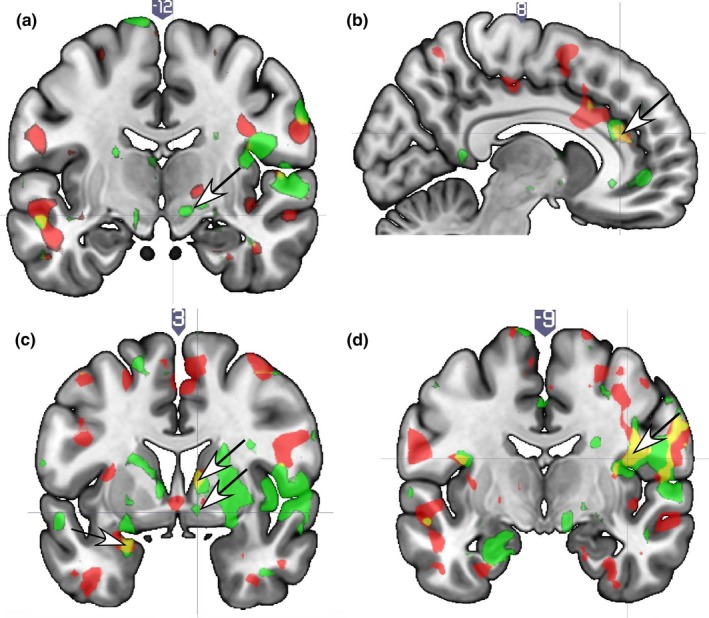
Brain localizations showing significant response interactions with sexual satisfaction scores and OXTR and/or AVPR. (a) The left ventral pallidum shows an interaction with AVPR at both T1 and T2 (arrow). (b) The left VTA shows an interaction with AVPR at both T1 and T2 (arrow). (c) The left ventral pallidum/anterior hypothalamus regions show an interaction with OXTR (arrow). (d) The dorsolateral prefrontal cortex (right arrow) and the intraparietal sulcus region (left arrow) show an interaction with OXTR at both T1 and T2. Legend. Red = T1 only; Green = T2 only; Yellow = overlap of T1 and T2
Figure 3
Figure 3
Brain localizations showing positive correlations with self‐reported sex frequency (times/week) while viewing face images of a spouse versus a familiar acquaintance. (a) The substantia nigra region is not correlated with sexual frequency at both time points, as it is for sexual satisfaction (arrow; compare to Figure 1a). (b) Anterior cingulate cortex (arrow). (c) Amygdala (arrow). (d) Parietal operculum/SII. Legend. Red = T1; Green = T2; Yellow/orange = overlap of T1 and T2
Figure 4
Figure 4
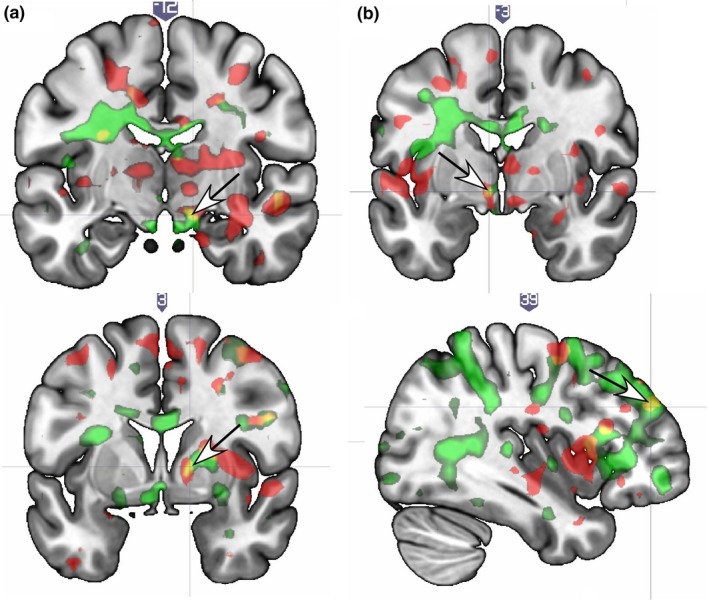
Brain localizations showing significant brain response interactions with sex frequency (times/week) and OXTR or AVPR. (a) At both T1 and T2 the substantia nigra region shows an interaction for AVPR (arrow) and sex frequency, which is the same region that correlated with sexual satisfaction (see Figure 1a). (b) The hypothalamus/paraventricular region showed an AVPR interaction at T1 and T2 (arrow). (c) The globus pallidus shows an interaction with OXTR at T1 and T2 (arrow). (d) The dorsolateral prefrontal cortex shows an interaction with OXTR at T1 and T2 (arrow). Legend. OXTR = Red; AVPR = Green
Figure 5
Figure 5
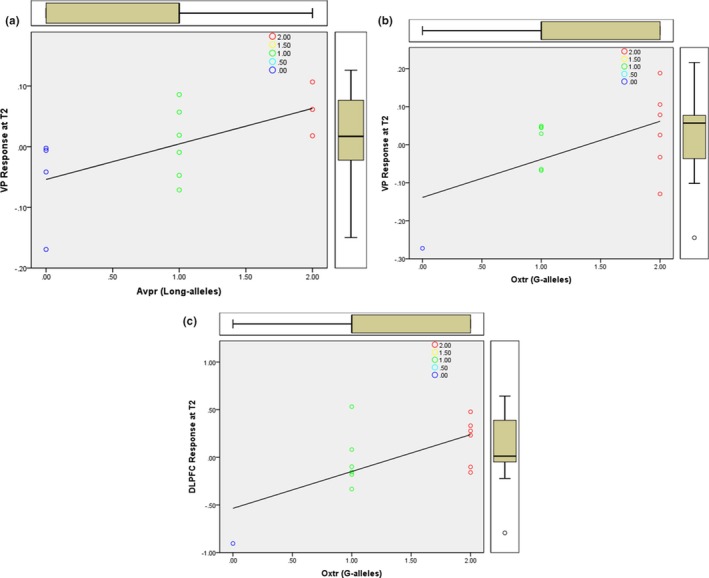
(a) Scatterplot shows the T2 correlation between Avpr1a rs3 (long‐alleles) and ventral pallidum (VP) response. (b) Scatterplot shows the T2 correlation between Oxtr rs53576 genotype with VP response. (c) Scatterplot shows the T2 correlation between Oxtr rs53576 genotype with response in the DLPFC

References

    1. Acevedo, B. P. (2015). Neural correlates of human attachment: Evidence from fMRI studies of adult pair‐bonding In: Zayas V., & Hazan C. (Eds.), Bases of adult attachment: From brain to mind to behavior. New York, NY: Springer.
    1. Acevedo, B. P. (2017). The positive psychology of romantic love In Warren A., & Donaldson S. (Eds.), Toward a positive psychology of relationships: New directions in theory and research. Santa Barbara, CA: Abc‐Clio.
    1. Acevedo, B. P. , & Aron, A. (2014). In Mikulincer M., & Shaver P. R. (Eds.), Mechanisms of social connection: From brain to group (pp. 55–69). Washington, DC: American Psychological Association.
    1. Acevedo, B. P. , Aron, A. , Fisher, H. E. , & Brown, L. L. (2012). Neural correlates of long‐term intense romantic love. Social Cognitive and Affective Neuroscience, 7, 145–159. 10.1093/scan/nsq092 - DOI - PMC - PubMed
    1. Acevedo, B. P. , Aron, E. N. , Aron, A. , Sangster, M.‐D. , Collins, N. , & Brown, L. L. (2014). The highly sensitive brain: An fMRI study of sensory processing sensitivity and response to others' emotions. Brain and Behavior, 4, 580–594. 10.1002/brb3.242 - DOI - PMC - PubMed

Publication types

LinkOut - more resources