Assessing the Content of Television Health Insurance Advertising during Three Open Enrollment Periods of the ACA
- PMID: 31091327
- PMCID: PMC6521724
- DOI: 10.1215/03616878-7104392
Assessing the Content of Television Health Insurance Advertising during Three Open Enrollment Periods of the ACA
Abstract
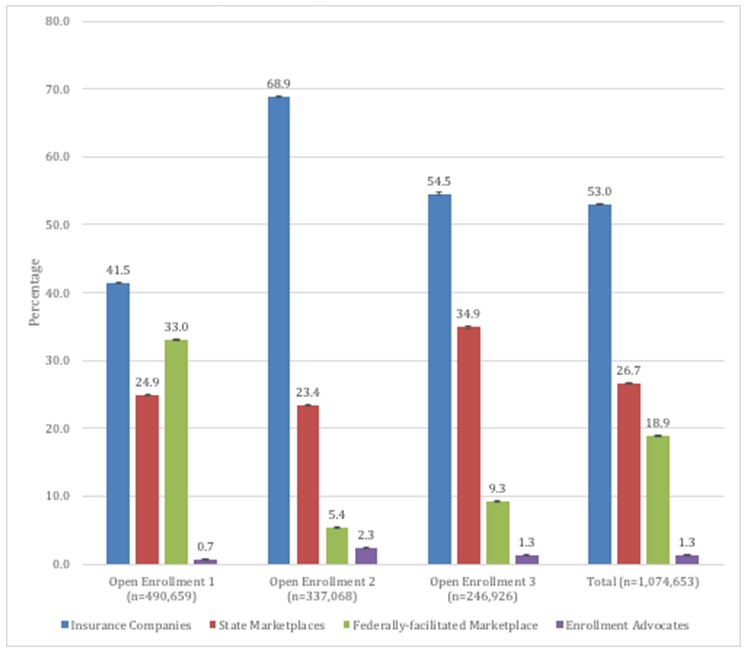
Television advertising has been a primary method for marketing new health plans available under the Affordable Care Act (ACA) to consumers. Data from Kantar Media's Campaign Media Analysis Group were used to analyze advertising content during three ACA open enrollment periods (fall 2013 to spring 2016). Few advertisement airings featured people who were elderly, disabled, or receiving care in a medical setting, and over time airings increasingly featured children, young adults, and people exercising. The most common informational messages focused on plan choice and availability of low-cost plans, but messages shifted over open enrollment cycles to emphasize avoidance of tax penalties and availability of financial assistance. Over the three open enrollment periods, there was a sharp decline in explicit mentions of the ACA or Obamacare in advertisements. Overall, television advertisements have increasingly targeted young, healthy consumers, and informational appeals have shifted toward a focus on financial factors in persuading individuals to enroll in marketplace plans. These advertising approaches make sense in the context of pressures to market plans to appeal to a sufficiently large, diverse group. Importantly, dramatic declines over time in explicit mention of the law mean that citizens may fail to understand the connection between the actions of government and the benefits they are receiving.
Keywords: advertising; health insurance; local news; media; politics; public opinion.
Copyright © 2018 by Duke University Press.
Figures
References
-
- Ball-Rokeach SJ, and DeFleur ML. 1976. “A Dependency Model of Mass-Media Effects.” Communication Research 3 (1): 3–21. 10.1177/009365027600300101. - DOI
-
- Blidook Kelly. 2008. “Media, Public Opinion and Health Care in Canada: How the Media Affect ‘The Way Things Are.’” Canadian Journal of Political Science / Revue Canadienne de Science Politique 41 (2): 355–74.
-
- Cutlip Scott M. 1994. The Unseen Power: Public Relations: A History. Routledge; Hillsdale, New Jersey.
-
- “CDC Vital Signs: Hispanic Health.” 2015. United States Department of Health and Human Services, Centers for Disease Control and Prevention. https://www.cdc.gov/vitalsigns/pdf/2015-05-vitalsigns.pdf.
-
- “DMA Regions.” 2013. The Nielsen Company. 2013. http://www.nielsen.com/intl-campaigns/us/dma-maps.html.
Publication types
MeSH terms
Grants and funding
LinkOut - more resources
Full Text Sources