Review
. 2019 May 14;24(10):1856.
doi: 10.3390/molecules24101856.

Black Ginseng and Its Saponins: Preparation, Phytochemistry and Pharmacological Effects

Affiliations
Review

Black Ginseng and Its Saponins: Preparation, Phytochemistry and Pharmacological Effects

Ahmed M Metwaly et al. Molecules. .

Abstract

Black ginseng is a type of processed ginseng that is prepared from white or red ginseng by steaming and drying several times. This process causes extensive changes in types and amounts of secondary metabolites. The chief secondary metabolites in ginseng are ginsenosides (dammarane-type triterpene saponins), which transform into less polar ginsenosides in black ginseng by steaming. In addition, apparent changes happen to other secondary metabolites such as the increase in the contents of phenolic compounds, reducing sugars and acidic polysaccharides in addition to the decrease in concentrations of free amino acids and total polysaccharides. Furthermore, the presence of some Maillard reaction products like maltol was also engaged. These obvious chemical changes were associated with a noticeable superiority for black ginseng over white and red ginseng in most of the comparative biological studies. This review article is an attempt to illustrate different methods of preparation of black ginseng, major chemical changes of saponins and other constituents after steaming as well as the reported biological activities of black ginseng, its major saponins and other metabolites.

Keywords: anti-inflammatory; anticancer; black ginseng; steaming and drying; transformed ginsenosides.


Conflict of interest statement

The authors declare that there is no conflict of interest regarding this publication.

Figures

Figure 1
Figure 1
Major classes of Ginsenoside.
Figure 2
Figure 2
Pathways of chemical changes of protopanaxadiol (PPD)-type ginsenosides during black ginseng processing.
Figure 3
Figure 3
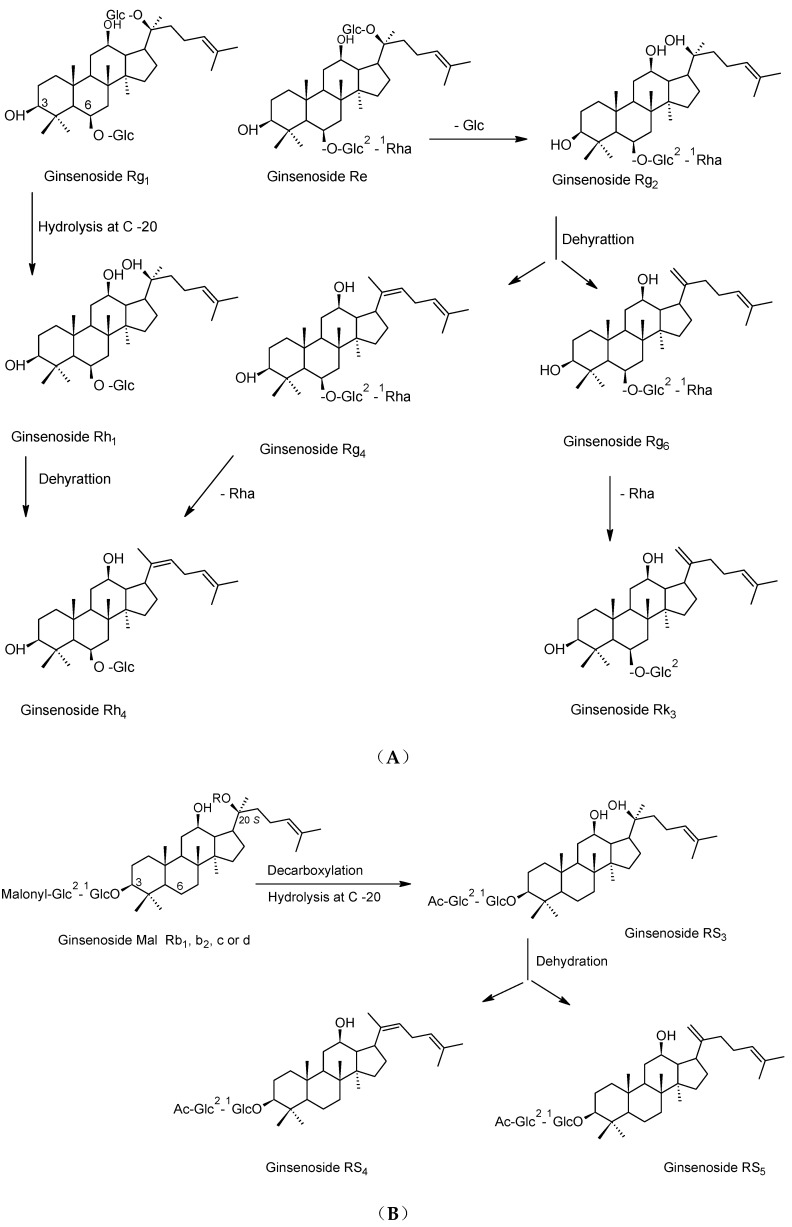
Pathways of chemical changes of some protopanaxatriol (PPT) (A) and PPD (B) type ginsenosides during black ginseng processing.
Figure 4
Figure 4
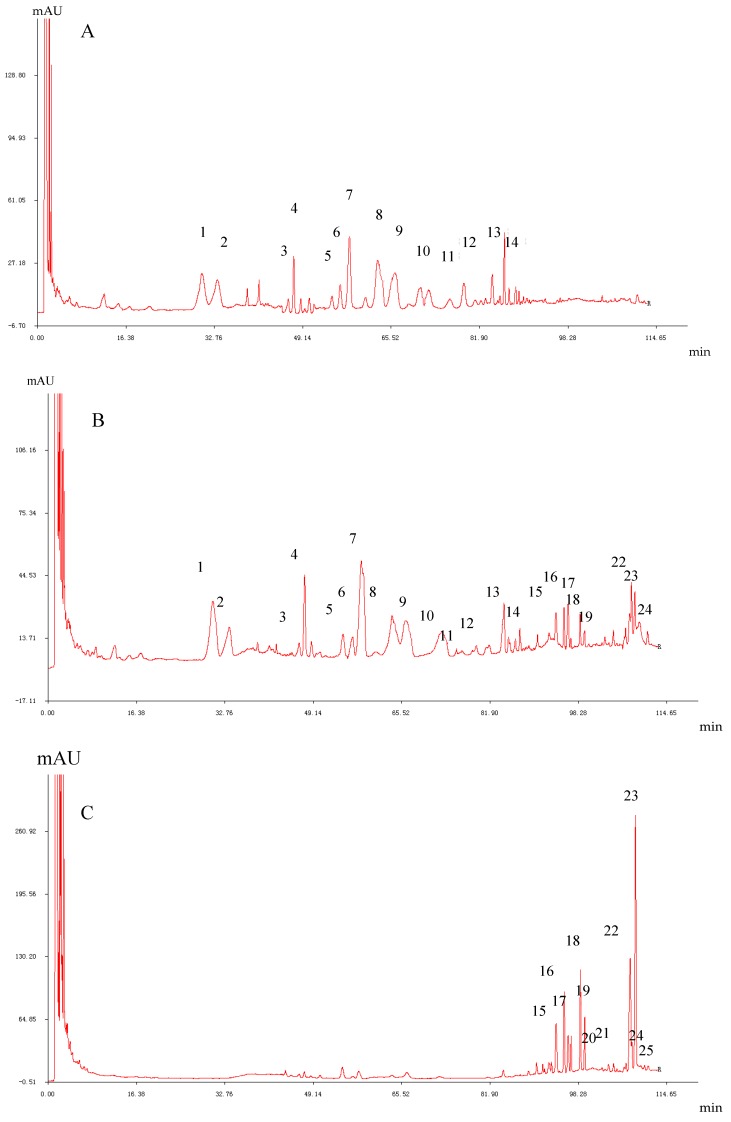
HPLC fingerprints of ginsenosides in white P. ginseng (A), red P. ginseng (B) and black P. ginseng (C). Note: 1-Rg1; 2-Re; 4-Rf; 5-(S)-Rg2; 6-(R)-Rg2; 7-Rb1; 8-Rc; 9-Ro; 11-Rb2; 12-Rb3; 13-Rd; 18-(S)-Rg3; 19-(R)-Rg3; 20-(S)-Rs3; 21-(R)-Rs3; 22-Rk1; 23-Rg5; 24-(S)-Rh2; 25-(R)-Rh2.
Figure 5
Figure 5
The relative percentage of individual ginsenosides (A) and oligosaccharides (B) in white P. ginseng, red P. ginseng and black P. ginseng. Note: 1-Rg1; 2-Re; 4-Rf; 5-(S)-Rg2; 6-(R)-Rg2; 7-Rb1; 8-Rc; 9-Ro; 11-Rb2; 12-Rb3; 13-Rd; 18-(S)-Rg3; 19-(R)-Rg3; 20-(S)-Rs3; 21-(R)-Rs3; 22-Rk1; 23-Rg5; 24-(S)-Rh2; 25-(R)-Rh2.

References

    1. Yun T.K. Brief introduction of Panax ginseng CA Meyer. J. Korean Med. Sci. 2001;16:S3. doi: 10.3346/jkms.2001.16.S.S3. - DOI - PMC - PubMed
    1. Nocerino E., Amato M., Izzo A.A. The aphrodisiac and adaptogenic properties of ginseng. Fitoterapia. 2000;71:S1–S5. doi: 10.1016/S0367-326X(00)00170-2. - DOI - PubMed
    1. Kang S., Min H. Ginseng, the’immunity boost’: The effects of Panax ginseng on immune system. J. Ginseng Res. 2012;36:354. doi: 10.5142/jgr.2012.36.4.354. - DOI - PMC - PubMed
    1. Shin H.R., Kim J.Y., Yun T.K., Morgan G., Vainio H. The cancer-preventive potential of Panax ginseng: A review of human and experimental evidence. Cancer Causes Control. 2000;11:565–576. doi: 10.1023/A:1008980200583. - DOI - PubMed
    1. Lee C.H., Kim J.-H. A review on the medicinal potentials of ginseng and ginsenosides on cardiovascular diseases. J. Ginseng Res. 2014;38:161–166. doi: 10.1016/j.jgr.2014.03.001. - DOI - PMC - PubMed

LinkOut - more resources