


Metabolomic Pattern Predicts Incident Coronary Heart Disease
- PMID: 31092011
- PMCID: PMC6839698
- DOI: 10.1161/ATVBAHA.118.312236
Metabolomic Pattern Predicts Incident Coronary Heart Disease
Abstract
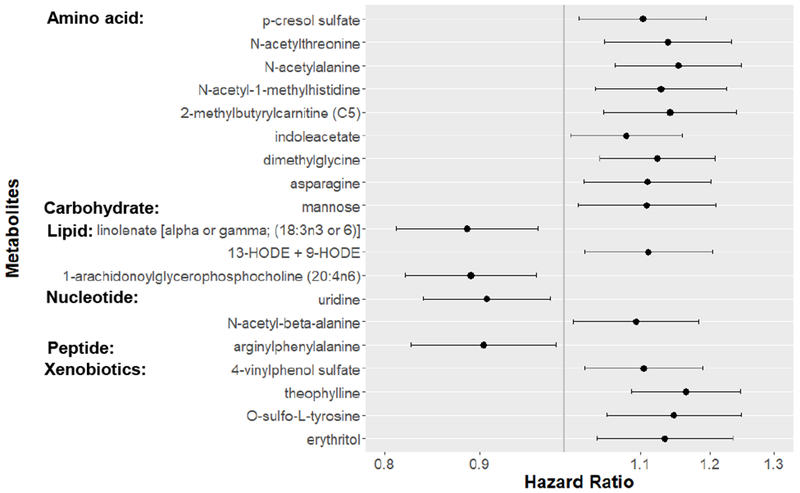
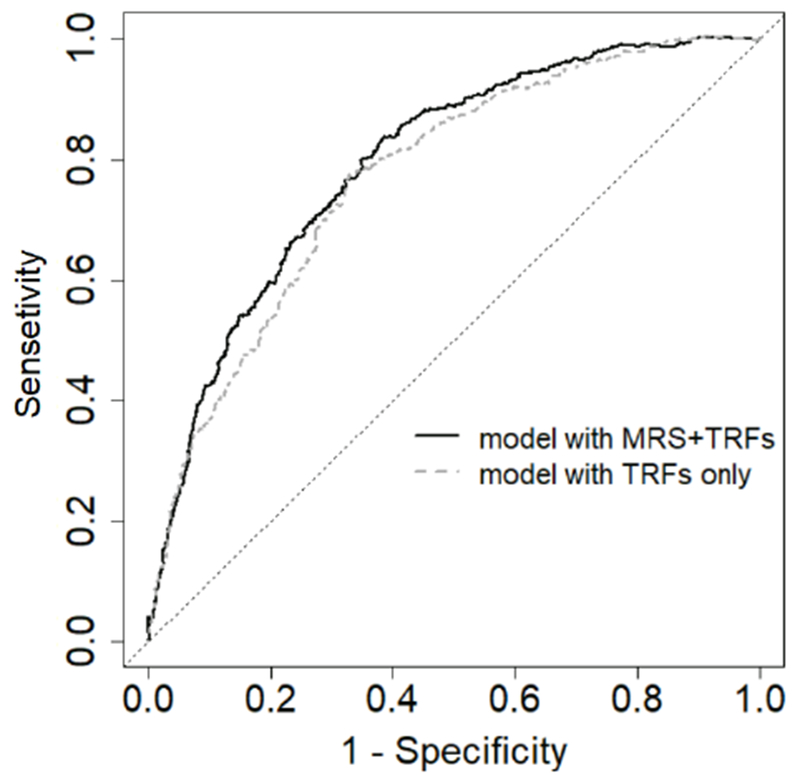
Objective- Alterations in the serum metabolome may be detectable in at-risk individuals before the onset of coronary heart disease (CHD). Identifying metabolomic signatures associated with CHD may provide insight into disease pathophysiology and prevention. Approach and Results- Metabolomic profiling (chromatography-mass spectrometry) was performed in 2232 African Americans and 1366 European Americans from the ARIC study (Atherosclerosis Risk in Communities). We applied Cox regression with least absolute shrinkage and selection operator to select metabolites associated with incident CHD. A metabolite risk score was constructed to evaluate whether the metabolite risk score predicted CHD risk beyond traditional risk factors. After 30 years of follow-up, we observed 633 incident CHD cases. Thirty-two metabolites were selected by least absolute shrinkage and selection operator to be associated with CHD, and 19 of the 32 showed significant individual associations with CHD, including a sugar substitute, erythritol. Theophylline (hazard ratio [95% CI] =1.16 [1.09-1.25]) and gamma-linolenic acid (hazard ratio [95% CI] =0.89 [0.81-0.97]) showed the greatest positive and negative associations with CHD, respectively. A 1 SD greater standardized metabolite risk score was associated with a 1.37-fold higher risk of CHD (hazard ratio [95% CI] =1.37 [1.27-1.47]). Adding the metabolite risk score to the traditional risk factors significantly improved model predictive performance (30-year risk prediction: Δ C statistics [95% CI] =0.016 [0.008-0.024], continuous net reclassification index [95% CI] =0.522 [0.480-0.556], integrated discrimination index [95% CI] =0.038 [0.019-0.065]). Conclusions- We identified 19 metabolites from known and novel metabolic pathways that collectively improved CHD risk prediction. Visual Overview- An online visual overview is available for this article.
Keywords: biomarkers; coronary disease; metabolome; risk factors.
Figures
Comment in
-
Letter Regarding Article, "Metabolomic Pattern Predicts Incident Coronary Heart Disease".Arterioscler Thromb Vasc Biol. 2019 Aug;39(8):e186. doi: 10.1161/ATVBAHA.119.313009. Epub 2019 Jul 24. Arterioscler Thromb Vasc Biol. 2019. PMID: 31339779 No abstract available.
-
Response Letter Regarding Article, "Metabolomic Pattern Predicts Incident Coronary Heart Disease".Arterioscler Thromb Vasc Biol. 2019 Aug;39(8):e187. doi: 10.1161/ATVBAHA.119.313013. Epub 2019 Jul 24. Arterioscler Thromb Vasc Biol. 2019. PMID: 31339783 Free PMC article. No abstract available.
References
-
- Organization WH. World health statistics 2017: Monitoring health for the sdgs Sustainable Development Goals. Geneva: WHO; 2017
-
- Benjamin EJ, Virani SS, Callaway CW, et al. Heart disease and stroke statistics-2018 update: A report from the american heart association. Circulation. 2018;137:e67–e492 - PubMed
-
- Vasan RS. Biomarkers of cardiovascular disease: Molecular basis and practical considerations. Circulation. 2006;113:2335–2362 - PubMed
-
- Chambless LE, Folsom AR, Sharrett AR, Sorlie P, Couper D, Szklo M, Nieto FJ. Coronary heart disease risk prediction in the atherosclerosis risk in communities (aric) study. J Clin Epidemiol 2003;56:880–890 - PubMed
-
- Ballantyne CM, Hoogeveen RC, Bang H, Coresh J, Folsom AR, Heiss G, Sharrett AR. Lipoprotein-associated phospholipase a2, high-sensitivity c-reactive protein, and risk for incident coronary heart disease in middle-aged men and women in the atherosclerosis risk in communities (aric) study. Circulation. 2004;109:837–842 - PubMed
Publication types
MeSH terms
Grants and funding
- 17SDG33661228/AHA/American Heart Association-American Stroke Association/United States
- U01 HG004402/HG/NHGRI NIH HHS/United States
- HHSN268201700002C/HL/NHLBI NIH HHS/United States
- HHSN268201700001I/HL/NHLBI NIH HHS/United States
- HHSN268201700004I/HL/NHLBI NIH HHS/United States
- HHSN268201700004C/HL/NHLBI NIH HHS/United States
- HHSN268201700003I/HL/NHLBI NIH HHS/United States
- HHSN268201700005C/HL/NHLBI NIH HHS/United States
- HHSN268201700001C/HL/NHLBI NIH HHS/United States
- HHSN268201700003C/HL/NHLBI NIH HHS/United States
- HHSN268201700002I/HL/NHLBI NIH HHS/United States
- HHSN268201700005I/HL/NHLBI NIH HHS/United States
LinkOut - more resources
Full Text Sources
