. 2019 Dec;10(1):116-125.
doi: 10.1080/19491034.2019.1616507.

Plant condensin II is required for the correct spatial relationship between centromeres and rDNA arrays

Affiliations

Plant condensin II is required for the correct spatial relationship between centromeres and rDNA arrays

Takuya Sakamoto et al. Nucleus. 2019 Dec.

Abstract

Plants possess the structural maintenance of chromosome (SMC) protein complexes cohesin, condensin, and SMC5/6, which function in fundamental biological processes such as sister chromatid cohesion, chromosome condensation and segregation, and damaged DNA repair. Recently, increasing evidence in several organisms has suggested that condensin is involved in chromatin organizations during interphase. In Arabidopsis thaliana, condensin II is localized in the nucleus throughout interphase and is suggested to be required for keeping centromeres apart and the assembly of euchromatic chromosome arms. However, it remains unclear how condensin II organizes chromatin associations. Here, we first showed the high possibility that the function of condensin II as a complex is required for the disassociation of centromeres. Analysis of the rDNA array distribution revealed that condensin II is also indispensable for the association of centromeres with rDNA arrays. Reduced axial compaction of chromosomes and impaired genome integrity in condensin II mutants are not related to the disruption of chromatin organization. In contrast, the axial compaction of chromosomes by condensin II produces the force leading to the disassociation of heterologous centromeres in Drosophila melanogaster. Taken together, our data imply that the condensin II function in chromatin organization differs among eukaryotes.

Keywords: Condensin II; centromere; genome integrity; histone hyperacetylation; rDNA.


Figures
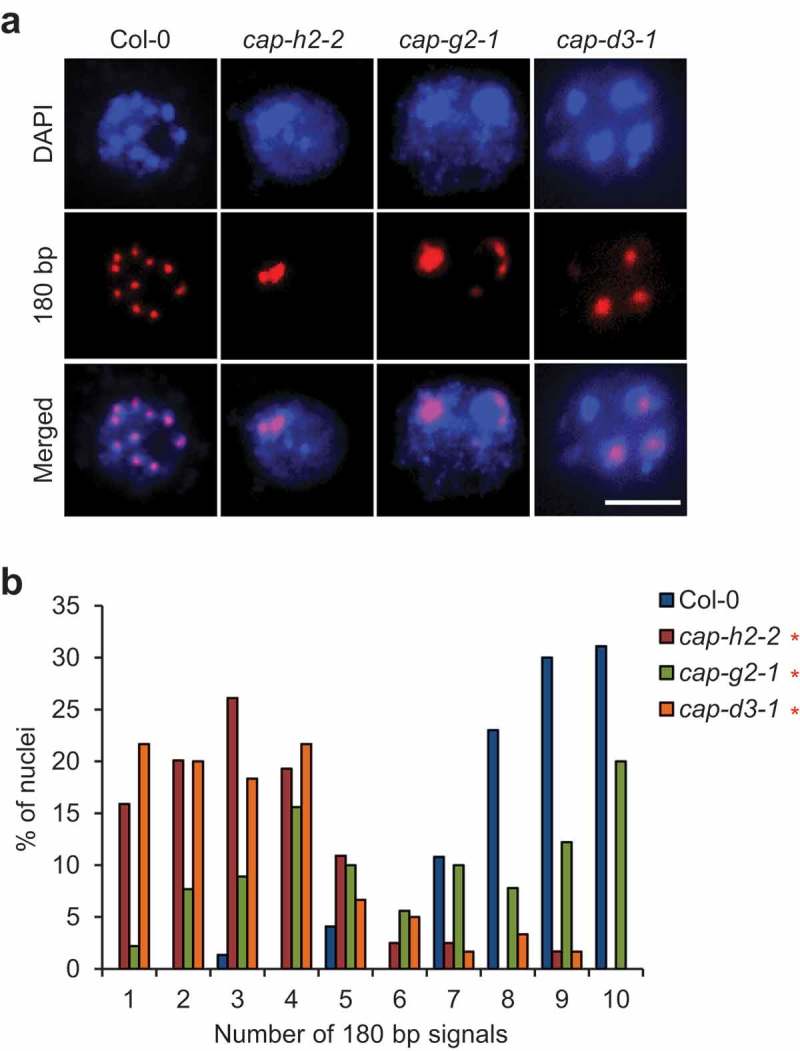
Figure 1.
Figure 1.
An increase in centromere association is observed in all mutants of condensin II-specific subunits. (a) Representative images of FISH detection of pericentromeric 180 bp signals in nuclei from flower buds of Col-0, cap-h2-2, cap-g2-1, and cap-d3-1. Bar = 5 μm. (b) Number of 180 bp signals in nuclei from flower buds of Col-0, cap-h2-2, cap-g2-1, and cap-d3-1. The frequency distribution of the number of 180 bp signals in each mutant was statistically compared with that in Col-0 by chi-squared test (*, p < 0.05, n = 74 for Col-0, n = 119 for cap-h2-2, n = 90 for cap-g2-1, n = 60 for cap-d3-1).
Figure 2.
Figure 2.
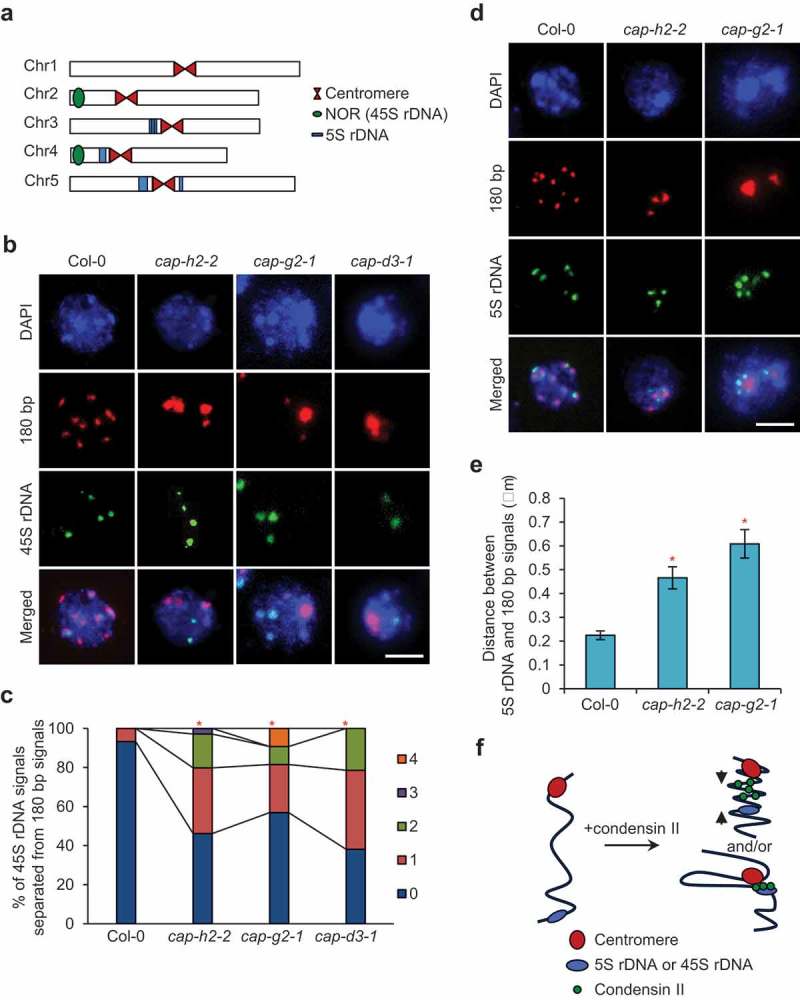
Defects in condensin II cause dissociation of centromeres from rDNA arrays. (a) Localization of rDNA arrays in the A. thaliana genome. 45S rDNA arrays are contained in nucleolar organizing regions (NORs) located on the short arms of chromosomes 2 and 4. 5S rDNA arrays are located in close proximity to the centromeres of chromosomes 3, 4, and 5. (b) Representative images of simultaneous FISH detection of pericentromeric 180 bp signals and 45S rDNA signals in nuclei from flower buds of Col-0, cap-h2-2, cap-g2-1, and cap-d3-1. Bar = 5 μm. (c) Number of 45S rDNA signals separated from 180 bp signals in nuclei from flower buds of Col-0, cap-h2-2, cap-g2-1, and cap-d3-1. The frequency distribution of the number of separated 45S rDNA signals in each mutant was statistically compared with that in Col-0 by chi-squared test (*, p < 0.05, n = 52 for Col-0, n = 104 for cap-h2-2, n = 65 for cap-g2-1, n = 42 for cap-d3-1). (d) Representative images of simultaneous FISH detection of pericentromeric 180 bp signals and 5S rDNA signals in nuclei from flower buds of Col-0, cap-h2-2, and cap-g2-1. Bar = 5 μm. (e) Quantification of the distance between 5S rDNA signals and 180 bp signals in nuclei from flower buds of Col-0, cap-h2-2, and cap-g2-1. Means ± SD are shown. The distance in each mutant was statistically compared with that in Col-0 by Student’s t-test (*, p < 0.01, n = 61 for Col-0, n = 51 for cap-h2-2, n = 61 for cap-g2-1). (f) Two possible models for condensin II-mediated association of centromeres with rDNA arrays: i) axial compaction of chromatin located between two loci (upper), ii) direct recruitment of an rDNA array to a centromeric region (lower).
Figure 3.
Figure 3.
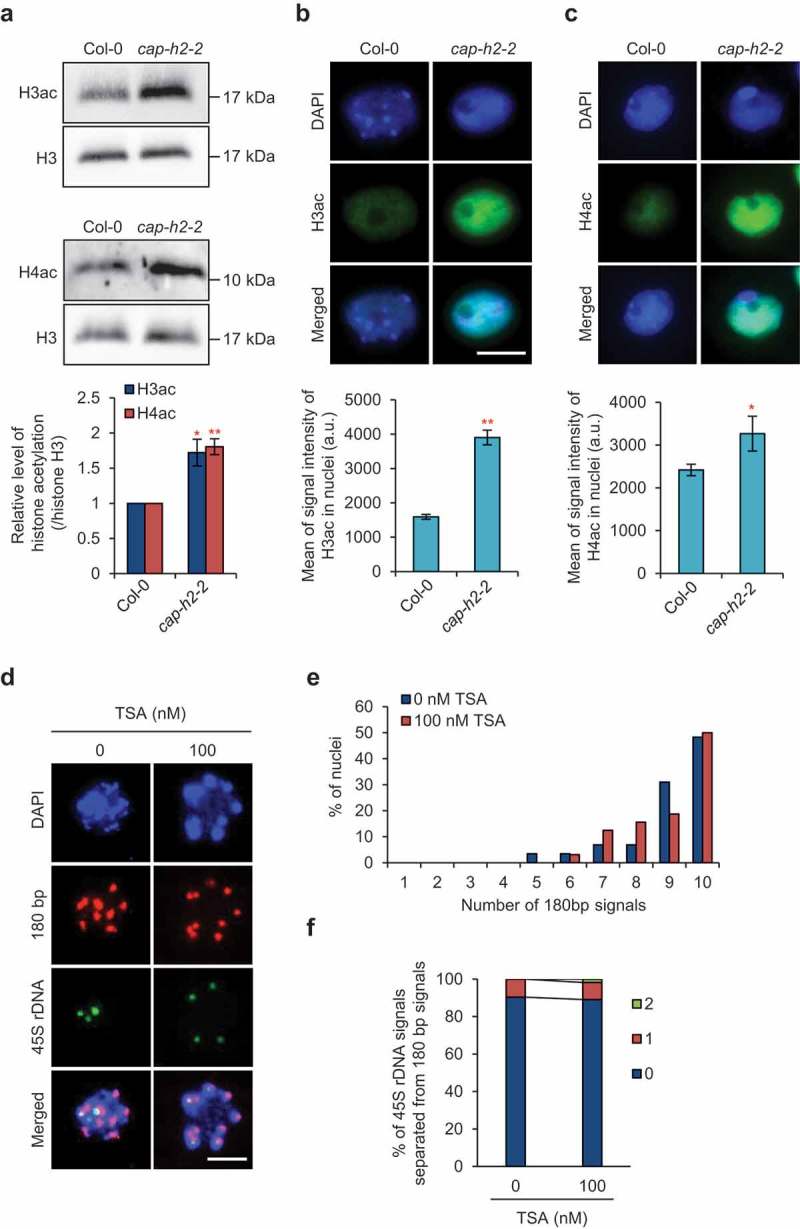
Defects in condensin II cause histone hyperacetylation, but this is unlikely to cause disruption of chromatin associations. (a) Immunoblotting of acetylated histone H3 and H4 in nuclei from 7-day-old seedlings of Col-0 and cap-h2-2. The graph shows the acetylated histone levels normalized by histone H3 levels. Error bars indicate SE. The level in cap-h2-2 was statistically compared with that in Col-0 by Student’s t-test (*, p < 0.05, **, p < 0.01, n = 3). (b,c) Immunostaining of acetylated histone H3 (b) and H4 (c) in nuclei from flower buds of Col-0 and cap-h2-2. Representative images of immunostained nuclei are shown. Bar = 5 μm. Each graph shows the acetylated histone levels represented by the mean intensity of immunofluorescence. Error bars indicate SE. The level in cap-h2-2 was statistically compared with that in Col-0 by Student’s t-test (*, p < 0.05, **, p < 0.01, n = 53 and 68 for H3ac, n = 41 and 65 for H4ac). (d) Representative images of simultaneous FISH detection of pericentromeric 180 bp signals and 45S rDNA signals in nuclei from 0 and 100 nM TSA-treated flower buds. Bar = 5 μm. (e) Number of 180 bp signals in nuclei from 0 and 100 nM TSA-treated flower buds. No significant differences in the frequency distribution of the number of 180 bp signals were detected in 100 nM TSA-treated plants compared with each control by chi-squared test (n = 29 for 0 nM TSA, n = 32 for 100 nM TSA). (f) Number of 45S rDNA signals separated from 180 bp signals in nuclei from 0 and 100 nM TSA-treated flower buds. No significant differences in the frequency distribution of the number of separated 45S rDNA signals were detected in 100 nM TSA-treated plants compared with each control by chi-squared test (n = 46).

References

    1. Jeppsson K, Kanno T, Shirahige K, et al. The maintenance of chromosome structure: positioning and functioning of SMC complexes. Nat Rev Mol Cell Biol. 2014;15:601–614. - PubMed
    1. Uhlmann F. SMC complexes: from DNA to chromosomes. Nat Rev Mol Cell Biol. 2016;17:399–412. - PubMed
    1. Hirano T. Condensins: organizing and segregating the genome. Curr Biol. 2005;15:R265–275. - PubMed
    1. Hirano T. Chromosome territories meet a condensin. PLoS Genet. 2012;8:e1002939. - PMC - PubMed
    1. Hirano T. Condensin-based chromosome organization from bacteria to vertebrates. Cell. 2016;164:847–857. - PubMed

Publication types

MeSH terms