


Does blended problem-based learning make Asian medical students active learners?: a prospective comparative study
- PMID: 31092243
- PMCID: PMC6521359
- DOI: 10.1186/s12909-019-1575-1
Does blended problem-based learning make Asian medical students active learners?: a prospective comparative study
Abstract
Background: Asian educators have struggled to implement problem-based learning (PBL) because students rarely discuss their work actively and are not sufficiently engaged in self-directed learning. Supplementing PBL with additional e-learning, i.e. 'blended' PBL (bPBL), could stimulate students' learning process.
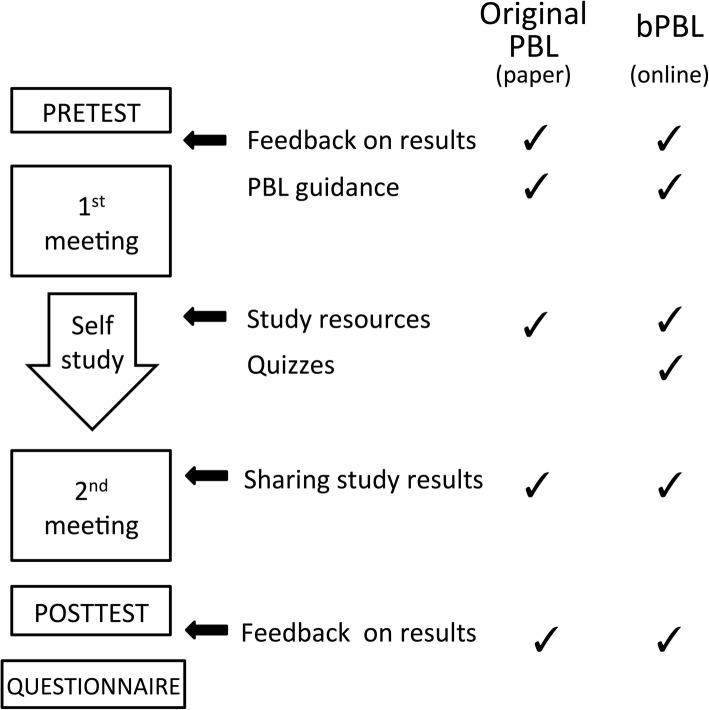
Methods: We investigated the effects of bPBL on tutorial group functioning (discussion, self-efficacy, self-directed learning, active participation, and tutor's perceived authority) and students' level of acceptance of the e-learning elements. We compared PBL and bPBL in a medical university in Japan. In the bPBL condition, the tutor's instructions were replaced with online materials and short quizzes. After the course, a 13-item questionnaire using a 5-point Likert scale was distributed regarding the tutorial group functioning of the tutorial group (influence of discussion, self-efficacy, self-directed learning, active participation, and tutors' authority). The mean scores of subscales were compared with analysis of covariance. Knowledge levels were measured using a pre-test post-test design. A multiple regression analysis was performed to explore the association between e-learning acceptance and the subscales related to PBL.
Results: Ninety-six students participated in the study (PBL: n = 24, bPBL: n = 72). Self-efficacy and motivation for learning triggered by group discussions was significantly higher for students in bPBL (p = 0.032 and 0.007, respectively). Knowledge gain in test scores was also significantly better in the bPBL condition (p = 0.026), and self-directed learning related positively to the acceptance of blended learning (p = 0.044).
Conclusions: bPBL seemed more effective in promoting active learning and improving knowledge, without affecting tutors' authority. Implementing e-learning into PBL is suggested to be an effective strategy in the Asian context.
Keywords: Blended learning; Health professions education; Problem-based learning; Quiz; Self-directed learning.
Conflict of interest statement
Authors’ information
Ikuo Shimizu is an assistant professor at Center for Medical Education and Clinical Training, Shinshu University, Japan, and a PhD candidate at School of Health Professions Education, Maastricht University, the Netherlands. His research interest is collaborative learning in the Asian context. He holds Master of Health Professions Education at Maastricht University, the Netherlands.
Hideyuki Nakazawa is a lecturer at Department of Internal Medicine II, Shinshu University, Japan. His research interest in education is workplace learning at the clinical setting.
Yoshihiko Sato is an associate professor at Department of Internal Medicine IV, Shinshu University, Japan. His research interest in education is lecture strategies and clinical teaching.
Ineke Wolfhagen is an associate professor at Department of Educational Development and Research, Maastricht University, the Netherlands. She has expertise in management, consultancies and workshops on quality assurance and problem-based learning.
Karen D. Könings is an associate professor at Department of Educational Development and Research, Maastricht University, the Netherlands. Her main research interest is participatory design of education, to better account for the different perspectives of students, teachers, and educational designers.
Ethics approval and consent to participate
This study was approved by the Institutional Review Board of Shinshu University (#3247).
Consent for publication
Not applicable.
Competing interests
The authors declare that they have no competing interests.
Publisher’s Note
Springer Nature remains neutral with regard to jurisdictional claims in published maps and institutional affiliations.
Figures
References
-
- Örtenblad A, Babur M, Kumari R. Learning in Asia. Asia Pacific J Educ. 2012;32(2):131–136.
-
- Barrows HS, Tamblyn R. Problem-based learning: an approach to medical education. New York: Springer; 1980.
-
- Barrows HS. A taxonomy of problem-based learning methods. Med Educ. 1986;20(6):481–486. - PubMed
-
- Albanese M, Mitchell SM. Problem-based learning: A Review of Literature on Its Outcomes and Implementation Issues. Acad Med. 1993;68(1):52–81. - PubMed
-
- Vernon DT, Blake RL. Does problem-based learning work? A meta-analysis of evaluative research. Acad Med. 1993;68(7):550–563. - PubMed
Publication types
MeSH terms
Grants and funding
LinkOut - more resources
Full Text Sources
