Review
. 2019 Jul 3;63(2):237-266.
doi: 10.1042/EBC20180042. Print 2019 Jul 3.

Using genetically incorporated unnatural amino acids to control protein functions in mammalian cells

Affiliations
Review

Using genetically incorporated unnatural amino acids to control protein functions in mammalian cells

Alexander R Nödling et al. Essays Biochem. .

Abstract

Genetic code expansion allows unnatural (non-canonical) amino acid incorporation into proteins of interest by repurposing the cellular translation machinery. The development of this technique has enabled site-specific incorporation of many structurally and chemically diverse amino acids, facilitating a plethora of applications, including protein imaging, engineering, mechanistic and structural investigations, and functional regulation. Particularly, genetic code expansion provides great tools to study mammalian proteins, of which dysregulations often have important implications in health. In recent years, a series of methods has been developed to modulate protein function through genetically incorporated unnatural amino acids. In this review, we will first discuss the basic concept of genetic code expansion and give an up-to-date list of amino acids that can be incorporated into proteins in mammalian cells. We then focus on the use of unnatural amino acids to activate, inhibit, or reversibly modulate protein function by translational, optical or chemical control. The features of each approach will also be highlighted.

Keywords: chemical biology; genetic code expansion; protein chemistry; protein engineering; unnatural amino acid.


Conflict of interest statement

The authors declare that there are no competing interests associated with the manuscript.

Figures
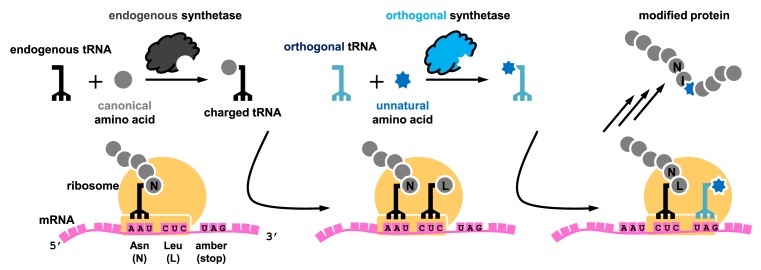
Figure 1
Figure 1. Mechanism of genetic code expansion for site-specific incorporation of an unnatural amino acid by amber suppression
Figure 2
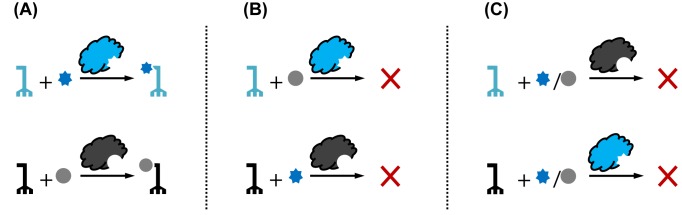
Figure 2. Allowed and not allowed reactivities between the orthogonal and endogenous aaRS/tRNA pairs
(A) Matching amino acid and aaRS/tRNA pairs; (B) mismatched amino acids; (C) mismatched aaRS/tRNA pairs.
Figure 3
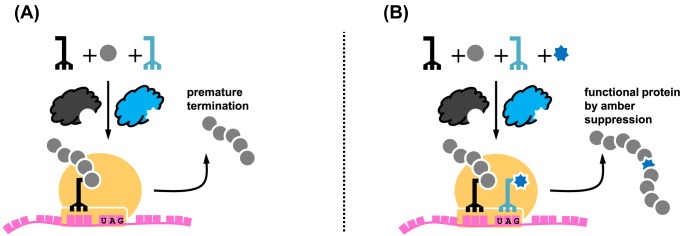
Figure 3. Use of amber suppression to switch on protein production
(A) Absence of the unnatural amino acid leads to recognition of the UAG codon for translation termination. (B) Addition of the unnatural amino acid leads to amber suppression and successful production of the full-length and functional protein.
Figure 4
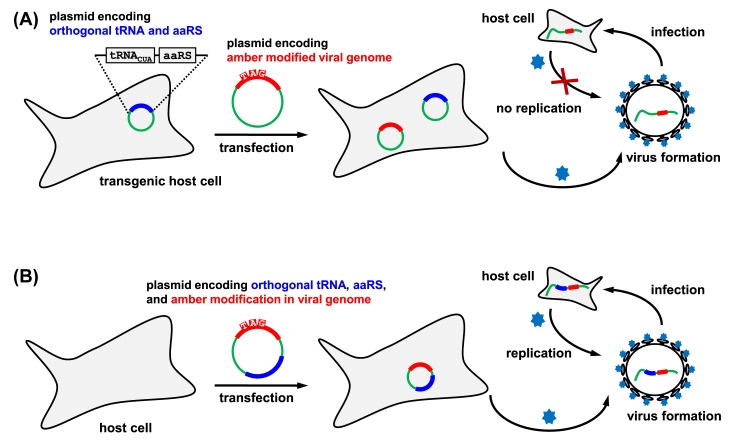
Figure 4. Translational activation approaches to control virus replication
(A) Use of genetic code expansion to control replication of an amber codon tagged virus within transgenic host cells containing the orthogonal tRNA/synthetase pairs [43,48]. (B) Use of genetic code expansion to control replication of an amber codon tagged virus within normal host cells with the orthogonal tRNA/synthetase pair gene encoded by the viral genome [49].
Figure 5
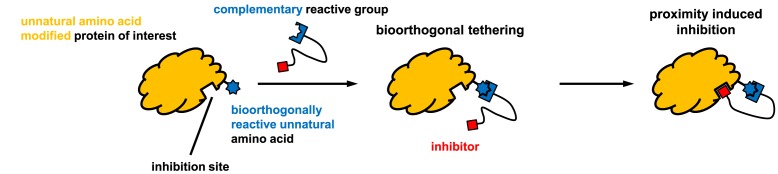
Figure 5. Example of the small-molecule approach to protein inhibition
Use of unnatural amino acid incorporation for selective inhibition of protein function by bioorthogonal tethering [64].

References

    1. McDonnell D.P., Wardell S.E. and Norris J.D. (2015) Oral selective estrogen receptor downregulators (SERDs), a breakthrough endocrine therapy for breast cancer. J. Med. Chem. 58, 4883–4887 10.1021/acs.jmedchem.5b00760 - DOI - PMC - PubMed
    1. Petta I., Lievens S., Libert C., Tavernier J. and De Bosscher K. (2016) Modulation of protein-protein interactions for the development of novel therapeutics. Mol. Ther. 24, 707–718 10.1038/mt.2015.214 - DOI - PMC - PubMed
    1. van Montfort R.L.M. and Workman P. (2017) Structure-based drug design: aiming for a perfect fit. Essays Biochem 61, 431–437 10.1042/EBC20170052 - DOI - PMC - PubMed
    1. Wan W., Tharp J.M. and Liu W.R. (2014) Pyrrolysyl-tRNA synthetase: an ordinary enzyme but an outstanding genetic code expansion tool. Biochim. Biophys. Acta 1844, 1059–1070 10.1016/j.bbapap.2014.03.002 - DOI - PMC - PubMed
    1. Dumas A., Lercher L., Spicer C.D. and Davis B.G. (2015) Designing logical codon reassignment - Expanding the chemistry in biology. Chem. Sci. 6, 50–69 10.1039/C4SC01534G - DOI - PMC - PubMed

Publication types