Review
. 2019 Jun;120(12):1090-1098.
doi: 10.1038/s41416-019-0451-4. Epub 2019 May 16.

Lipid metabolism in cancer cells under metabolic stress

Affiliations
Review

Lipid metabolism in cancer cells under metabolic stress

Rimsha Munir et al. Br J Cancer. 2019 Jun.

Abstract

Cancer cells are often exposed to a metabolically challenging environment with scarce availability of oxygen and nutrients. This metabolic stress leads to changes in the balance between the endogenous synthesis and exogenous uptake of fatty acids, which are needed by cells for membrane biogenesis, energy production and protein modification. Alterations in lipid metabolism and, consequently, lipid composition have important therapeutic implications, as they affect the survival, membrane dynamics and therapy response of cancer cells. In this article, we provide an overview of recent insights into the regulation of lipid metabolism in cancer cells under metabolic stress and discuss how this metabolic adaptation helps cancer cells thrive in a harsh tumour microenvironment.


Conflict of interest statement

The authors declare no competing interests.

Figures
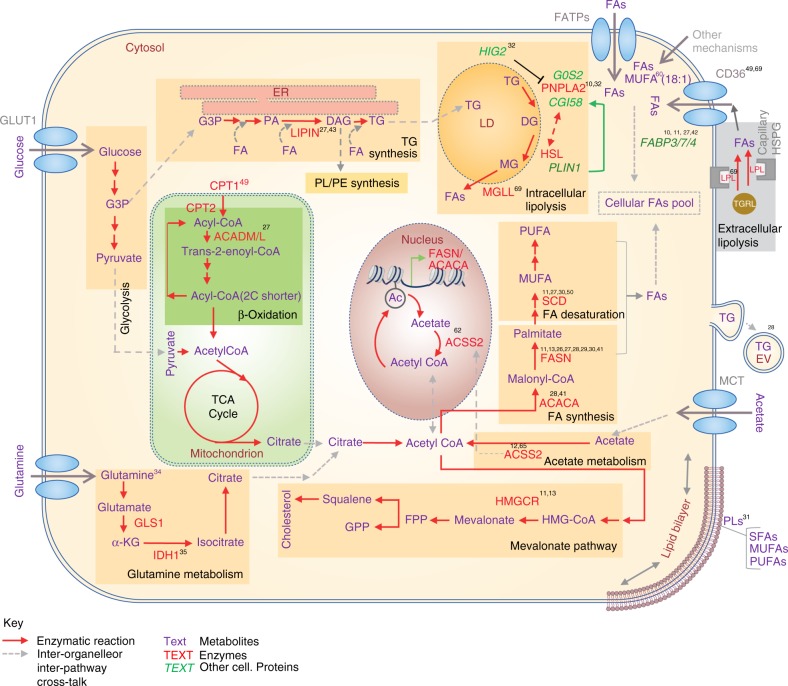
Fig. 1
Fig. 1
Overview of the major lipid metabolism pathways shown to be affected by metabolic stress. The figure highlights all the key lipid metabolism pathways activated in cancer cells. Major pathways are shown as boxes without outlines. The systematic names of these pathways are given at the bottom-right corner of each box. The numbers shown superscripted to each protein/metabolite indicate the reference number. For further details see the text and Supplementary Table 1. ACACA acetyl-CoA carboxylase 1, ACACB acetyl-CoA carboxylase 2, ACSS2 acyl Co-A synthetase-2, ADFP adipose differentiation protein, ATGL adipose triglyceride lipase, FA fatty acids, FABP3 fatty acid binding protein 3, FABP7 fatty acid binding protein 7, FFA free fatty acids, FASN fatty acid synthase, H hypoxia, HIF-1α hypoxia-inducible factor 1-α, HIF-2α hypoxia-inducible factor 2α, HIG2 hypoxia-inducible gene 2 protein, HMGCR 3-hydroxy-3-methylglutaryl-CoA reductase, LD lipid droplet, LCAD long-chain specific acyl-CoA dehydrogenase, MAG monoacylglycerol, MCAD medium-chain acyl-CoA dehydrogenase, MUFA monounsaturated fatty acids, PBMCs peripheral blood mononuclear cells, PC phosphatidylcholines, PE phosphatidylethanolamines, Pcho propargyl-choline, PI phosphatidylinositol, PS phosphatidylserine, PUFA polyunsaturated fatty acids, SCD stearoyl-CoA desaturase, SFA saturated fatty acids, SREBP sterol regulatory element-binding proteins, TG triglycerides
Fig. 2
Fig. 2
Effect of oxygen deprivation and/or nutrient deprivation on fatty acid (FA) metabolism in cancer cells. a Cancer cells with a sufficient supply of nutrients and oxygen mainly use glucose-derived acetyl-CoA for de novo FA synthesis to support rapid cell proliferation. They can also acquire FAs from the environment. b Different types of hypoxic cancer cells differentially regulate FA synthesis depending on various environmental factors—particularly, nutrient availability. Hypoxia inhibits the entry of glucose-derived pyruvate into the TCA cycle. Hence, cells either switch to alternative carbon sources (i.e. glutamine or acetate) for FA synthesis or increase their FA uptake. FA desaturation is impaired by oxygen deprivation; therefore, the uptake of unsaturated FAs is particularly enhanced. FAs are rapidly incorporated into cellular triglycerides (TGs) that enhance TG and lipid droplet (LD) accumulation. c Under nutrient and lipid restriction cancer cells mainly rely on endogenous FAs and desaturation. d When hypoxia is induced in combination with nutrient and lipid deprivation, cells cannot acquire FAs from the environment. Hence, they switch back to de novo FA synthesis, but fully depend on glutamine or acetate as an alternative substrate. Parts (b), (c) and (d) are drawn in comparison to the normoxic state depicted in (a). The line thickness represents the level of flux through the pathway. Dashed lines indicate biosynthetic pathways that are inactive due to lack of substrates or cofactors. The colours of the pathway boxes in (b), (c) and (d) represent upregulation (green), downregulation (grey) or differential regulation (green/grey) of the corresponding pathway in comparison to the normoxic state (with sufficient nutrient supply) in (a)

References

    1. Beloribi-Djefaflia S, Vasseur S, Guillaumond F. Lipid metabolic reprogramming in cancer cells. Oncogenesis. 2016;5:e189. doi: 10.1038/oncsis.2015.49. - DOI - PMC - PubMed
    1. Mullen PJ, Yu R, Longo J, Archer MC, Penn LZ. The interplay between cell signalling and the mevalonate pathway in cancer. Nat. Rev. Cancer. 2016;16:718. doi: 10.1038/nrc.2016.76. - DOI - PubMed
    1. Röhrig F, Schulze A. The multifaceted roles of fatty acid synthesis in cancer. Nat. Rev. Cancer. 2016;16:732. doi: 10.1038/nrc.2016.89. - DOI - PubMed
    1. Menendez JA, Lupu R. Fatty acid synthase and the lipogenic phenotype in cancer pathogenesis. Nat. Rev. Cancer. 2007;7:763. doi: 10.1038/nrc2222. - DOI - PubMed
    1. Brusselmans K, Timmermans L, Van de Sande T, Van Veldhoven PP, Guan G, Shechter I, et al. Squalene synthase, a determinant of Raft-associated cholesterol and modulator of cancer cell proliferation. J. Biol. Chem. 2007;282:18777–18785. doi: 10.1074/jbc.M611763200. - DOI - PubMed

Publication types
