


Research Community Collaboration in Observational Implementation Research: Complementary Motivations and Concerns in Engaging in the Study of Implementation as Usual
- PMID: 31093824
- PMCID: PMC7055481
- DOI: 10.1007/s10488-019-00939-w
Research Community Collaboration in Observational Implementation Research: Complementary Motivations and Concerns in Engaging in the Study of Implementation as Usual
Abstract
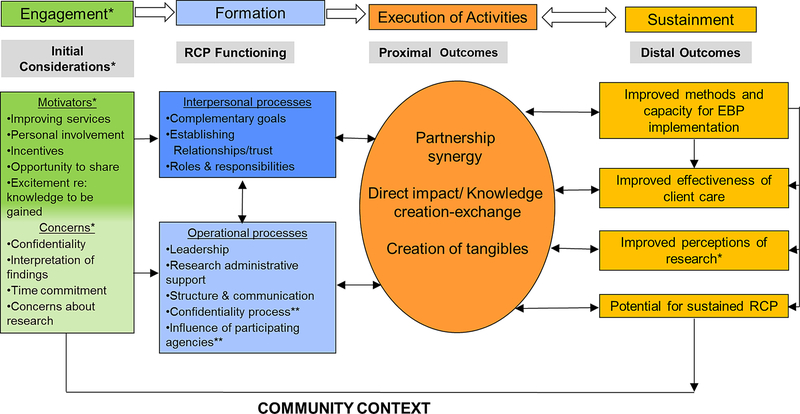
Implementation research is dominated by studies of investigator-driven implementation of evidence-based practices (EBPs) in community settings. However, systems of care have increasingly driven the scale-up of EBPs through policy and fiscal interventions. Research community partnerships (RCPs) are essential to generating knowledge from these efforts. Interviews were conducted with community stakeholders (system leaders, program managers, therapists) involved in a study of a system-driven implementation of multiple EBPs in children's mental health services. Findings suggest novel considerations in initial engagement phases of an RCP, given the unique set of potentially competing and complementary interests of different stakeholder groups in implementation as usual.
Keywords: Children’s mental health services; Evidence-based practice; Implementation as usual; Research community partnerships.
Figures
References
-
- Brookman-Frazee L, Stadnick N, Roesch S, Regan J, Barnett M, Bando L,… Lau A (2016). Measuring sustainment of multiple practices fiscally mandated in children’s mental health services. Administration and Policy in Mental Health and Mental Health Services Research, 43(6), 1009–1022. 10.1007/s10488-016-0731-8 - DOI - PMC - PubMed
-
- Brookman-Frazee L, Stahmer A, Stadnick N, Chlebowski C, Herschell A, & Garland AF (2016b). Characterizing the use of research-community partnerships in studies of evidence-based interventions in children’s community services. Administration and Policy in Mental Health and Mental Health Services Research, 43(1), 93–104. 10.1007/s10488-014-0622-9. - DOI - PMC - PubMed
MeSH terms
Grants and funding
LinkOut - more resources
Full Text Sources
Medical
