


Radiogenomics Consortium Genome-Wide Association Study Meta-Analysis of Late Toxicity After Prostate Cancer Radiotherapy
- PMID: 31095341
- PMCID: PMC7019089
- DOI: 10.1093/jnci/djz075
Radiogenomics Consortium Genome-Wide Association Study Meta-Analysis of Late Toxicity After Prostate Cancer Radiotherapy
Erratum in
-
Erratum.J Natl Cancer Inst. 2020 Jun 1;112(6):654. doi: 10.1093/jnci/djz237. J Natl Cancer Inst. 2020. PMID: 31886862 Free PMC article. No abstract available.
Abstract
Background: A total of 10%-20% of patients develop long-term toxicity following radiotherapy for prostate cancer. Identification of common genetic variants associated with susceptibility to radiotoxicity might improve risk prediction and inform functional mechanistic studies.
Methods: We conducted an individual patient data meta-analysis of six genome-wide association studies (n = 3871) in men of European ancestry who underwent radiotherapy for prostate cancer. Radiotoxicities (increased urinary frequency, decreased urinary stream, hematuria, rectal bleeding) were graded prospectively. We used grouped relative risk models to test associations with approximately 6 million genotyped or imputed variants (time to first grade 2 or higher toxicity event). Variants with two-sided Pmeta less than 5 × 10⁻⁸ were considered statistically significant. Bayesian false discovery probability provided an additional measure of confidence. Statistically significant variants were evaluated in three Japanese cohorts (n = 962). All statistical tests were two-sided.
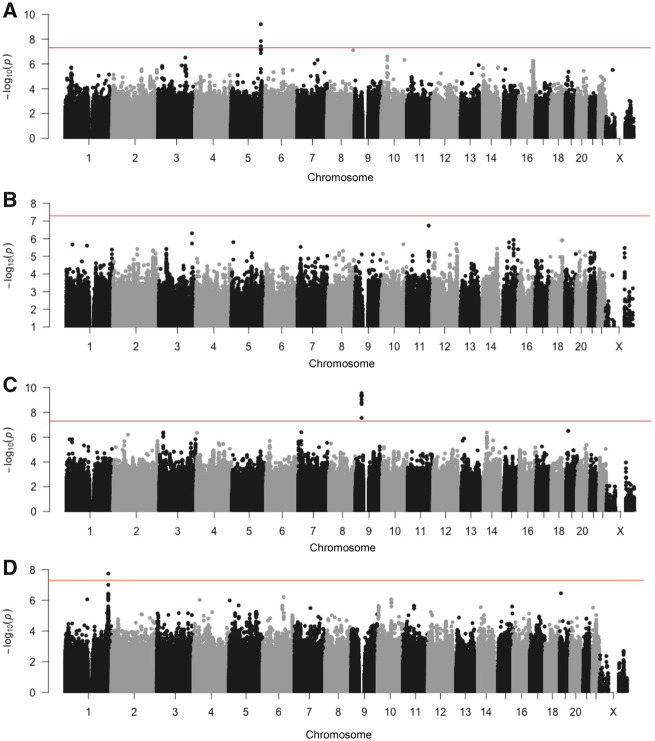
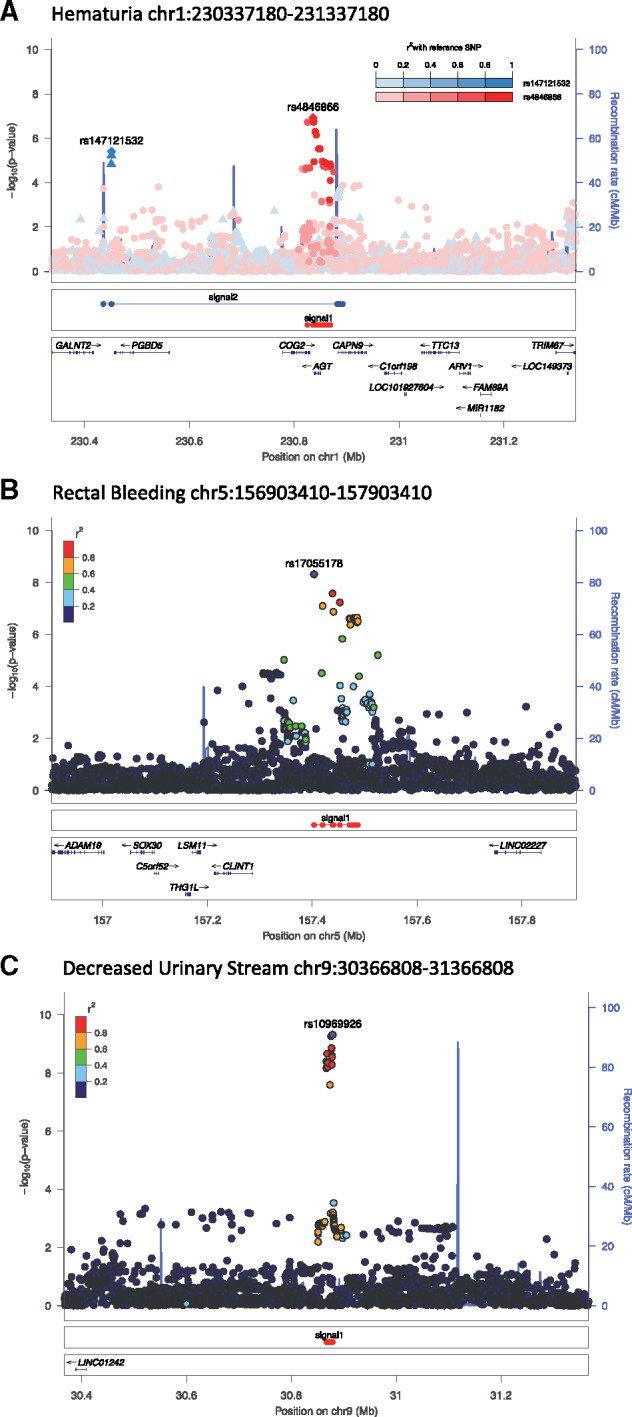
Results: Meta-analysis of the European ancestry cohorts identified three genomic signals: single nucleotide polymorphism rs17055178 with rectal bleeding (Pmeta = 6.2 × 10⁻¹⁰), rs10969913 with decreased urinary stream (Pmeta = 2.9 × 10⁻¹⁰), and rs11122573 with hematuria (Pmeta = 1.8 × 10⁻⁸). Fine-scale mapping of these three regions was used to identify another independent signal (rs147121532) associated with hematuria (Pconditional = 4.7 × 10⁻⁶). Credible causal variants at these four signals lie in gene-regulatory regions, some modulating expression of nearby genes. Previously identified variants showed consistent associations (rs17599026 with increased urinary frequency, rs7720298 with decreased urinary stream, rs1801516 with overall toxicity) in new cohorts. rs10969913 and rs17599026 had similar effects in the photon-treated Japanese cohorts.
Conclusions: This study increases the understanding of the architecture of common genetic variants affecting radiotoxicity, points to novel radio-pathogenic mechanisms, and develops risk models for testing in clinical studies. Further multinational radiogenomics studies in larger cohorts are worthwhile.
© The Author(s) 2019. Published by Oxford University Press.
Figures
References
-
- Sanda MG, Dunn RL, Michalski J, et al.. Quality of life and satisfaction with outcome among prostate-cancer survivors. N Engl J Med. 2008;358(12):1250–1261. - PubMed
-
- Wu X, Spitz MR, Amos CI, et al.. Mutagen sensitivity has high heritability: evidence from a twin study. Cancer Res. 2006;66(12):5993–5996. - PubMed
-
- Safwat A, Bentzen SM, Turesson I, et al.. Deterministic rather than stochastic factors explain most of the variation in the expression of skin telangiectasia after radiotherapy. Int J Radiat Oncol Biol Phys. 2002;52(1):198–204. - PubMed
-
- Barnett GC, Thompson D, Fachal L, et al.. A genome wide association study (GWAS) providing evidence of an association between common genetic variants and late radiotherapy toxicity. Radiother Oncol. 2014;111(2):178–185. - PubMed
Publication types
Grants and funding
- K07 CA187546/CA/NCI NIH HHS/United States
- 18504/CRUK_/Cancer Research UK/United Kingdom
- MC_UU_12023/28/MRC_/Medical Research Council/United Kingdom
- C5047/A7357/CRUK_/Cancer Research UK/United Kingdom
- C1094/A18504/CRUK_/Cancer Research UK/United Kingdom
- 16565/CRUK_/Cancer Research UK/United Kingdom
- C5047/A10692/CRUK_/Cancer Research UK/United Kingdom
- C147/A25254/CRUK_/Cancer Research UK/United Kingdom
- R01 GM114434/GM/NIGMS NIH HHS/United States
- 12518/CRUK_/Cancer Research UK/United Kingdom
- C1287/A10118/CRUK_/Cancer Research UK/United Kingdom
- 7253/CRUK_/Cancer Research UK/United Kingdom
- 28284/CRUK_/Cancer Research UK/United Kingdom
- C16913/A6135/CRUK_/Cancer Research UK/United Kingdom
- C1287/A16563/CRUK_/Cancer Research UK/United Kingdom
- U01 CA188392/CA/NCI NIH HHS/United States
- C5047/A3354/CRUK_/Cancer Research UK/United Kingdom
- S10 OD018522/OD/NIH HHS/United States
- S10 OD026880/OD/NIH HHS/United States
- HHSN261201500043C/CA/NCI NIH HHS/United States
- U19 CA148537/CA/NCI NIH HHS/United States
- C8197/A16565/CRUK_/Cancer Research UK/United Kingdom
- HHSN268201200008I/HL/NHLBI NIH HHS/United States
LinkOut - more resources
Full Text Sources
Other Literature Sources
