. 2019 May 16;14(5):e0216475.
doi: 10.1371/journal.pone.0216475. eCollection 2019.

Computational identification of tissue-specific transcription factor cooperation in ten cattle tissues

Affiliations

Computational identification of tissue-specific transcription factor cooperation in ten cattle tissues

Lukas Steuernagel et al. PLoS One. .

Abstract

Transcription factors (TFs) are a special class of DNA-binding proteins that orchestrate gene transcription by recruiting other TFs, co-activators or co-repressors. Their combinatorial interplay in higher organisms maintains homeostasis and governs cell identity by finely controlling and regulating tissue-specific gene expression. Despite the rich literature on the importance of cooperative TFs for deciphering the mechanisms of individual regulatory programs that control tissue specificity in several organisms such as human, mouse, or Drosophila melanogaster, to date, there is still need for a comprehensive study to detect specific TF cooperations in regulatory processes of cattle tissues. To address the needs of knowledge about specific combinatorial gene regulation in cattle tissues, we made use of three publicly available RNA-seq datasets and obtained tissue-specific gene (TSG) sets for ten tissues (heart, lung, liver, kidney, duodenum, muscle tissue, adipose tissue, colon, spleen and testis). By analyzing these TSG-sets, tissue-specific TF cooperations of each tissue have been identified. The results reveal that similar to the combinatorial regulatory events of model organisms, TFs change their partners depending on their biological functions in different tissues. Particularly with regard to preferential partner choice of the transcription factors STAT3 and NR2C2, this phenomenon has been highlighted with their five different specific cooperation partners in multiple tissues. The information about cooperative TFs could be promising: i) to understand the molecular mechanisms of regulating processes; and ii) to extend the existing knowledge on the importance of single TFs in cattle tissues.


Conflict of interest statement

The authors have declared that no competing interests exist.

Figures
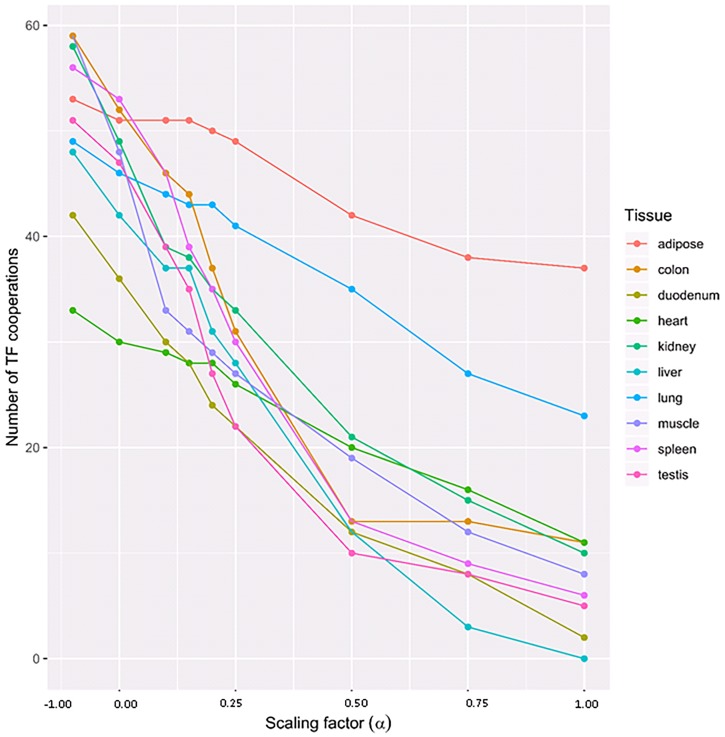
Fig 1
Fig 1. Number of tissue-specific TF cooperations identified by the PC-TraFF+ algorithm with different α-values.
The subtracted background grows with α, thus reducing the number of specific cooperations.
Fig 2
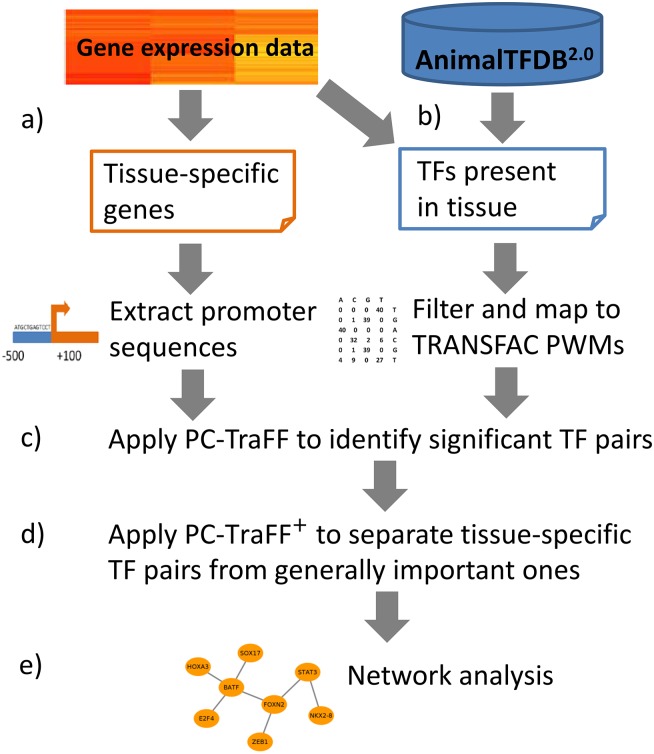
Fig 2. Flowchart of analysis procedures.
(a) Identification of tissue-specific genes from RNA-seq data and extraction of promoter region of genes. (b) Identification of TFs expressed for each tissue in RNA-seq data. (c) Application of PC-TraFF [1]. (d) Application of PC-TraFF+ [26]. (e) Reconstruction of tissue-specific TF-TF cooperation networks.
Fig 3
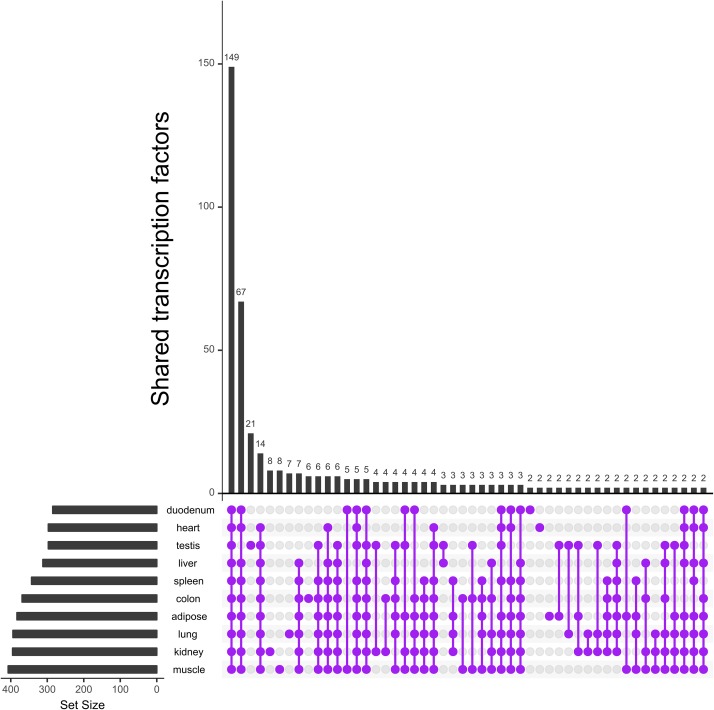
Fig 3. Occurrence of TFs present in the tissues.
Number of TFs with an expression value ≥ τ and their overlap between ten tissues represented in matrix layouts using the UpSet technique [35]. Purple circles in the matrix layout are related to the tissues that are part of the intersection. For the sake of clarity not all intersections are displayed.
Fig 4
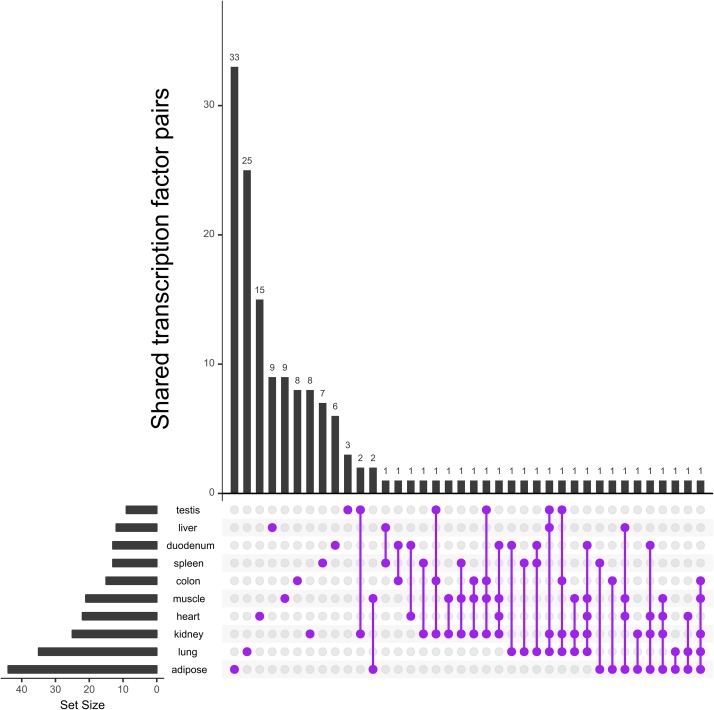
Fig 4. Occurrence of TSG-set-specific TF cooperations identified by PC-TraFF+ approach in ten tissues.
Number of TF cooperations and their overlap between tissues represented in matrix layouts using the UpSet technique [35]. Lines with purple circles in the matrix layout show the tissues with overlapping TF cooperations. For the sake of clarity not all intersections are displayed.
Fig 5
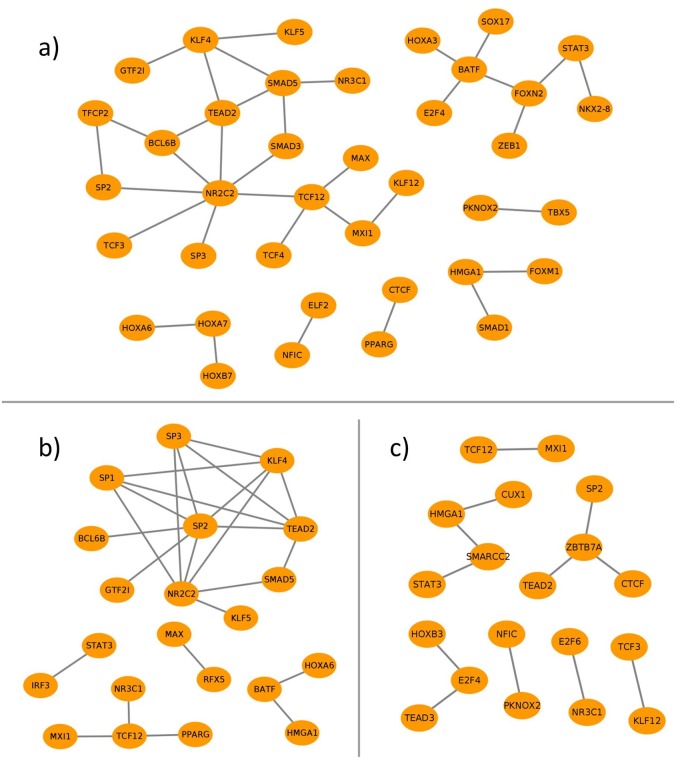
Fig 5. Cooperation networks for the TSG-set-specific TF pairs of (a) lung-, (b) kidney- and (c) liver-tissue.

References

    1. Meckbach C, Tacke R, Hua X, Waack S, Wingender E, Gültas M. PC-TraFF: identification of potentially collaborating transcription factors using pointwise mutual information. BMC Bioinformatics. 2015;16(400). 10.1186/s12859-015-0827-2 - DOI - PMC - PubMed
    1. MacNeil LT, Pons C, Arda HE, Giese GE, Myers CL, Walhout AJ. Transcription factor activity mapping of a tissue-specific in vivo gene regulatory network. Cell systems. 2015;1(2):152–162. 10.1016/j.cels.2015.08.003 - DOI - PMC - PubMed
    1. de Souza N. Transcription factor interaction maps. Nature methods. 2010;7(5):344 10.1038/nmeth0510-344b - DOI - PubMed
    1. Whitfield TW, Wang J, Collins PJ, Partridge EC, Aldred SF, Trinklein ND, et al. Functional analysis of transcription factor binding sites in human promoters. Genome Biology. 2012. September;13(9):R50 Available from: 10.1186/gb-2012-13-9-r50 - DOI - PMC - PubMed
    1. Sonawane AR, Platig J, Fagny M, Chen CY, Paulson JN, Lopes-Ramos CM, et al. Understanding tissue-specific gene regulation. Cell reports. 2017;21(4):1077–1088. 10.1016/j.celrep.2017.10.001 - DOI - PMC - PubMed

Publication types