


Randomized clinical trial of endovenous laser ablation versus direct and indirect radiofrequency ablation for the treatment of great saphenous varicose veins
- PMID: 31095724
- PMCID: PMC6618092
- DOI: 10.1002/bjs.11187
Randomized clinical trial of endovenous laser ablation versus direct and indirect radiofrequency ablation for the treatment of great saphenous varicose veins
Abstract
Background: The current treatment strategy for many patients with varicose veins is endovenous thermal ablation. The most common forms of this are endovenous laser ablation (EVLA) and radiofrequency ablation (RFA). However, at present there is no clear consensus on which of these treatments is superior. The objective of this study was to compare EVLA with two forms of RFA: direct RFA (dRFA; radiofrequency-induced thermotherapy) and indirect RFA (iRFA; VNUS ClosureFast™).
Methods: Patients with symptomatic great saphenous vein (GSV) incompetence were randomized to receive EVLA, dRFA or iRFA. Patients were followed up at 2 weeks, 6 and 12 months. The primary outcome was GSV occlusion rate. Secondary outcomes included Venous Clinical Severity Score (VCSS), Aberdeen Varicose Vein Questionnaire (AVVQ) score and adverse events.
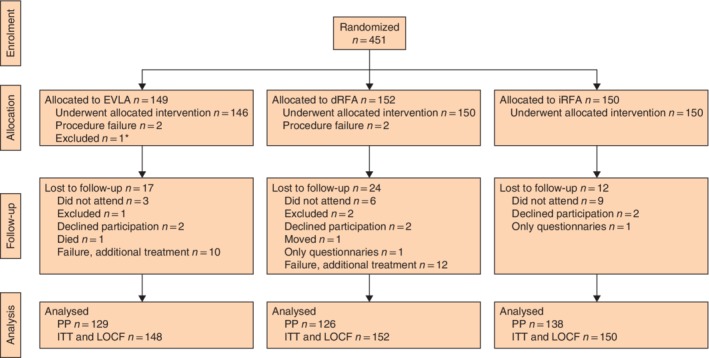
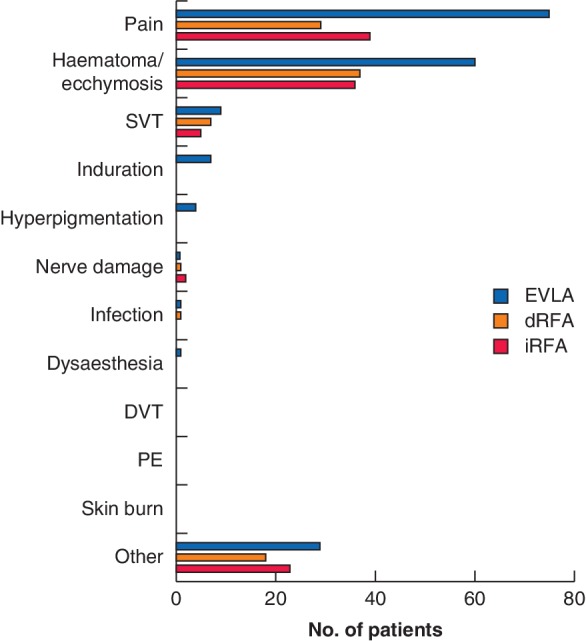
Results: Some 450 patients received the allocated treatment (EVLA, 148; dRFA, 152; iRFA, 150). The intention-to-treat analysis showed occlusion rates of 75·0 (95 per cent c.i. 68·0 to 82·0), 59·9 (52·1 to 67·7) and 81·3 (75·1 to 87·6) per cent respectively after 1 year (P = 0·007 for EVLA versus dRFA, P < 0·001 for dRFA versus iRFA, P = 0·208 for EVLA versus iRFA). VCSS improved significantly for all treatments with no significant differences between them. AVVQ scores also improved significantly for all treatments, but iRFA had significantly better scores than dRFA at 12 months. Significantly more adverse events were reported after treatment with EVLA (103) than after dRFA (61) and iRFA (65), especially more pain.
Conclusion: Primary GSV occlusion rates were better after iRFA and EVLA than dRFA. All three interventions were effective in improving the clinical severity of varicose veins at 1 year.
© 2019 The Authors. BJS published by John Wiley & Sons Ltd on behalf of BJS Society Ltd.
Figures
References
-
- Rabe E, Berboth G, Pannier F. [Epidemiology of chronic venous diseases.] Wien Med Wochenschr 2016; 166: 260–263. - PubMed
-
- Rabe E, Guex JJ, Puskas A, Scuderi A, Fernandez Quesada F; VCP Coordinators . Epidemiology of chronic venous disorders in geographically diverse populations: results from the Vein Consult Program. Int Angiol 2012; 31: 105–115. - PubMed
-
- Nicolaides A, Kakkos S, Eklof B, Perrin M, Nelzen O, Neglen P et al Management of chronic venous disorders of the lower limbs – guidelines according to scientific evidence. Int Angiol 2014; 33: 87–208. - PubMed
-
- Wittens C, Davies AH, Bækgaard N, Broholm R, Cavezzi A, Chastanet S et al Editor's choice – management of chronic venous disease: Clinical Practice Guidelines of the European Society for Vascular Surgery (ESVS). Eur J Vasc Endovasc Surg 2015; 49: 678–737. - PubMed
Publication types
MeSH terms
LinkOut - more resources
Full Text Sources
Medical
