Nasal eosinophilia and eosinophil peroxidase in children and adolescents with rhinitis
- PMID: 31096743
- PMCID: PMC6753315
- DOI: 10.3345/kjp.2019.00318
Nasal eosinophilia and eosinophil peroxidase in children and adolescents with rhinitis
Abstract
Background: Researchers have shown that eosinophil peroxidase (EPO) is a relatively accurate marker of eosinophilia and eosinophil activity. However, its use as a marker of eosinophilic inflammation in nasal secretions is limited because the diagnostic cutoff values of EPO for use as a one-time test for allergic diseases such as allergic rhinitis have not been established.
Purpose: To identify the correlation between nasal eosinophil count and EPO in children and adolescents with rhinitis.
Methods: We recruited patients <18 years of age with rhinitis for more than 2 weeks or more than 2 episodes a year whose nasal eosinophil and EPO were measured at a single allergy clinic. The eosinophil percentage was calculated by dividing the eosinophil count by the number of total cells under light microscopy at ×1,000 magnification. EPO and protein were measured from nasal secretions. We retrospectively analyzed the correlation between nasal eosinophils and protein-corrected EPO (EPO/protein) value.
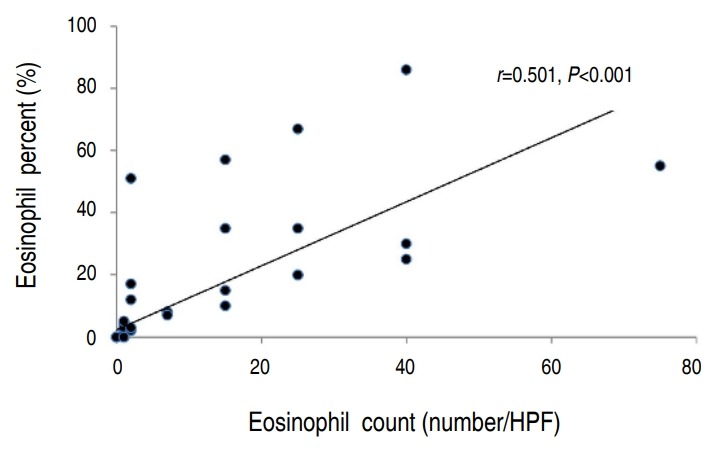
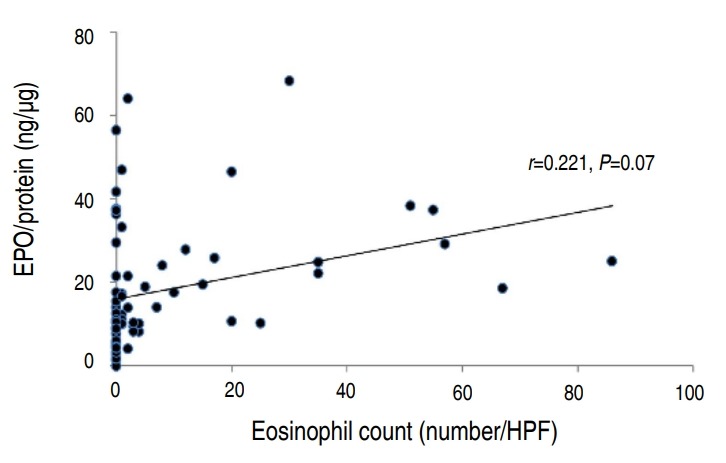
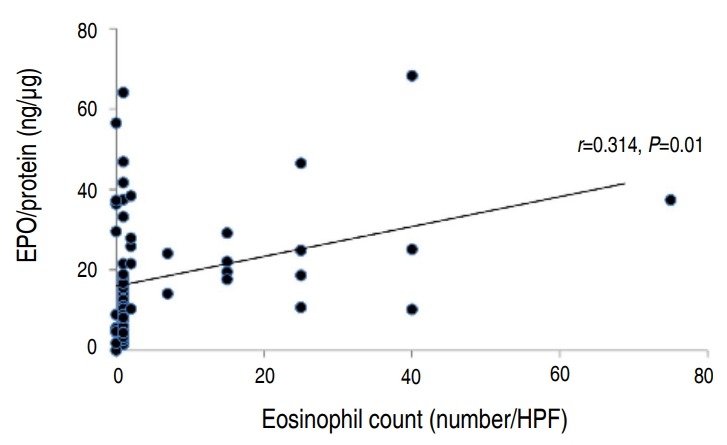
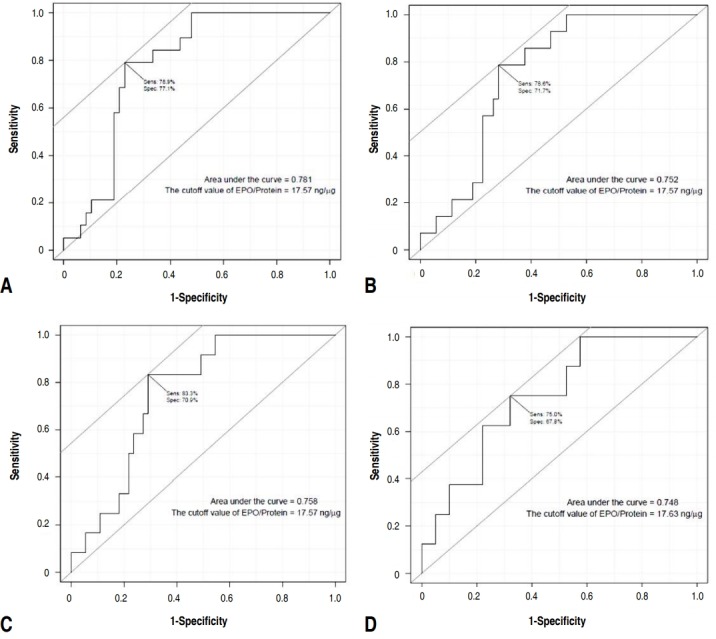
Results: Of the 67 patients enrolled, 41 were male (61.2%); the mean age was 8.2±4.0 years. The median nasal eosinophil count was 1 and percentage was 1%. The median protein-corrected EPO value was 12.5 ng/μg (range, 0-31 ng/μg). There was a statistically significant correlation between eosinophil count and percentage (P<0.001). However, the eosinophil percentage and EPO did not correlate. The eosinophil count and EPO had a statistically significant correlation (P =0.01). The EPO cutoff value examined for nasal eosinophil counts of 2, 5, 10, and 20 was 17.57 ng/μg regardless of the reference count. The largest area under the curve value was obtained when the receiver operating characteristic curve was drawn using the eosinophil count of 2.
Conclusion: Nasal eosinophil count was significantly associated with protein-corrected EPO.
Keywords: Child; Eosinophil; Eosinophil peroxidase; Rhinitis.
Conflict of interest statement
No potential conflict of interest relevant to this article was reported.
Figures
References
-
- Kariyawasam HH, Robinson DS. The eosinophil: the cell and its weapons, the cytokines, its locations. Semin Respir Crit Care Med. 2006;27:117–27. - PubMed
-
- Gleich GJ. Mechanisms of eosinophil-associated inflammation. J Allergy Clin Immunol. 2000;105:651–63. - PubMed
-
- Kay AB. Allergy and allergic diseases. First of two parts. N Engl J Med. 2001;344:30–7. - PubMed
-
- Ahmadiafshar A, Taghiloo D, Esmailzadeh A, Falakaflaki B. Nasal eosinophilia as a marker for allergic rhinitis: a controlled study of 50 patients. Ear Nose Throat J. 2012;91:122–4. - PubMed
-
- Lans DM, Alfano N, Rocklin R. Nasal eosinophilia in allergic and nonallergic rhinitis: usefulness of the nasal smear in the diagnosis of allergic rhinitis. Allergy Proc. 1989;10:275–80. - PubMed
Grants and funding
LinkOut - more resources
Full Text Sources
Research Materials