


Seroprevalence of Brucella canis antibodies in dogs entering a Minnesota humane society, Minnesota, 2016-2017
- PMID: 31097129
- PMCID: PMC6592273
- DOI: 10.1016/j.prevetmed.2019.04.015
Seroprevalence of Brucella canis antibodies in dogs entering a Minnesota humane society, Minnesota, 2016-2017
Abstract
Background: Canine brucellosis, caused by the bacterium Brucella canis, is a zoonotic and largely reproductive disease of dogs. The disease is a recognized problem in canine breeding populations, and the risk to individuals assisting with birthing is well described. Prior to 2015, all cases of canine brucellosis reported to the Minnesota Board of Animal Health were in dogs used for breeding. In 2015, canine brucellosis was identified in eight Minnesota rescue dogs, all originating from specific geographic areas in South Dakota. Our objective was to measure the seroprevalence of B. canis in stray and previously owned dogs entering a large Minnesota animal rescue organization to determine if our observations represented a localized or generalized disease issue among rescue dogs.
Methods: A stratified random sample of stray and previously owned dogs entering the largest Minnesota animal rescue organization between November 1, 2016 and November 7, 2017, was tested for B. canis antibodies by the 2-Mercaptoethanol Rapid Slide Agglutination Test (2ME-RSAT) (Zoetis d-TEC® CB kit). Sample sizes for each strata were calculated using previously published seroprevalence estimates. Blood from selected dogs was collected, serum harvested, and transported to the Minnesota Veterinary Diagnostic Laboratory for testing. Positive samples in the 2ME-RSAT were shipped to Cornell University for confirmation by Agarose Gel Immunodiffusion (AGID) testing. Demographics, state and setting of origin, and health status were collected on study-dogs.
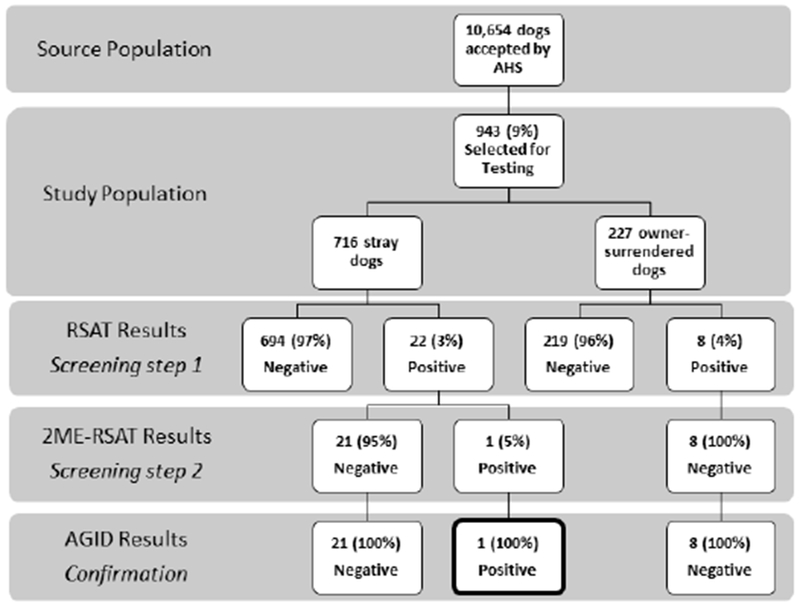
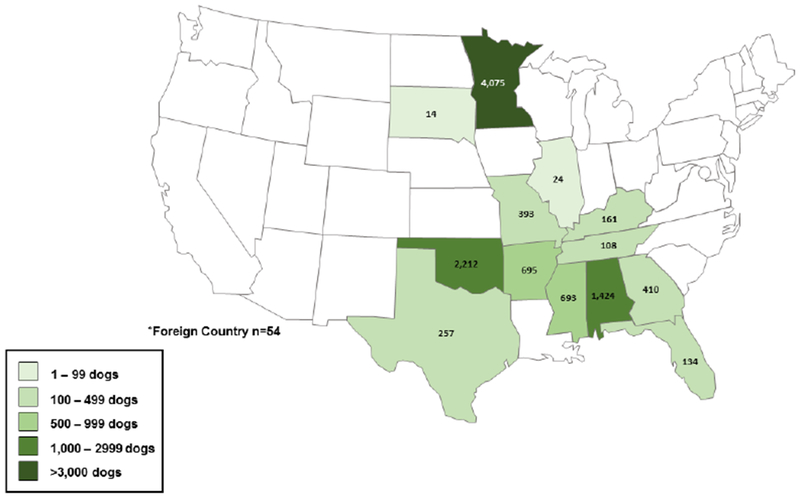
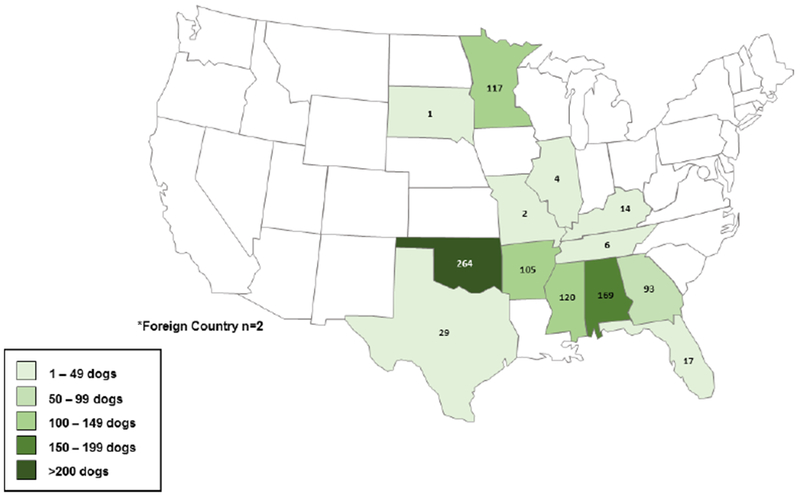
Results: Of the 10,654 dogs accepted by AHS during the study period, 943 (8.9%) were selected for testing. Most study dogs arrived from Oklahoma (28%), Alabama (18%), and Minnesota (12%). The median age of study dogs was 1.5 years; 303 (32%) were intact males and 294 (31%) were intact females. Most study dogs were strays (n = 716, 76%). Of the total, 22 (3.1%) stray and eight (3.5%) owner-surrendered dogs were presumptively positive by RSAT; one (0.11%) of the stray dogs was positive by 2ME-RSAT and confirmed by AGID. The positive dog was a healthy-appearing 1 year-old neutered male beagle from Texas.
Conclusions: The seroprevalence of canine brucellosis in dogs entering Minnesota for adoption from multiple states was low. Never-the-less, care must to be taken to consider all potential risks and outcomes of interstate and international dog trade, including the spread of infectious diseases such as canine brucellosis.
Keywords: Brucella canis; Canine brucellosis; Rescue dogs; Seroprevalence; Zoonosis.
Copyright © 2019 Elsevier B.V. All rights reserved.
Figures
References
-
- American College of Theriogenologists. Position statement: welfare of breeding dogs. Available at: https://www.theriogenology.org/page/PositionStatements#Welfare. Accessed April 27, 2018.
-
- American Veterinary Medical Association, 2012: American Veterinary Medical Association Household Pet Survey US pet ownership and demographics sourcebook. AVMA, Shaumburg, IL.
-
- Bershaker M The President’s Blog: Are animal shelter outcomes improving? ASPCA Professional; Available at: https://www.aspcapro.org/blog/2017/04/19/presidents-blog-are-animal-shel.... Accessed May 10, 2018.
-
- Blankenship RM, Sanford JP. Brucella canis. A cause of undulant fever. AM J Med 1975;59:424–426. - PubMed
-
- Boebel FW, Ehrenford FA, Brown GM, Angus RD, Thoen CO. Agglutinins to Brucella canis in stray dogs from certain counties in Illinois and Wisconsin. J Am Vet Med Assoc 1979;175:276–277. - PubMed
MeSH terms
Substances
Grants and funding
LinkOut - more resources
Full Text Sources
