


10-Year Risk Equations for Incident Heart Failure in the General Population
- PMID: 31097157
- PMCID: PMC6527121
- DOI: 10.1016/j.jacc.2019.02.057
10-Year Risk Equations for Incident Heart Failure in the General Population
Abstract
Background: Primary prevention strategies to mitigate the burden of heart failure (HF) are urgently needed. However, no validated risk prediction tools are currently in use.
Objectives: This study sought to derive 10-year risk equations of developing incident HF.
Methods: Race- and sex-specific 10-year risk equations for HF were derived and validated from individual-level data from 7 community-based cohorts with at least 12 years of follow-up. Participants who were recruited between 1985 and 2000, between 30 to 79 years, and were free of cardiovascular disease at baseline were included to create a pooled cohort (PC) and were randomly split for derivation and internal validation. Model performance was also assessed in 2 additional cohorts.
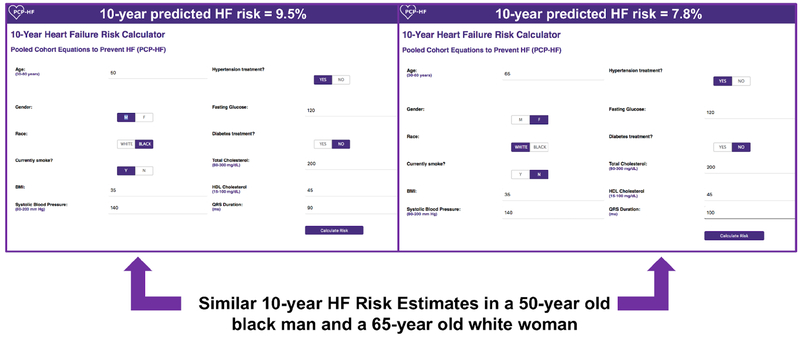
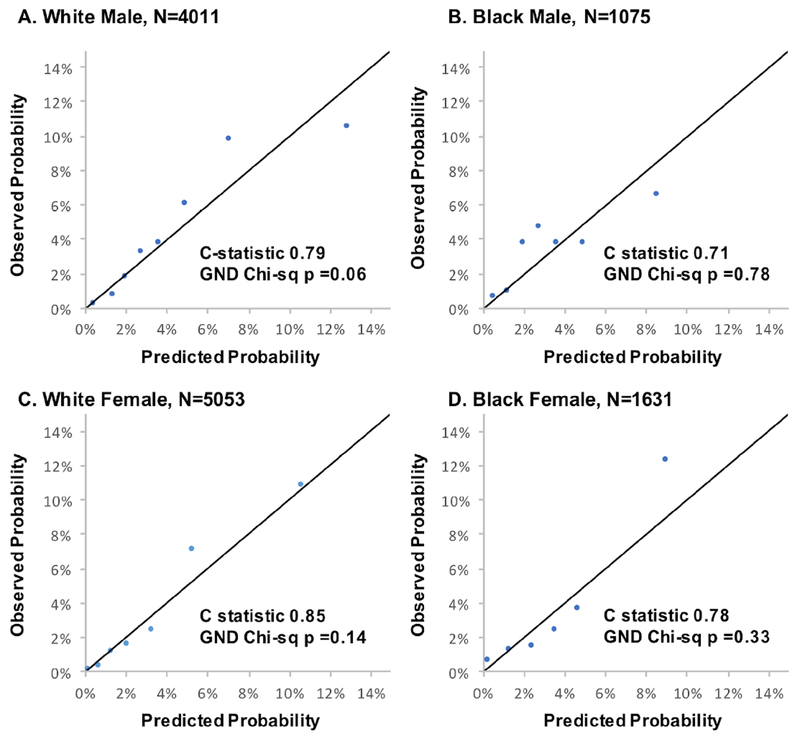
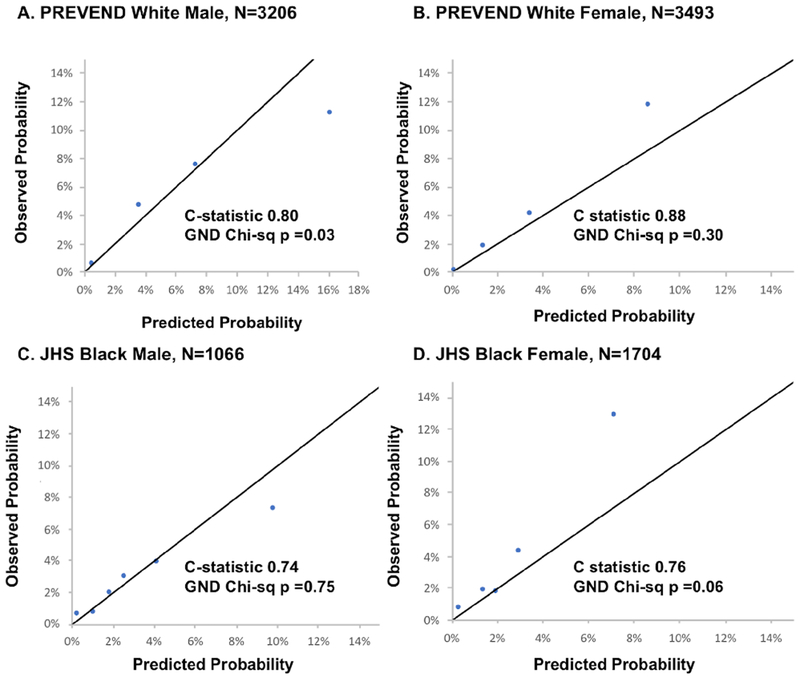
Results: In the derivation sample of the PC (n = 11,771), 58% were women, 22% were black with a mean age of 52 ± 12 years, and HF occurred in 1,339 participants. Predictors of HF included in the race-sex-specific models were age, blood pressure (treated or untreated), fasting glucose (treated or untreated), body mass index, cholesterol, smoking status, and QRS duration. The PC equations to Prevent HF model had good discrimination and strong calibration in internal and external validation cohorts. A web-based tool was developed to facilitate clinical application of this tool.
Conclusions: The authors present a contemporary analysis from 33,010 men and women demonstrating the utility of the sex- and race-specific 10-year PC equations to Prevent HF risk score, which integrates clinical parameters readily available in primary care settings. This tool can be useful in risk-based decision making to determine who may merit intensive screening and/or targeted prevention strategies.
Keywords: epidemiology; heart failure; primary prevention; risk factor.
Copyright © 2019 American College of Cardiology Foundation. Published by Elsevier Inc. All rights reserved.
Conflict of interest statement
Figures
Comment in
-
Prevention or Procrastination for Heart Failure?: Why We Need a Universal Definition of Heart Failure.J Am Coll Cardiol. 2019 May 21;73(19):2398-2400. doi: 10.1016/j.jacc.2019.03.471. J Am Coll Cardiol. 2019. PMID: 31097158 No abstract available.
References
-
- Benjamin EJ, Virani SS, Callaway CW et al. Heart Disease and Stroke Statistics-2018 Update: A Report From the American Heart Association. Circulation 2018;137:e67–e492. - PubMed
Publication types
MeSH terms
Grants and funding
- U01 HL125511/HL/NHLBI NIH HHS/United States
- U10 HL110312/HL/NHLBI NIH HHS/United States
- HHSN268201800014I/HB/NHLBI NIH HHS/United States
- HHSN268201800014C/HL/NHLBI NIH HHS/United States
- UL1 TR001422/TR/NCATS NIH HHS/United States
- HHSN268201800013I/MD/NIMHD NIH HHS/United States
- HHSN268201800011C/HL/NHLBI NIH HHS/United States
- HHSN268201800015I/HB/NHLBI NIH HHS/United States
- R01 AG045551/AG/NIA NIH HHS/United States
- HHSN268201800011I/HB/NHLBI NIH HHS/United States
- HHSN268201800012C/HL/NHLBI NIH HHS/United States
- HHSN268201800012I/HB/NHLBI NIH HHS/United States
- K23 HL133601/HL/NHLBI NIH HHS/United States
- KL2 TR001424/TR/NCATS NIH HHS/United States
- R01 HL136942/HL/NHLBI NIH HHS/United States
- R21 HL085375/HL/NHLBI NIH HHS/United States
- HHSN268201800010I/HB/NHLBI NIH HHS/United States
LinkOut - more resources
Full Text Sources
Medical
Research Materials
Miscellaneous
