


Biochemical and biological characterisation of lancehead (Bothrops venezuelensis Sandner 1952) snake venom from the Venezuelan Central Coastal range
- PMID: 31097966
- PMCID: PMC6516077
Biochemical and biological characterisation of lancehead (Bothrops venezuelensis Sandner 1952) snake venom from the Venezuelan Central Coastal range
Abstract
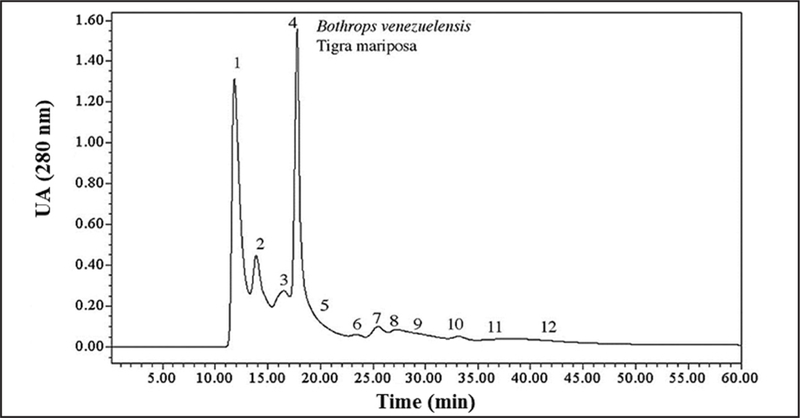
Venom fractions isolated from Bothrops venezuelensis were shown to contain a broad spectrum of proteins with varied activities. This study describes venom fractions with coagulant, haemorrhagic, fibrinolytic, proteolytic and antiplatelet activities, and analyses their physico-chemical properties and biological activities via molecular exclusion chromatography, gel electrophoresis and a bioassay battery. The LD50, determined by injecting intraperitoneally serial dilutions of B. venezuelensis venom into mice, was 6.39 mg/kg body weight. Twelve fractions were collected from B. venezuelensis venom using molecular exclusion chromatography. Of these, fractions 1-5 and 7-9 showed haemorrhagic activity, and all fractions except 3 and 6 showed fibrinolytic activity. However, none of the fractions had significant gelatinase activity, and only fractions 4-6 demonstrated activity on hide powder azure. With the exception of fractions 1 and 4, all fractions hydrolysed the insulin B-chain. In addition, all fractions as well as the crude venom showed strong procoagulant activity when tested using a Sonoclot Analyzer. Fractions 1, 3, 5 and 9 inhibited platelet function. In this study we have described the activities of the crude venom and its size-fractions from the scarcely studied B. venezuelensis. Haemorrhagic, fibrinolytic, procoagulant and proteolytic activities, and the inhibition of platelet function were detected. This preliminary study paves the way for the identification of specific molecules in B. venezuelensis venom that could have therapeutic potential for cancer and aberrant haemostasis treatment.
Se aislaron fracciones del veneno de Bothrops venezuelensis que demuestran ser un espectro abundante de proteínas con actividades variadas (coagulante, hemorrágica, fibrinolítica, proteolítica y de función plaquetaria), para el análisis de sus propiedades físico-químicas y biológicas, el veneno fue fraccionado por cromatografía de exclusión molecular, corrido en una electroforesis en gel y realizada una batería de ensayos biológicos. La DL50 del veneno de B. venezuelensis fue 6,39 mg/kg de peso corporal, fue determinada inyectando intraperitonealmente en ratones, diluciones seriadas de veneno de B. venezuelensis. Se colectaron doce fracciones a partir del veneno de B. venezuelensis mediante cromatografía de exclusión molecular. Las fracciones 1–5 y 7–9 tenían actividad hemorrágica. Todas las fracciones, con la excepción de las fracciones 3 y 6, tenían actividad fibrinolítica. Ninguna de las fracciones tuvo actividad de gelatinasa significativa, y sólo fracciones 4–6 demostraron actividad en polvo azul de ocultamiento. Con la excepción de las fracciones 1 y 4, todas hidrolizaron la cadena β de la insulina. Cada fracción del veneno, así como el veneno crudo mostraron actividad procoagulante, cuando se probó en un analizador Sonoclot. Las fracciones 1, 3, 5 y 9 inhibieron la función plaquetaria. En este estudio se señalan actividades biológicas de un veneno poco estudiado (B. venezuelensis) y sus fracciones. Al detectar actividades hemorrágicas, fibrinolíticas, procoagulantes, proteolíticas y de inhibición de la función plaquetaria. Este estudio preliminar abre el camino para la identificación de moléculas específicas que podrían tener potencial terapéutico en hemostasia y cáncer, que vienen siendo estudiados en nuestro grupo.
Keywords: Bothrops venezuelensis; fibrinolysis; haemorrhages; haemostasis; platelet function; venom.
Conflict of interest statement
Conflict of interests The authors declare that there is no conflict of interests regarding the publication of this paper.
Figures


References
-
- Assakura MT, Silva CA, Mentele R, Camargo AC & Serrano SM (2003). Molecular cloning and expression of structural domains of bothropasin, a P-III metalloproteinase from the venom of Bothrops jararaca. Toxicon 41: 217–27. - PubMed
-
- Austen D & Rhymes IA (1975). In: Mead O (Ed.), Laboratory Manual of Blood Coagulation Blackwell Scientific Publications, Oxford, England.
-
- Bajwa SS, Markland FS & Russell FE (1980). Fibrinolytic enzyme(s) in western diamondback rattlesnake (Crotalus atrox) venom. Toxicon 18: 285–290. - PubMed
-
- Bello CA, Hermogenes AL, Magalhaes A, Veiga SS, Gremski LH, Richardson M, et al. (2006). Isolation and biochemical characterization of a fibrinolytic proteinase from Bothrops leucurus (white-tailed jararaca) snake venom. Biochimie 88: 189–200. - PubMed
-
- Berger M, Pinto AF & Guimarães JA (2008) Purification and functional characterization of bothrojaractivase, a prothrombin-activating metalloproteinase isolated from Bothrops jararaca snake venom. Toxicon 51: 488–501. - PubMed
Grants and funding
LinkOut - more resources
Full Text Sources