


POLICY: A novel modelling technique to predict resource -requirements in critical care - a case study
- PMID: 31098580
- PMCID: PMC6520084
- DOI: 10.7861/futurehosp.6-1-17
POLICY: A novel modelling technique to predict resource -requirements in critical care - a case study
Abstract
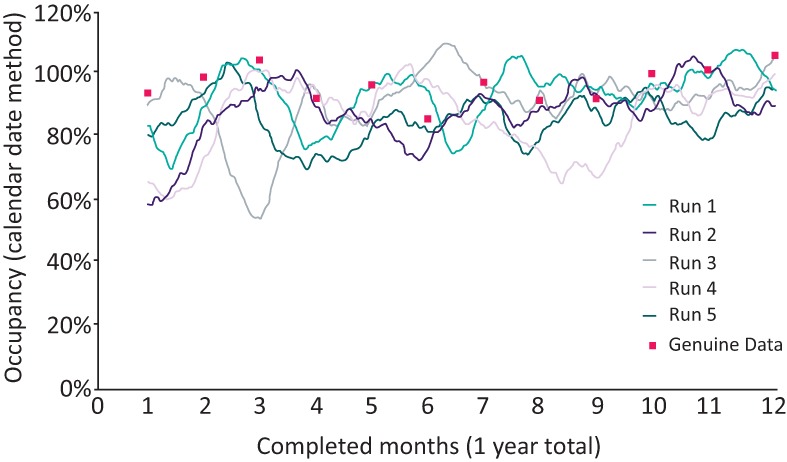
Modelling is an under-used tool in the NHS operationally; this is primarily due to a lack of familiarity, but also due to the complex nature of the healthcare system, lack of sufficiently detailed data, and difficulties trying to distil the heterogeneity of individual patient experience into manageable groups. This paper describes a model of patient flow and resource use on the critical care unit at Bradford Royal Infirmary, -produced using a novel technique which helps avoid these issues by using genuine routinely collected historical data in lieu of trying to model individual patients. This has had -unexpected benefits in terms of engagement with the model as it is much easier to justify its validity when it is based directly on real people. Going forward, we will use this approach to model an entire hospital.
Keywords: Modelling; Monte Carlo; critical care; simulation.
Figures
References
-
- Guidelines for the Provision of Intensive Care Services. The Faculty of Intensive Care Medicine, 2016. http://ficm.ac.uk/standards-and-guidelines/gpics [Accessed 27 July 2018].
-
- Brailsford S, Hilton N. A comparison of discrete event simulation and system dynamics for modelling healthcare systems. In: Riley J. (ed), Planning for the future: Health service quality and emergency accessibility. Glasgow: Glasgow Caledonian University, Operational Research Applied to Health Services (ORAHS), 2001:17.
-
- Siebers PO, Macal CM, Garnett J, Buxton D, Pidd M. Discrete-event simulation is dead, long live agent-based simulation! J Simul 2010;4:204–10.
-
- Kumar A, Mo J. Models for bed occupancy management of a hospital in Singapore. In: Proceedings of the 2010 International Conference on Industrial Engineering and Operations Management. IIEOM & cosponsored by INFORMS; 2010:1–6. https://researchbank.rmit.edu.au/view/rmit:13221.
-
- Jones SS, Thomas A, Evans RS, et al. Forecasting daily patient volumes in the emergency department. Acad Emerg Med 2008;15:159–70. - PubMed
Publication types
LinkOut - more resources
Full Text Sources
