Association of Sugary Beverage Consumption With Mortality Risk in US Adults: A Secondary Analysis of Data From the REGARDS Study
- PMID: 31099861
- PMCID: PMC6537924
- DOI: 10.1001/jamanetworkopen.2019.3121
Association of Sugary Beverage Consumption With Mortality Risk in US Adults: A Secondary Analysis of Data From the REGARDS Study
Abstract
Importance: Research has linked sugar-sweetened beverage (SSB) consumption to coronary heart disease (CHD) risk, but the role of nutritionally similar fruit juice and the association of these beverages with mortality risk is unknown.
Objective: To assess the association of SSBs and 100% fruit juices, alone and in combination (sugary beverages), with mortality.
Design, setting, and participants: This cohort study is a secondary analysis of data obtained from 30 183 participants in the Reasons for Geographic and Racial Differences in Stroke (REGARDS) study. The REGARDS study was designed to examine modifiers of stroke risk. Enrollment took place from February 2003 to October 2007, with follow-up every 6 months through 2013. Overall, 30 183 non-Hispanic black and white adults 45 years and older were enrolled in the REGARDS study. Those with known CHD, stroke, or diabetes at baseline (12 253 [40.6%]) and those lacking dietary data (4490 [14.9%]) were excluded from the current study, resulting in a sample size of 13 440. Data were analyzed from November 2017 to December 2018.
Exposures: Sugar-sweetened beverage and 100% fruit juice consumption was estimated using a validated food frequency questionnaire and examined using categories of consumption that align with recommended limits for added sugar intake as a percentage of total energy (TE; <5%, 5%-<10%, and ≥10%) and 12-oz serving increments.
Main outcomes and measures: All-cause and CHD-specific mortality were determined from cause of death records and family interviews and adjudicated by a trained team. Multivariable adjusted hazard ratios (HRs) were estimated using regression models.
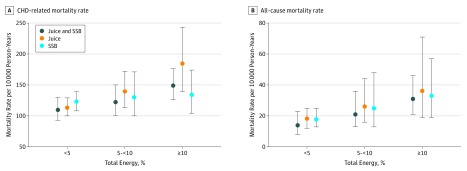
Results: Overall, 13 440 participants had a mean (SD) age of 63.6 (9.1) years at baseline, 7972 (59.3%) were men, 9266 (68.9%) were non-Hispanic white, and 9482 (70.8%) had overweight or obesity. There were 1000 all-cause and 168 CHD-related deaths during follow-up (mean [SD] follow-up, 6.0 [1.8] years). Mean (SD) sugary beverage consumption was 8.4% (8.3%) of TE/d (4.4% [6.8%] TE/d from SSBs; 4.0% [6.8%] TE/d from 100% fruit juice). Among high (≥10% of TE) vs low (<5% of TE) sugary beverage consumers, risk-adjusted HRs were 1.44 (95% CI, 0.97-2.15) for CHD mortality and 1.14 (95% CI, 0.97-1.33) for all-cause mortality. Risk-adjusted all-cause mortality HRs were 1.11 (95% CI, 1.03-1.19) for each additional 12 oz of sugary beverage consumed and 1.24 (95% CI, 1.09-1.42) for each additional 12 oz of fruit juice consumed. In risk-adjusted models, there was no significant association of sugary beverage consumption with CHD mortality.
Conclusions and relevance: These findings suggest that consumption of sugary beverages, including fruit juices, is associated with all-cause mortality. Well-powered and longer-term studies are needed to inform their association with CHD mortality risk.
Conflict of interest statement
Figures
Comment in
-
Are Fruit Juices Just as Unhealthy as Sugar-Sweetened Beverages?JAMA Netw Open. 2019 May 3;2(5):e193109. doi: 10.1001/jamanetworkopen.2019.3109. JAMA Netw Open. 2019. PMID: 31099854 No abstract available.
References
-
- Go AS, Mozaffarian D, Roger VL, et al. ; American Heart Association Statistics Committee and Stroke Statistics Subcommittee . Heart disease and stroke statistics, 2014 update: a report from the American Heart Association. Circulation. 2014;129(3):-.
-
- Mozaffarian D, Benjamin EJ, Go AS, et al. ; Writing Group Members; American Heart Association Statistics Committee; Stroke Statistics Subcommittee . Executive summary: heart disease and stroke statistics, 2016 update: a report from the American Heart Association. Circulation. 2016;133(4):447-454. doi: 10.1161/CIR.0000000000000366 - DOI - PubMed
Publication types
MeSH terms
Grants and funding
LinkOut - more resources
Full Text Sources
Medical