Review
. 2019 May 16;8(5):468.
doi: 10.3390/cells8050468.

Role of the Hippo Pathway in Fibrosis and Cancer

Affiliations
Review

Role of the Hippo Pathway in Fibrosis and Cancer

Cho-Long Kim et al. Cells. .

Abstract

The Hippo pathway is the key player in various signaling processes, including organ development and maintenance of tissue homeostasis. This pathway comprises a core kinases module and transcriptional activation module, representing a highly conserved mechanism from Drosophila to vertebrates. The central MST1/2-LATS1/2 kinase cascade in this pathway negatively regulates YAP/TAZ transcription co-activators in a phosphorylation-dependent manner. Nuclear YAP/TAZ bind to transcription factors to stimulate gene expression, contributing to the regenerative potential and regulation of cell growth and death. Recent studies have also highlighted the potential role of Hippo pathway dysfunctions in the pathology of several diseases. Here, we review the functional characteristics of the Hippo pathway in organ fibrosis and tumorigenesis, and discuss its potential as new therapeutic targets.

Keywords: ECM; EMT; LATS1/2; MST1/2; TAZ; YAP; cancer; fibrosis; myofibroblast.


Conflict of interest statement

The author declares that there is no conflict of interest.

Figures
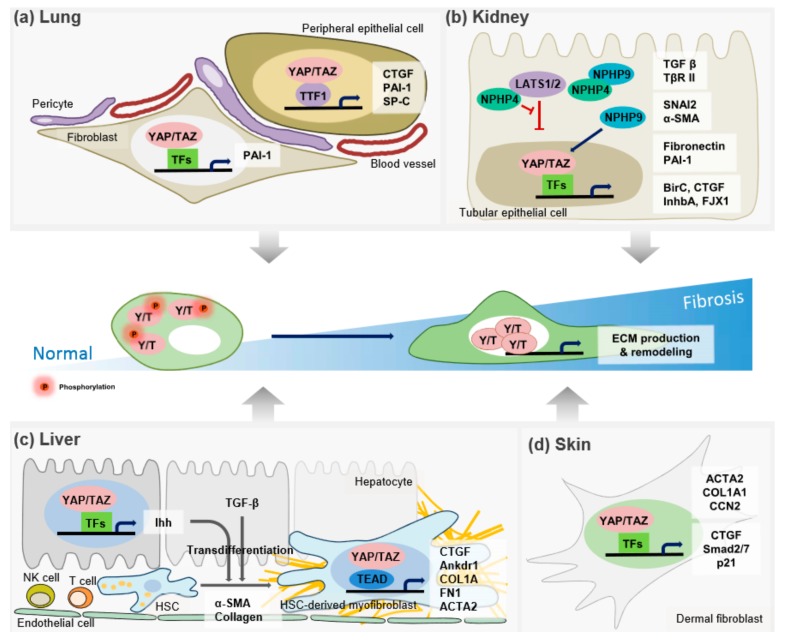
Figure 1
Figure 1
The role of the Hippo pathway in the pathogenesis of tissue fibrosis. In normal cells, YAP/TAZ are phosphorylated and localized in the cytoplasm, leading to their inactivation. However, in many pathological situations, YAP/TAZ localize to the nucleus, and up-regulate their target genes to remodel the ECM. This action leads to tissue fibrosis. (a) In respiratory epithelial cells, binding YAP/TAZ with TTF-1 synergistically activates the expression of target genes, including SP-C, CTGF, and PAI-1. Also, active fibroblasts promote matrix synthesis via YAP/TAZ that are critical to the induction of profibrotic genes, such as CTGF and PAI-1, in the development of lung fibrosis. (b) NPHP4, by interacting with LATS1/2, promotes YAP/TAZ transcriptional activity. In contrast, NPHP9, another NPH proteins (NPHPs), directly interacts with YAP/TAZ and induces its nuclear localization to regulate a subset of target genes involved in renal fibrosis. (c) YAP/TAZ-mediated Indian hedgehog (Ihh) gene induction, which increases transcriptional reprogramming by modulating profibrotic gene expression in HSCs. In response to Ihh and TGF-β, HSCs transdifferentiate into the ECM-producing myofibroblasts. (d) YAP/TAZ are mainly localized with the nucleus, resulting in the profibrotic gene expression in dermal fibrolasts. See text for further details. The red spheres indicate the phosphorylation of YAP/TAZ by kinase.
Figure 2
Figure 2
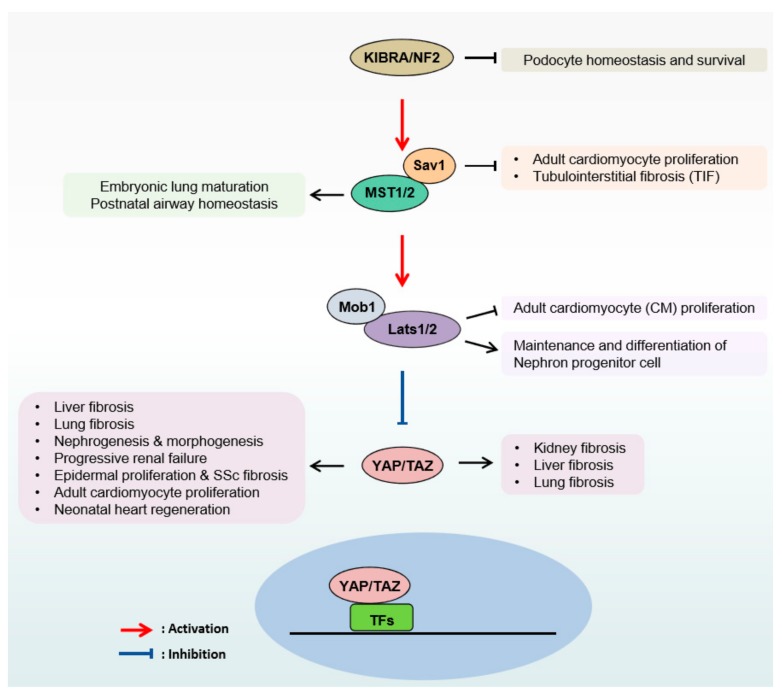
The Hippo pathway drives fibrosis across the organs.
Figure 3
Figure 3
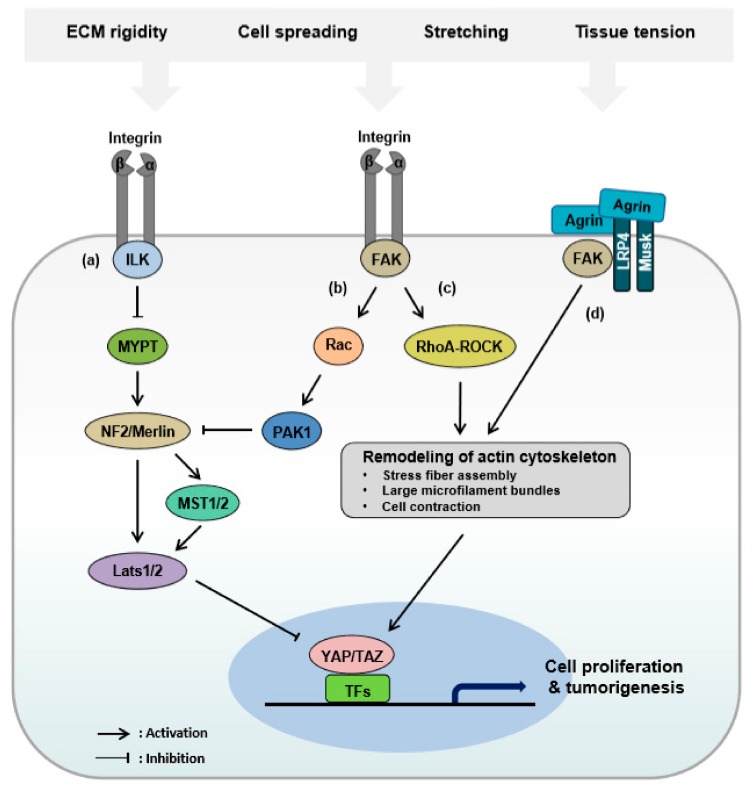
Schematic model of regulation of the Hippo pathway by numerous signaling pathways in cancer. (a) Integrin-ILK signaling inhibits MYPT1, leading to inactivation of the MST1/2-LATS1/2 kinase cascade, which triggers YAP/TAZ activation. (b) RAC1 and PAK1 phosphorylate NF2 that inhibits the interaction between YAP and NF2, resulting in YAP/TAZ activation. (c) Integrin-FAK signaling activates the RhoA-ROCK pathway to control remodeling of the actin cytoskeleton. (d) In response to ECM, Agrin enhances RhoA-ROCK-dependent actin cytoskeletal remodeling. As a later event, YAP/TAZ are translocated to the nucleus to interact with transcription factors (TFs), which drive profibrotic and tumorigenic effects.
Figure 4
Figure 4
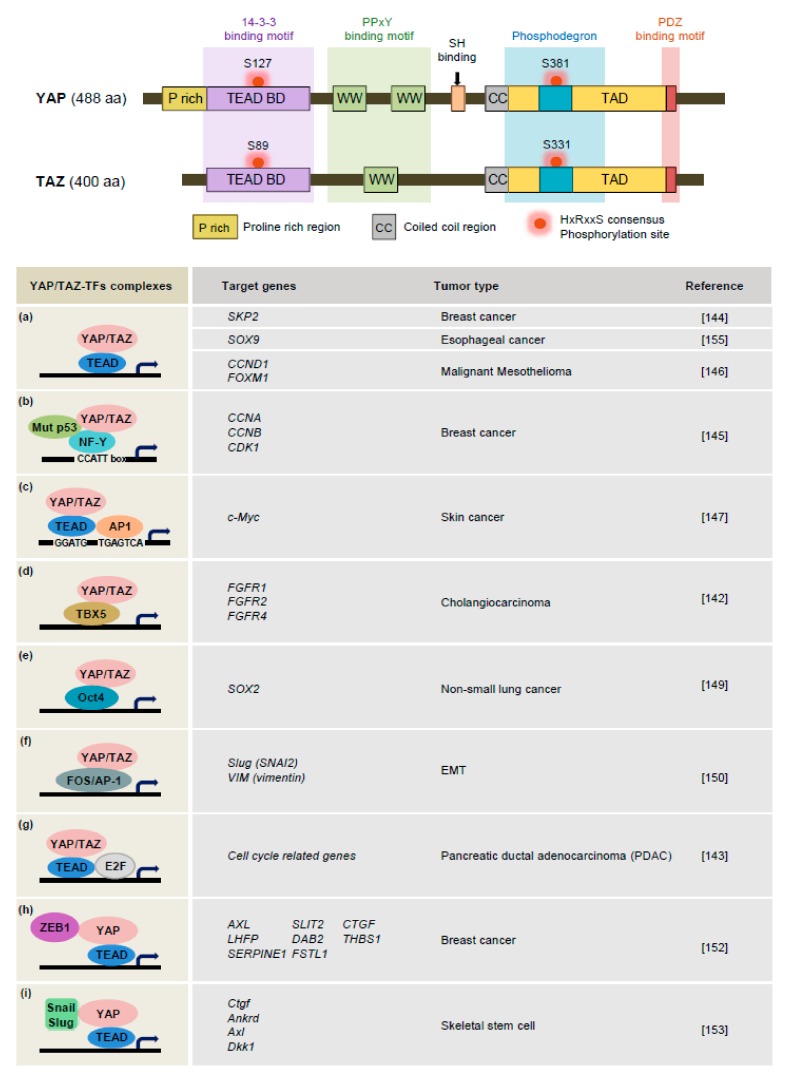
YAP/TAZ-mediated regulatory networks in cancer. YAP/TAZ are the major downstream mediators of the Hippo pathway and are composed of several domains (see Figure 1). The nuclear YAP/TAZ interacts with multiple transcription factors and signaling pathway that collectively contribute to tumorigenesis.

References

    1. Yu F.X., Zhao B., Guan K.L. Hippo Pathway in Organ Size Control, Tissue Homeostasis, and Cancer. Cell. 2015;163:811–828. doi: 10.1016/j.cell.2015.10.044. - DOI - PMC - PubMed
    1. Harvey K.F., Pfleger C.M., Hariharan I.K. The Drosophila Mst ortholog, hippo, restricts growth and cell proliferation and promotes apoptosis. Cell. 2003;114:457–467. doi: 10.1016/S0092-8674(03)00557-9. - DOI - PubMed
    1. Jia J., Zhang W., Wang B., Trinko R., Jiang J. The Drosophila Ste20 family kinase dMST functions as a tumor suppressor by restricting cell proliferation and promoting apoptosis. Genes Dev. 2003;17:2514–2519. doi: 10.1101/gad.1134003. - DOI - PMC - PubMed
    1. Justice R.W., Zilian O., Woods D.F., Noll M., Bryant P.J. The Drosophila tumor suppressor gene warts encodes a homolog of human myotonic dystrophy kinase and is required for the control of cell shape and proliferation. Genes Dev. 1995;9:534–546. doi: 10.1101/gad.9.5.534. - DOI - PubMed
    1. Pantalacci S., Tapon N., Leopold P. The Salvador partner Hippo promotes apoptosis and cell-cycle exit in Drosophila. Nat. Cell Biol. 2003;5:921–927. doi: 10.1038/ncb1051. - DOI - PubMed

Publication types

MeSH terms

Substances