


Baseline testing in cluster randomised controlled trials: should this be done?
- PMID: 31101078
- PMCID: PMC6524320
- DOI: 10.1186/s12874-019-0750-8
Baseline testing in cluster randomised controlled trials: should this be done?
Abstract
Background: Comparisons of baseline covariates in randomised controlled trials whilst often undertaken is regarded by many as an exercise in futility. Because of randomisation the null hypothesis is true for baseline comparisons and therefore any differences will occur by chance. However, this is only the case if allocations are not known in advance of recruitment. If this occurs then selection bias at randomisation may be present and it is possible that the statistical testing of covariates may unveil selection bias. In this paper we show that this is particularly the case for cluster randomised trials when post-randomised recruitment often occurs and can lead to selection bias.
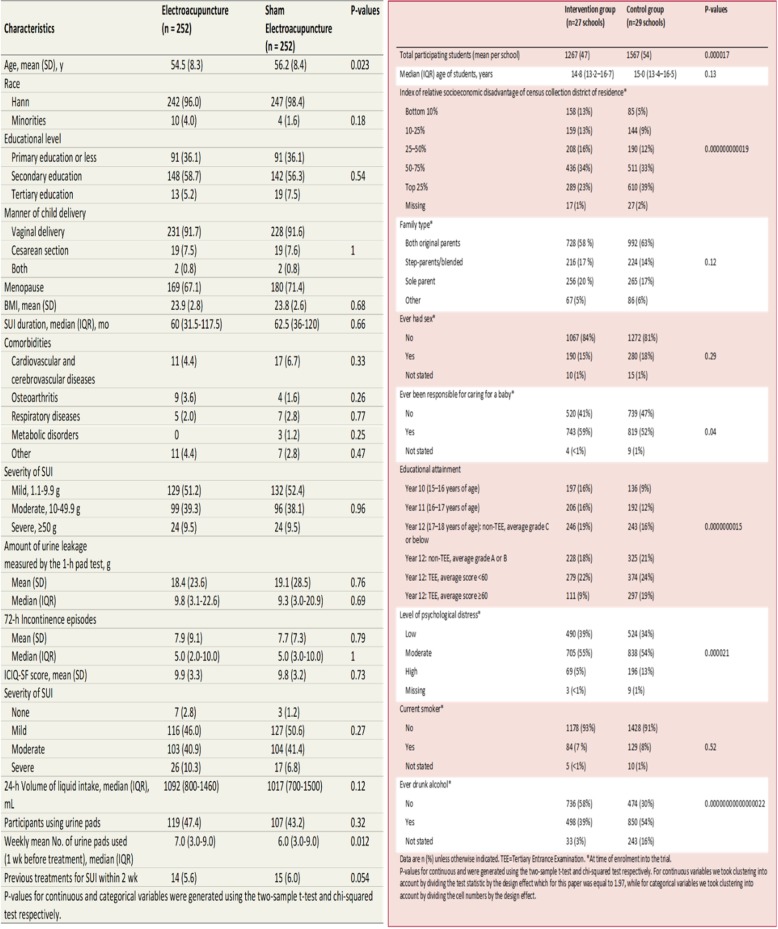
Main text: We take a recently published cluster randomised trial that has suffered from selection bias due to differential recruitment and calculate baseline p values. We show that statistically significant imbalances of p < 0.0001 occurred in 5 of the 10 covariates. In comparison for an individually randomised trial that had no evidence of selection bias only 1 p value of p < 0.05 out of 20 tests was observed. Had baseline p values for the cluster trial been presented to journal editors, reviewers and readers then the results of the trial might have been treated with more caution.
Conclusion: We argue that the blanket ban of baseline testing as advocated by some may reduce the chance of identifying deficient cluster randomised trials and this opposition should be reconsidered for cluster trials.
Conflict of interest statement
All authors have declare no competing interests.
Figures
References
-
- Torgerson DJ, Torgerson CJ. Designing randomised trials in health, education and the social sciences: an introduction. Basingstoke: Palgrave MacMillan; 2008.
-
- Altman DG. Adjustment for covariate imbalance. In: Armitage P, Colton T, editors. Encyclopedia of biostatistics. 2. Chichester: John Wiley; 2005. pp. 1273–1278.
Publication types
MeSH terms
LinkOut - more resources
Full Text Sources
