. 2019 May 17;21(1):65.
doi: 10.1186/s13058-019-1148-6.

Identification of three subtypes of triple-negative breast cancer with potential therapeutic implications

Affiliations

Identification of three subtypes of triple-negative breast cancer with potential therapeutic implications

Pascal Jézéquel et al. Breast Cancer Res. .

Abstract

Background: Heterogeneity and lack of targeted therapies represent the two main impediments to precision treatment of triple-negative breast cancer (TNBC), and therefore, molecular subtyping and identification of therapeutic pathways are required to optimize medical care. The aim of the present study was to define robust TNBC subtypes with clinical relevance.

Methods: Gene expression profiling by means of DNA chips was conducted in an internal TNBC cohort composed of 238 patients. In addition, external data (n = 257), obtained by using the same DNA chip, were used for validation. Fuzzy clustering was followed by functional annotation of the clusters. Immunohistochemistry was used to confirm transcriptomics results: CD138 and CD20 were used to test for plasma cell and B lymphocyte infiltrations, respectively; MECA79 and CD31 for tertiary lymphoid structures; and UCHL1/PGP9.5 and S100 for neurogenesis.

Results: We identified three molecular clusters within TNBC: one molecular apocrine (C1) and two basal-like-enriched (C2 and C3). C2 presented pro-tumorigenic immune response (immune suppressive), high neurogenesis (nerve infiltration), and high biological aggressiveness. In contrast, C3 exhibited adaptive immune response associated with complete B cell differentiation that occurs in tertiary lymphoid structures, and immune checkpoint upregulation. External cohort subtyping by means of the same approach proved the robustness of these results. Furthermore, plasma cell and B lymphocyte infiltrates, tertiary lymphoid structures, and neurogenesis were validated at the protein levels by means of histological evaluation and immunohistochemistry.

Conclusion: Our work showed that TNBC can be subcategorized in three different subtypes characterized by marked biological features, some of which could be targeted by specific therapies.

Keywords: Breast cancer; Immunome; Molecular subtypes; Neurogenesis; Tertiary lymphoid structures; Transcriptomics; Triple-negative.


Conflict of interest statement

The authors declare that they have no competing interests.

Figures
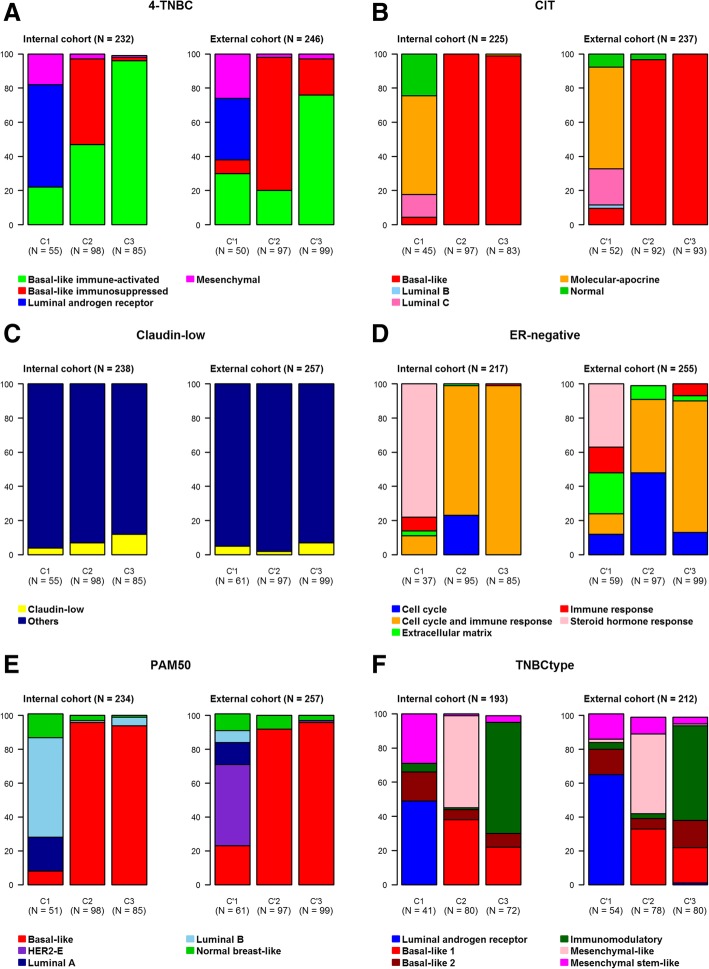
Fig. 1
Fig. 1
Subtype distributions of patients between the three clusters by means of categorical GES, for the internal (left) and external (right) TNBC cohorts. a 4-TNBC. b CIT. c Claudin-low. d ER-negative. e PAM50. f TNBCtype
Fig. 2
Fig. 2
Molecular annotation of TNBC by means of continuous score GES in function of clusters. a Internal cohort. b External cohort. Differences in GES scores according to clusters (ANOVA results) are represented as a radar plot, where each of the 47 radii represents a GES. Black circles represent significantly different levels of expression from low (smallest circle) to high (largest circle). Expression level of each cluster is represented on the corresponding circle as a blue (C1, C’1), red (C2, C’2), or green (C3, C’3) dot. Dots located on same circles correspond to clusters with not significantly different expressions. Dots located on different circles correspond to clusters with significantly different expressions. Dots located in between black circles correspond to a cluster with expression level not significantly different from clusters whose dots are located on both near circles. This figure is an illustration of Additional files 10 and 21 statistical analyses
Fig. 3
Fig. 3
Immunohistochemistry and histological evaluations of neurogenesis and immune markers. a Detection of nerve fibers in C2 TNBC tumors. Nerve fibers in the tumoral stroma, with their typical spindled and wavy morphology, detected with IHC against the axonal marker UCHL1 (60×) and the schwannian marker S100 (60×). UCHL1 and S100 displayed a C2 > C3 profile. b Immune features of C3 TNBC tumors. Tertiary lymphoid structure (TLS) in the vicinity of invasive front of carcinoma, defined by the presence of a germinal center (hematoxylin and eosin staining) (10×), highlighted by follicular dendritic cells marker CD21 (20×). HEV, specialized blood vessels in lymphocytes recruitment, stained by MECA79 (20×), preferentially found in lymphocytes-rich regions of tumors. Plasma cell and B lymphocyte infiltrates were analyzed, respectively, with CD138 and CD20 stainings in the tumoral stroma (40×). Infiltrates were assessed according to recommendations of an international working group, by determining the area occupied by plasma cells or B lymphocytes over the total intratumoral stromal area. TLS, CD21, MECA79, CD138 and CD20 displayed a C3 > C2 profile. Arrows indicate cells expressing each marker (brown). Statistical plots on the right of each picture display the numbers (Pos: positive; Neg: negative) or percentages of marked cells in C2 compared to C3

References

    1. Foulkes WD, Smith IE, Reis-Filho JS. Triple-negative breast cancer. N Engl J Med. 2010;363:1938–1948. doi: 10.1056/NEJMra1001389. - DOI - PubMed
    1. Ahn SG, Kim SJ, Kim C, Jeong J. Molecular classification of triple-negative breast cancer. J Breast Cancer. 2016;19:223–230. doi: 10.4048/jbc.2016.19.3.223. - DOI - PMC - PubMed
    1. Bonsang-Kitzis H, Sadacca B, Hamy-Petit AS, Moarii M, Pinheiro A, Laurent C, et al. Biological network-driven gene selection identifies a stromal immune module as a key determinant of triple-negative breast carcinoma prognosis. Oncoimmunology. 2016;5:e1061176. doi: 10.1080/2162402X.2015.1061176. - DOI - PMC - PubMed
    1. Lehmann BD, Bauer JA, Chen X, Sanders ME, Chakravarthy AB, Shyr Y, et al. Identification of human triple-negative breast cancer subtypes and preclinical models for selection of targeted therapies. J Clin Invest. 2011;121:2750–2767. doi: 10.1172/JCI45014. - DOI - PMC - PubMed
    1. Burstein MD, Tsimelzon A, Poage GM, Covington KR, Contreras A, Fuqua SA, et al. Comprehensive genomic analysis identifies novel subtypes and targets of triple-negative breast cancer. Clin Cancer Res. 2015;21:1688–1698. doi: 10.1158/1078-0432.CCR-14-0432. - DOI - PMC - PubMed

Publication types

Substances
