


Modified stall-side crossmatch for transfusions in horses
- PMID: 31102487
- PMCID: PMC6639470
- DOI: 10.1111/jvim.15519
Modified stall-side crossmatch for transfusions in horses
Abstract
Background: After-hours or out-of-clinic crossmatches are often limited by the lack of access to specialized material and technical expertise.
Hypothesis/objectives: The goal was to adapt a stall-side crossmatch test for pretransfusion evaluation in horses.
Animals: Twelve healthy mares (plasma and blood donors, teaching mares).
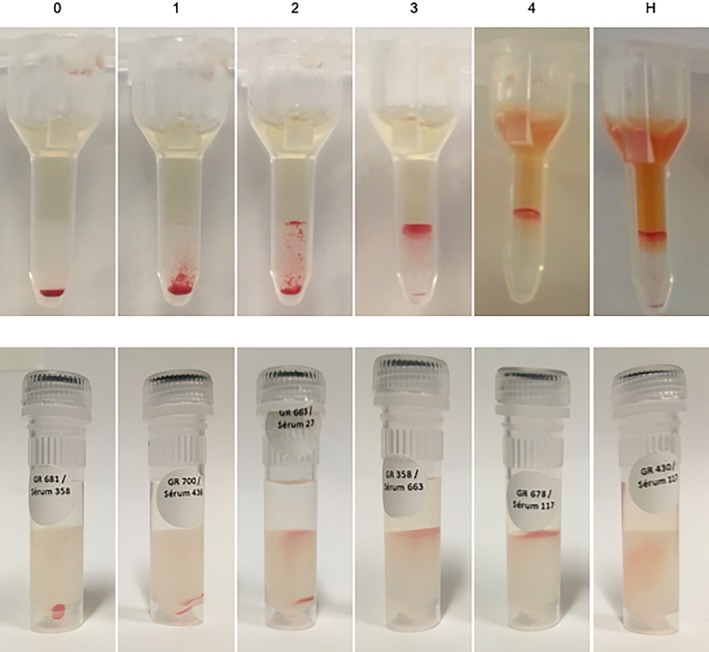
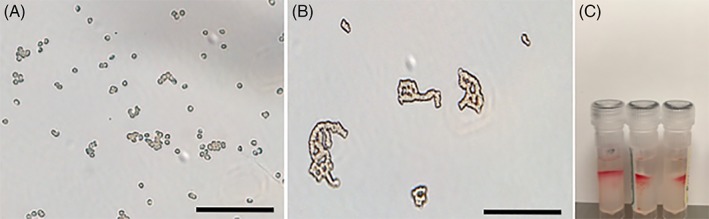
Methods: In a prospective study, blood from 12 mares was used to compare the results of 132 crossmatches performed with a rapid gel assay to crossmatches performed with a microgel column assay, and with predicted compatibilities based on blood types and detection of antibodies at a reference laboratory (microplate assay). The rapid gel assay protocol for dogs was adapted to decrease the formation of rouleaux that initially precluded equine erythrocytes migration through the gel.
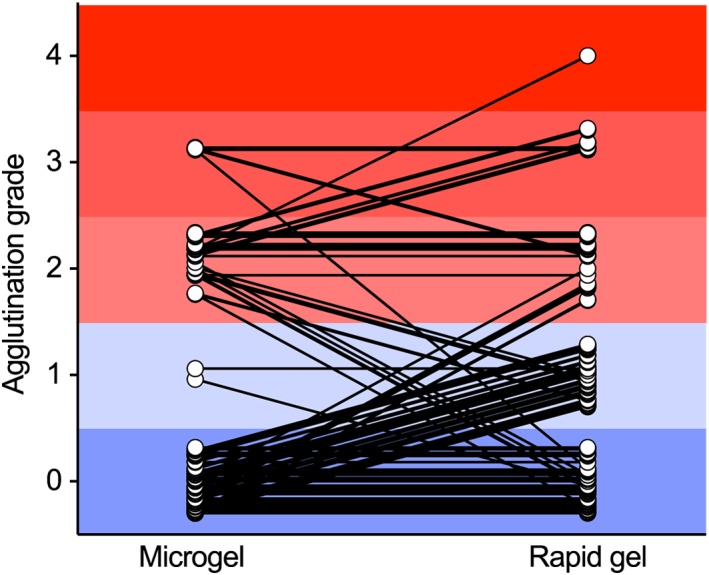
Results: There was a good agreement between the rapid gel assay and the microgel assay as well as with the predicted compatibilities (κ > .6 for both). Agreement was higher between the microgel assay and the predicted compatibilities (κ = .8). The rapid gel assay failed to detect 6 predicted Aa incompatibilities (agglutinins-related), 3 of which were also not detected with the microgel assay.
Conclusions and clinical importance: Based on these results, the modified rapid gel assay could be useful in settings when access to the microgel assay is not available. Discrepancies between both gel techniques and predicted compatibilities were most often low-grade agglutination, which warrants further investigation to assess their clinical importance.
Keywords: agglutination; blood transfusion; compatibility; equine.
© 2019 The Authors. Journal of Veterinary Internal Medicine published by Wiley Periodicals, Inc. on behalf of the American College of Veterinary Internal Medicine.
Conflict of interest statement
Since the completion of this study, Dr Blais has started a collaboration with DMS laboratories. This collaboration is non‐financial. Funding was provided by the Equine Health Fund from the Faculty of Veterinary Medicine of the Université de Montréal, supported by Zoetis. Funding sources did not have any involvement in the study design, data analysis and interpretation, or writing and publication of the manuscript.
Figures
References
-
- Dean L. Blood Groups and Red Cell Antigens [Internet] Bethesda (MD): National Center for Biotechnology Information (US); 2005. Chapter 2, Blood group antigens are surface markers on the red blood cell membrane. Available from: https://www.ncbi.nlm.nih.gov/books/NBK2264/.
-
- Sandberg K, Cothran EG. Blood groups and biochemical polymorphisms In: Bowling AT, Ruvinsky A, eds. The Genetics of the Horse. Cambridge, MA: CABI Publishing; 2000:85‐108.
-
- Sandberg K. Guidelines for the interpretation of blood typing tests in horses. Paper presented at: International Society for Animal Genetics 1996:1‐10.
-
- Sandberg K. Blood typing of horses: current status and application to identification problems. Paper presented at: Proceedings of the 1st Congress on Genetics Applied to Livestock Production, Madrid 1974;253‐265.
-
- Wong PL, Nickel LS, Bowling AT, Steffey EP. Clinical survey of antibodies against red blood cells in horses after homologous blood transfusion. Am J Vet Res. 1986;47:2566‐2571. - PubMed
MeSH terms
Substances
LinkOut - more resources
Full Text Sources
