Review
. 2019 Aug;24(8):1524-1538.
doi: 10.1016/j.drudis.2019.05.006. Epub 2019 May 15.

Therapeutic implications of nanomedicine for ocular drug delivery

Affiliations
Review

Therapeutic implications of nanomedicine for ocular drug delivery

Tuo Meng et al. Drug Discov Today. 2019 Aug.

Abstract

Delivering therapeutics to the eye is challenging on multiple levels: rapid clearance of eyedrops from the ocular surface requires frequent instillation, which is difficult for patients; transport of drugs across the blood-retinal barrier when drugs are administered systemically, and the cornea when drugs are administered topically, is difficult to achieve; limited drug penetration to the back of the eye owing to the cornea, conjunctiva, sclera and vitreous barriers. Nanomedicine offers many advantages over conventional ophthalmic medications for effective ocular drug delivery because nanomedicine can increase the therapeutic index by overcoming ocular barriers, improving drug-release profiles and reducing potential drug toxicity. In this review, we highlight the therapeutic implications of nanomedicine for ocular drug delivery.


Figures

Figure 1
Figure 1
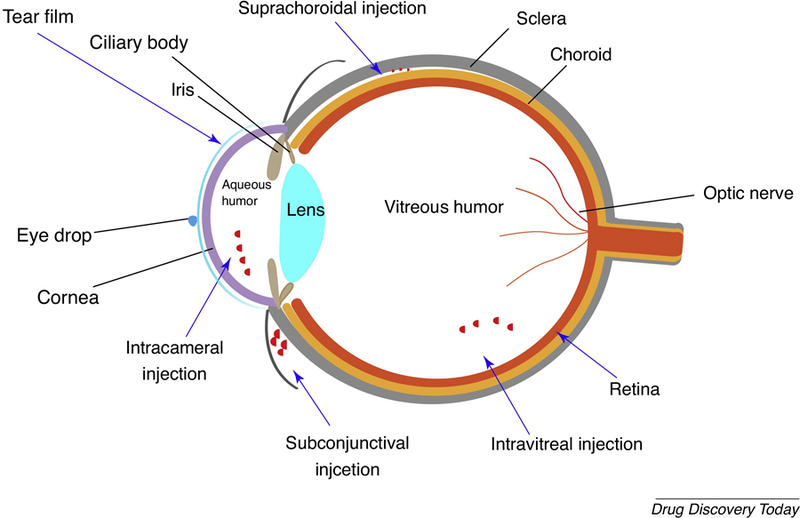
Scheme of the ocular anatomy and ocular nanomedicine administered through various routes including topical administration, subconjunctival injection, intravitreal injection, subretinal injection and suprachoroidal injection.
Figure 2
Figure 2
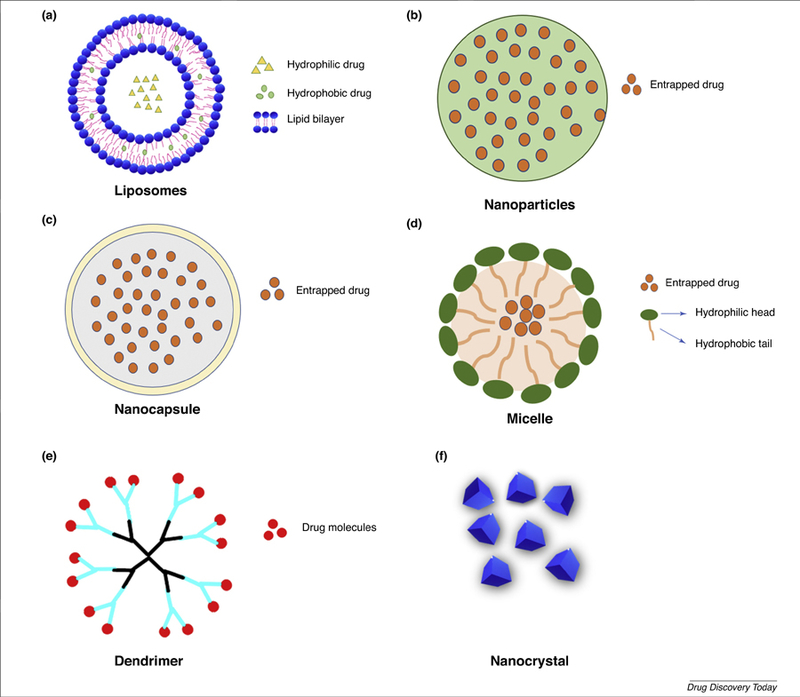
Scheme of representative nanomedicine platforms for ocular drug delivery. (a) Liposomes are small spherical vesicles with lipid bilayers. (b) Nanoparticles are usually made of biodegradable polymers for sustained drug release. (c) Nanocapsules typically consist of a lipid core and a protective shell with particle size from 10 nm to 1000 nm. (d) Micelles are self-assembled spherical vesicles consisting of hydrophilic corona and hydrophobic core. (e) Dendrimers are nanostructured macromolecules with uniform tree-like branches that can be used to encapsulate or conjugate drugs. (f) Drug nanocrystals are nanosized drug crystals stabilized with specific surface coatings.
Figure 3
Figure 3
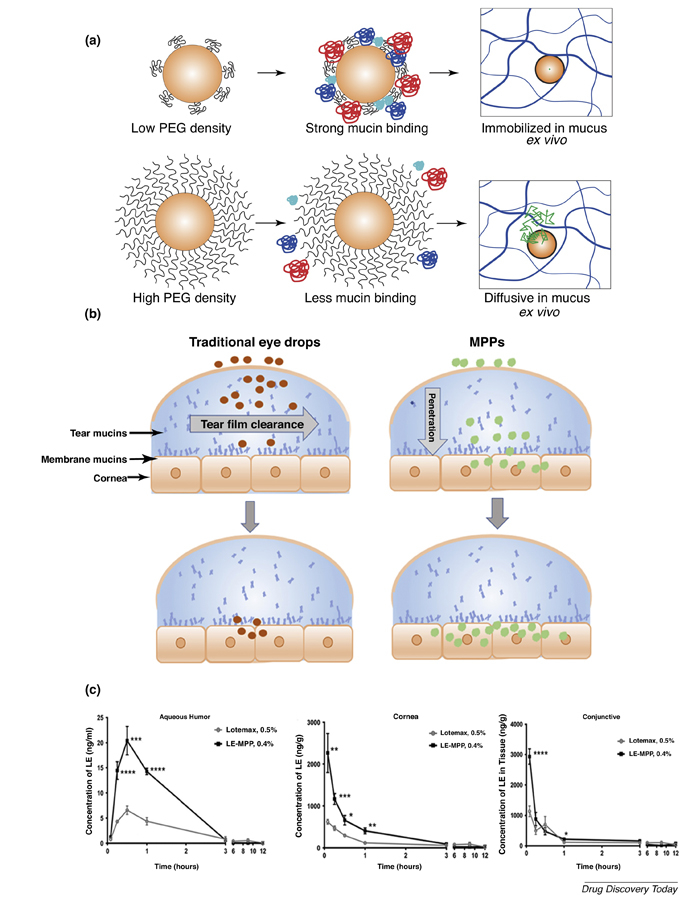
(a) Poly(lactic-co-glycolic acid) (PLGA)-PEG nanoparticles with low density PEG coating had strong mucin binding, which was related to immobilization within mucus. High PEG density coating avoids the adhesion of mucin on the surface of PLGA-PEG nanoparticles (MPP) in vitro, resulting in rapid diffusion in mucus ex vivo. (b) Traditional suspension eyedrops adhere to the mucins and are rapidly cleared from the tear film. MPP move through tear mucins to the epithelium-tethered mucins, allowing particle penetration to corneal epithelium. (c) Loteprednol etabonate (LE) pharmacokinetic profiles in rabbit aqueous humor, cornea and conjunctiva. Reproduced, with permission, from Refs.[76](a), and [24](c). Abbreviations: BID, twice daily; QID, 4-times daily.
Figure 4
Figure 4
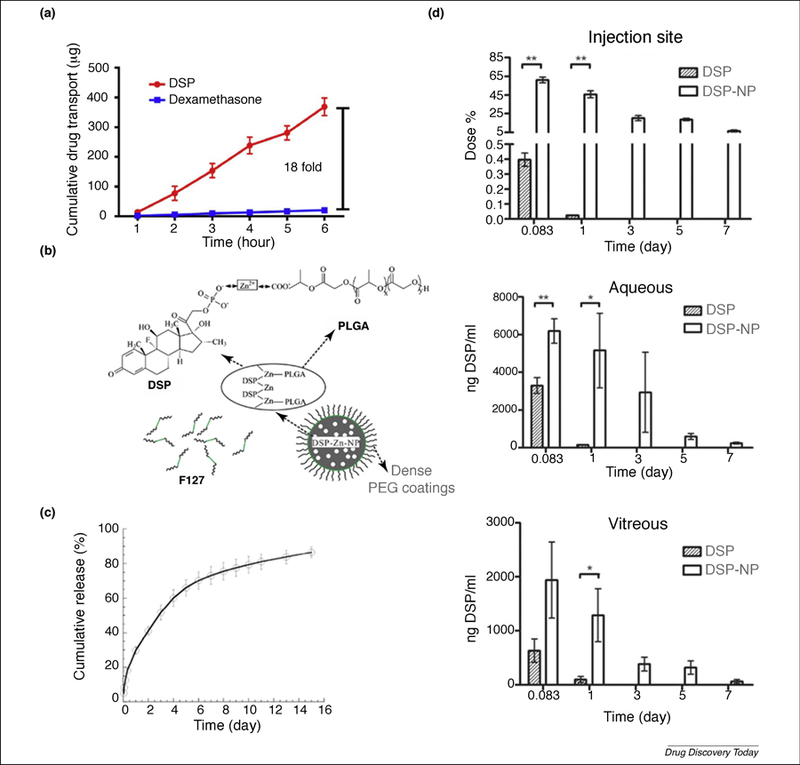
(a) Hydrophilic DSP provided 18-fold increase in transscleral diffusion over hydrophobic dexamethasone (DEX) at 6 h. (b) Scheme of encapsulation of dexamethasone sodium phosphate (DSP) into carboxyl-terminated poly(lactic-co-glycolic acid) (PLGA) nanoparticles using zinc ions. (c) Sustained DSP release in vitro under infinite sink conditions for DSP nanoparticles (DSP-NP). (d) Pharmacokinetic study of DSP-NP and DSP free drug solution at injection site, aqueous humor and vitreous humor after subconjunctival (SCT) injection in rats. Reproduced, with permission, from Refs. [44] (a), [43] (b), and [40] (c, d).

References

    1. Kels BD et al. (2015) Human ocular anatomy. Clin. Dermatol 33, 140–146 - PubMed
    1. Jonas JB et al. (2008) Short-term complications of intravitreal injections of triamcinolone and bevacizumab. Eye 22, 590–591 - PubMed
    1. Bochot A and Fattal E (2012) Liposomes for intravitreal drug delivery: a state of the art. J. Control. Release 161, 628–634 - PubMed
    1. Chiang B et al. (2018) The suprachoroidal space as a route of administration to the posterior segment of the eye. Adv. Drug Deliv. Rev 126, 58–66 - PMC - PubMed
    1. Weng Y et al. (2017) Nanotechnology-based strategies for treatment of ocular disease. Acta Pharm. Sin. B 7, 281–291 - PMC - PubMed

Publication types

LinkOut - more resources