. 2019 Aug:102:133-141.
doi: 10.1016/j.jaut.2019.05.005. Epub 2019 May 15.

IL233, an IL-2-IL-33 hybrid cytokine induces prolonged remission of mouse lupus nephritis by targeting Treg cells as a single therapeutic agent

Affiliations

IL233, an IL-2-IL-33 hybrid cytokine induces prolonged remission of mouse lupus nephritis by targeting Treg cells as a single therapeutic agent

Marta E Stremska et al. J Autoimmun. 2019 Aug.

Abstract

Lupus glomerulonephritis (GN) is an autoimmune disease characterized by immune complex-deposition, complement activation and glomerular inflammation. In lupus-prone NZM2328 mice, the occurrence of lupus GN was accompanied by a decrease in Treg cells and an increase in proinflammatory cytokine-producing T cells. Because IL-33 in addition to IL-2 has been shown to be important for Treg cell proliferation and ST2 (IL-33 receptor) positive Treg cells are more potent in suppressor activity, a hybrid cytokine with active domains of IL-2 and IL-33 was generated to target the ST2+ Treg cells as a therapeutic agent to treat lupus GN. Three mouse models were used: spontaneous and Ad-IFNα- accelerated lupus GN in NZM2328 and the lymphoproliferative autoimmune GN in MRL/lpr mice. Daily injections of IL233 for 5 days prevented Ad-IFNα-induced lupus GN and induced remission of spontaneous lupus GN. The remission was permanent in that no relapses were detected. The remission was accompanied by persistent elevation of Treg cells in the renal lymph nodes. IL233 is more potent than IL-2 and IL-33 either singly or in combination in the treatment of lupus GN. The results of this study support the thesis that IL233 should be considered as a novel agent for treating lupus GN.

Keywords: Autoantibodies; Autoimmunity; IL-2-IL-33 fusion protein; Lupus nephritis; Treg cells.


Figures

Figure 1.
Figure 1.. NZM2328 mice develop a defect in expression of IL-2, IL-10, Foxp3 and ST2 on CD4+ T-cells.
In the blood, 6 months old NZM2328 female mice had lower expression of IL-2+ T cells as compared to 2 months old mice (n=4 per group) (A), Foxp3+ T cells (B) and IL-10+ T cells (C) as compared to 2 months old mice. The proportion of TNFα producing cells was higher (D) and absolute number of Foxp3+ cells (E) and ST2+Foxp3+ T cells (F) were lower in older NZM2328 mice as compared to young mice (n≥ 3). Treatment strategy of NZM2328 mice with IL-2 or IL233 (G) increased Foxp3+ and IL-10 producing CD4+ T cells in the blood (H). IL233, but not IL-2 inhibited the generation of TNFα+ and increased the ratio of IL-10+ T cells /TNFα+ T cells. Individual values are shown; # comparison with IL-2 only group; p value: *<0.05; **<0.01, ***<0.001.
Figure 2.
Figure 2.. IL-2/IL-33 and IL233 prevent the development of IFNα accelerated lupus GN in NZM2328.
A. NZM2328 mice (12 week old) were injected (i.p.) with 66 pmols each of IL-2, IL-33 (n=6 for both), mixture of IL-2 and IL-33, IL233 or saline (n=11 for all) daily for 5 days and with Ad-IFNα (i.v.) on day9. IL-2/IL33(IL-2 and IL-33), especially IL233 protected NZM2328 mice from the development of Ad-IFNα-accelerated GN and severe proteinuria. B. Glomerular hypertrophy, mesangial expansion, and leukocytic infiltration were seen in the saline control mice (left panel) but not in IL233 treated mice (right panel). C. Treatment with IL-2/IL-33 and especially with IL233 led to a persistent increase in the proportion of Foxp3+ Treg cells in the CD4+ T cell populations in renal lymph nodes. D. The total numbers of Treg cells in the renal lymph nodes are depicted. E. There were increases in the proportion of Treg cells in the spleen in mice treated with IL-2, IL33, IL-2/IL-33 and IL233. F. Increase in the total numbers of Treg cells in spleens were seen only in IL-2/IL-33 and IL233 treated mice. Green scale bars in (B) = 50μM; p values: *<0.05, **<0.01, ***<0.001, ****<0.0001 and NS>0.05.
Figure 3.
Figure 3.. IL233-mediated protection from GN development was not accompanied with decreases in circulating anti-dsDNA antibodies and immune complex deposits.
Levels of circulating anti-dsDNA IgG (A) Anti-dsDNA Ab levels by ELISA in the terminal sera of a representative cohort (n=6) of NZM2328 mice treated with different cytokines. B. Representative images of IgG and C3 deposits in kidneys of saline and IL233 treated mice. C. Immunofluorescence studies of IgG2a and IgG2b immune complex deposits in mice treated with saline or with IL233. D. Significant increase in IgG2a deposits in the glomeruli of IL233-treated mice. E. No significant difference in IgG2b immune complex deposits in the glomeruli in mice treated with saline or IL233. Green scale bar in (B) and (C) is 50μM; p value: **<0.01, N.S. >0.05.
Figure 4.
Figure 4.. IL233 treatment after the onset of proteinuria reverses established Ad-IFNα accelerated lupus GN in NZM2328.
NZM2328 female mice (12 week old) were injected (i.v.) with Ad-IFNα and monitored for proteinuria. Once the mice had moderate proteinuria (>100mg/dL) for 2 weeks, they were injected with 66pmol/mouse of IL233 (n=11) or saline (n=5) daily for 5 days. IL233 treatment induced persistent remission from severe proteinuria (A) (also see supplemental Figure 1A) and mortality (B) in Ad-IFNα-accelerated lupus GN. The IL233 treated mice had elevated levels of Foxp3+CD4+ T cells (C) and IL-10+CD4+ T-cells (D) day 90 after Ad-IFNα injection. E. Elevation of circulating Foxp3+CD4+ T cells 300days post Ad-IFNα in IL233 treated mice as compared to saline-treated controls. Lines represent individual mice in (A) and arrows indicate IL233 cytokine treatment. The truncation of red lines in panel (A) indicate that mice either died or were euthanized due to severe proteinuria. p value: *<0.05; **<0.01, ***<0.001.
Figure 5.
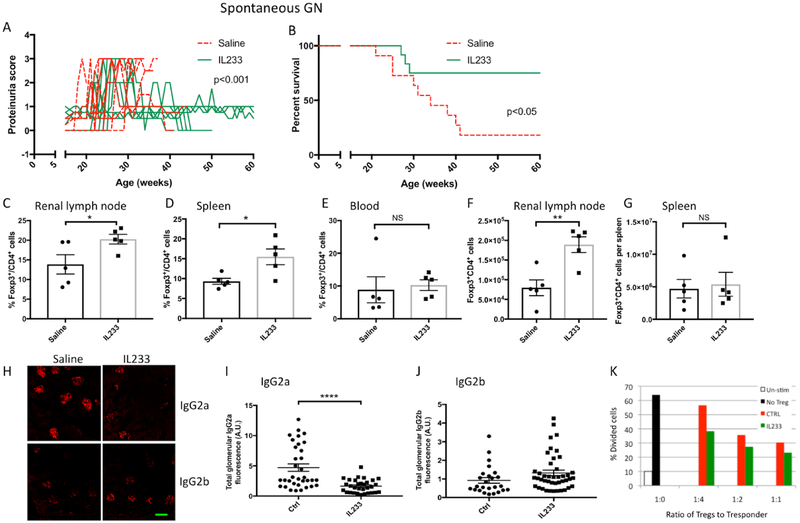
Figure 5.. IL233 treatment reverses proteinuria in NZM2328 with spontaneous lupus GN with prolonged survival.
Female NZM2328 mice were monitored for proteinuria. Once the mice had moderate proteinuria (>100mg/dL) for 2 weeks, they were injected (i.p.) with 66pmol/mouse of IL233 (n=12) or saline (n=11) daily for 5 days. IL233 treatment reversed severe spontaneous proteinuria (A) (also see supplemental Figure 1B) and reduced mortality (B) in NZM2328 mice compared to saline controls. Levels of Tregs in NZM2328 mice in renal lymph nodes (C and F), Spleen (D and G) and blood (E). H. Glomerular immune complex deposits were analyzed for IgG2a (I) and IgG2b (J) subtypes by immunofluorescence and quantified by ImageJ as described in section 2.3 in materials and methods. K. CD4+CD25+ Tregs isolated from pooled lymph nodes of IL233 treated mice (4 mice) more efficiently inhibited the proliferation of CD4+CD25 Tresponder cells compared to pooled Tregs isolated from saline controls (4 mice). Lines in (A) represent individual mice. The truncation of red lines in panel (A) indicates that mice either died or were euthanized due to severe proteinuria; Green scale bar in (H) is 50μM; p value: *<0.05; **<0.01, ****<0.0001 and NS p>0.05.
Figure 6.
Figure 6.. IL233 prevents lupus-GN prone MRL/lpr mice from the development GN.
Female MRL/lpr mice (10 weeks old) were injected (i.p.) with 66 pmol/mouse of IL233 or saline daily for 5 days. A. IL233 treatment protected MRL/lpr mice from the development of severe proteinuria (individual mice are shown above and mean ± SEM is shown in the lower panel). B. Kidneys of saline-treated, but not IL233-treated mice showed enlarged glomeruli with marked cellular infiltration and sclerosis, interstitial cellular infiltration, dilated tubules and fibrosis. C. Decrease in inflammatory scores in the kidneys of IL233 treated mice. D. The pathological changes in IL233 were accompanied by the increase in Treg (fold change in %Foxp3+ cells) and IL-2 producing cells (E). IL233 treated MRL/lpr mice had reduced proportions of recently activated (CD69+) (F), memory (CD44+CD62L+) (G) and follicular T-helper cells (H). In the renal lymph nodes there were fewer CD11b+ (I) and CD11c+ (L) cells, which had lower expression of CD80 (J and M) and CD86 (K and N). In IL233-treated mice, there was a trend for lower anti-dsDNA IgG2a (O) and higher anti-ds IgG2b (P) antibodies, with a higher trend for the ratio of IgG2b to IgG2a anti-dsDNA in the IL233 group (Q). Yellow circles - glomeruli and green scale bars - 50μM in panel B. Symbols represent individual mice; n=10 for (A to B) and 7–9 for D to N; p value: *<0.05, **<0.001, and ***<0.001.

References

    1. Tsokos GC (2011) Systemic lupus erythematosus. The New England journal of medicine 365, 2110–2121 - PubMed
    1. Crow MK (2009) Developments in the clinical understanding of lupus. Arthritis research & therapy 11, 245. - PMC - PubMed
    1. Cervera R, Khamashta MA, Font J, Sebastiani GD, Gil A, Lavilla P, Mejia JC, Aydintug AO, Chwalinska-Sadowska H, de Ramon E, Fernandez-Nebro A, Galeazzi M, Valen M, Mathieu A, Houssiau F, Caro N, Alba P, Ramos-Casals M, Ingelmo M, and Hughes GR (2003) Morbidity and mortality in systemic lupus erythematosus during a 10-year period: a comparison of early and late manifestations in a cohort of 1,000 patients. Medicine 82, 299–308 - PubMed
    1. Ward MM (2000) Changes in the incidence of end-stage renal disease due to lupus nephritis, 1982–1995. Archives of internal medicine 160, 3136–3140 - PubMed
    1. Paz Z, and Tsokos GC (2013) New therapeutics in systemic lupus erythematosus. Current opinion in rheumatology 25, 297–303 - PubMed

Publication types