


Neuroinflammation as a risk factor for attention deficit hyperactivity disorder
- PMID: 31103523
- PMCID: PMC6855401
- DOI: 10.1016/j.pbb.2019.05.005
Neuroinflammation as a risk factor for attention deficit hyperactivity disorder
Abstract
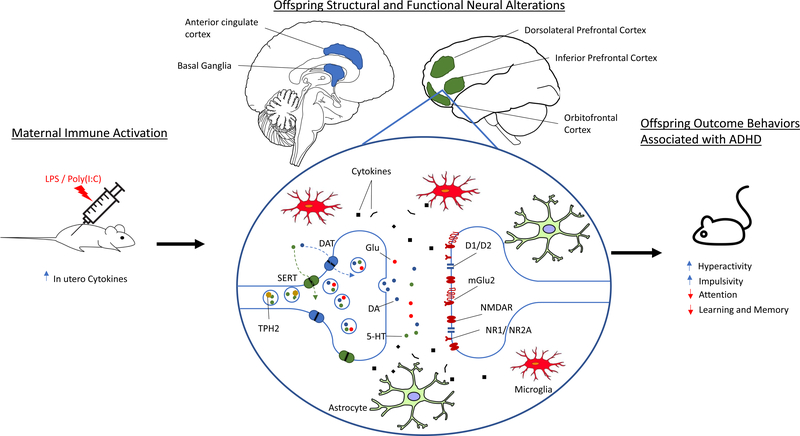
Attention Deficit Hyperactivity Disorder (ADHD) is a persistent, and impairing pediatric-onset neurodevelopmental condition. Its high prevalence, and recurrent controversy over its widespread identification and treatment, drive strong interest in its etiology and mechanisms. Emerging evidence for a role for neuroinflammation in ADHD pathophysiology is of great interest. This evidence includes 1) the above-chance comorbidity of ADHD with inflammatory and autoimmune disorders, 2) initial studies indicating an association with ADHD and increased serum cytokines, 3) preliminary evidence from genetic studies demonstrating associations between polymorphisms in genes associated with inflammatory pathways and ADHD, 4) emerging evidence that early life exposure to environmental factors may increase risk for ADHD via an inflammatory mechanism, and 5) mechanistic evidence from animal models of maternal immune activation documenting behavioral and neural outcomes consistent with ADHD. Prenatal exposure to inflammation is associated with changes in offspring brain development including reductions in cortical gray matter volume and the volume of certain cortical areas -parallel to observations associated with ADHD. Alterations in neurotransmitter systems, including the dopaminergic, serotonergic and glutamatergic systems, are observed in ADHD populations. Animal models provide strong evidence that development and function of these neurotransmitters systems are sensitive to exposure to in utero inflammation. In summary, accumulating evidence from human studies and animal models, while still incomplete, support a potential role for neuroinflammation in the pathophysiology of ADHD. Confirmation of this association and the underlying mechanisms have become valuable targets for research. If confirmed, such a picture may be important in opening new intervention routes.
Keywords: Maternal immune activation; Neurodevelopmental.
Copyright © 2019 Elsevier Inc. All rights reserved.
Figures
References
-
- Abazyan B, Nomura J, Kannan G, Ishizuka K, Tamashiro KL, Nucifora F, Pogorelov V, Ladenheim B, Yang C, Krasnova IN, Cadet JL, Pardo C, Mori S, Kamiya A, Vogel MW, Sawa A, Ross CA, Pletnikov MV, 2010. Prenatal interaction of mutant DISC1 and immune activation produces adult psychopathology. Biol Psychiatry 68(12), 1172–1181. - PMC - PubMed
-
- Allard MJ, Bergeron JD, Baharnoori M, Srivastava LK, Fortier LC, Poyart C, Sebire G, 2017. A sexually dichotomous, autistic-like phenotype is induced by Group B Streptococcus maternofetal immune activation. Autism Res 10(2), 233–245. - PubMed
Publication types
MeSH terms
Substances
Grants and funding
LinkOut - more resources
Full Text Sources
Medical
