


Risks and clinical predictors of cirrhosis and hepatocellular carcinoma diagnoses in adults with diagnosed NAFLD: real-world study of 18 million patients in four European cohorts
- PMID: 31104631
- PMCID: PMC6526616
- DOI: 10.1186/s12916-019-1321-x
Risks and clinical predictors of cirrhosis and hepatocellular carcinoma diagnoses in adults with diagnosed NAFLD: real-world study of 18 million patients in four European cohorts
Abstract
Background: Non-alcoholic fatty liver disease (NAFLD) is a common condition that progresses in some patients to steatohepatitis (NASH), cirrhosis and hepatocellular carcinoma (HCC). Here we used healthcare records of 18 million adults to estimate risk of acquiring advanced liver disease diagnoses in patients with NAFLD or NASH compared to individually matched controls.
Methods: Data were extracted from four European primary care databases representing the UK, Netherlands, Italy and Spain. Patients with a recorded diagnosis of NAFLD or NASH (NAFLD/NASH) were followed up for incident cirrhosis and HCC diagnoses. Each coded NAFLD/NASH patient was matched to up to 100 "non-NAFLD" patients by practice site, gender, age ± 5 years and visit recorded within ± 6 months. Hazard ratios (HR) were estimated using Cox models adjusted for age and smoking status and pooled across databases by random effects meta-analyses.
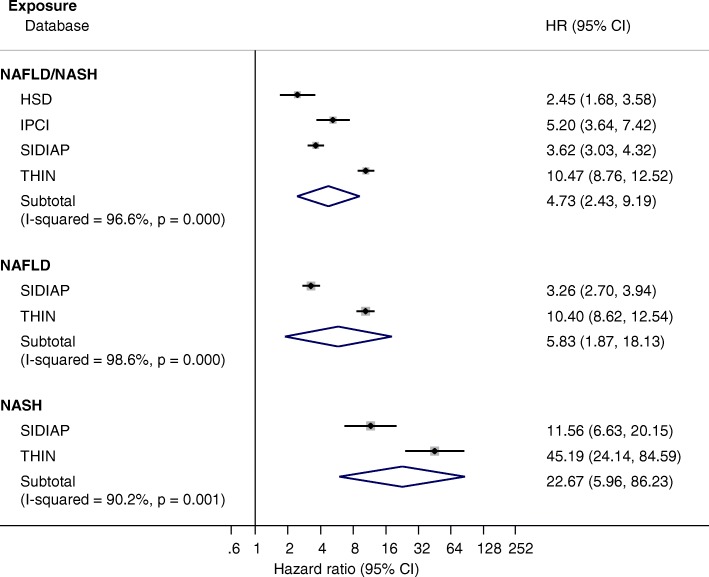
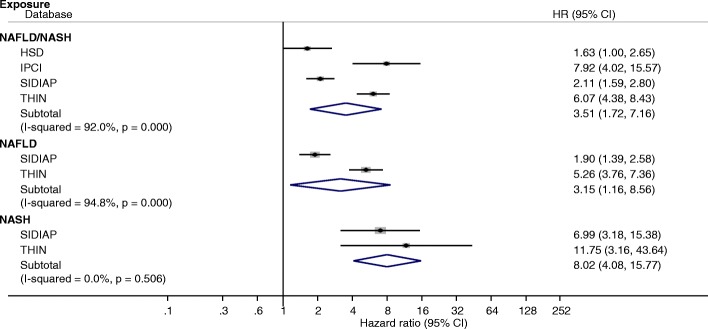
Results: Out of 18,782,281 adults, we identified 136,703 patients with coded NAFLD/NASH. Coded NAFLD/NASH patients were more likely to have diabetes, hypertension and obesity than matched controls. HR for cirrhosis in patients compared to controls was 4.73 (95% CI 2.43-9.19) and for HCC, 3.51 (95% CI 1.72-7.16). HR for either outcome was higher in patients with NASH and those with high-risk Fib-4 scores. The strongest independent predictor of a diagnosis of HCC or cirrhosis was baseline diagnosis of diabetes.
Conclusions: Real-world population data show that recorded diagnosis of NAFLD/NASH increases risk of life-threatening liver outcomes. Diabetes is an independent predictor of advanced liver disease diagnosis, emphasising the need to identify specific groups of patients at highest risk.
Keywords: Cirrhosis; Hepatocellular cancer; NAFLD; NASH; Population.
Conflict of interest statement
MA was contracted to work at and SK and DMW are employees of GlaxoSmithKline which has conducted clinical research including trials of therapeutic agents in NAFLD. AKL is an employee of Pfizer which is conducting clinical research including trials of therapeutic agents in NAFLD. TDS: none to declare. DP-A: unrestricted research grants from UCB, Amgen, Servier, and consultancy fees (paid to his department/research group) from UCB Pharma. DA: consultancy and advice to many pharmaceutical companies on undertaking outcomes studies using real-world evidence. FL: consultancy for AlfaSigma, Bayer and Abbvie. SK: Employee and stock holder, GlaxoSmithKline. NS: consulted for Boehringer Ingelheim, Eli Lilly, Novo Nordisk, Janssen, and grants from Astrazeneca and BI. WA: Consultant and sponsored lectures: UCB Pharma, Gilead, Intercept and Medimmune.
Figures
Comment in
-
Assessing the disease burden of non-alcoholic fatty liver disease in the real world - big data and big numbers.BMC Med. 2019 Jul 4;17(1):123. doi: 10.1186/s12916-019-1357-y. BMC Med. 2019. PMID: 31269936 Free PMC article. No abstract available.
References
Publication types
MeSH terms
Grants and funding
LinkOut - more resources
Full Text Sources
Other Literature Sources
Medical
