


Ultra-Processed Diets Cause Excess Calorie Intake and Weight Gain: An Inpatient Randomized Controlled Trial of Ad Libitum Food Intake
- PMID: 31105044
- PMCID: PMC7946062
- DOI: 10.1016/j.cmet.2019.05.008
Ultra-Processed Diets Cause Excess Calorie Intake and Weight Gain: An Inpatient Randomized Controlled Trial of Ad Libitum Food Intake
Erratum in
-
Ultra-Processed Diets Cause Excess Calorie Intake and Weight Gain: An Inpatient Randomized Controlled Trial of Ad Libitum Food Intake.Cell Metab. 2019 Jul 2;30(1):226. doi: 10.1016/j.cmet.2019.05.020. Cell Metab. 2019. PMID: 31269427 Free PMC article. No abstract available.
-
Ultra-Processed Diets Cause Excess Calorie Intake and Weight Gain: An Inpatient Randomized Controlled Trial of Ad Libitum Food Intake.Cell Metab. 2020 Oct 6;32(4):690. doi: 10.1016/j.cmet.2020.08.014. Cell Metab. 2020. PMID: 33027677 No abstract available.
Abstract
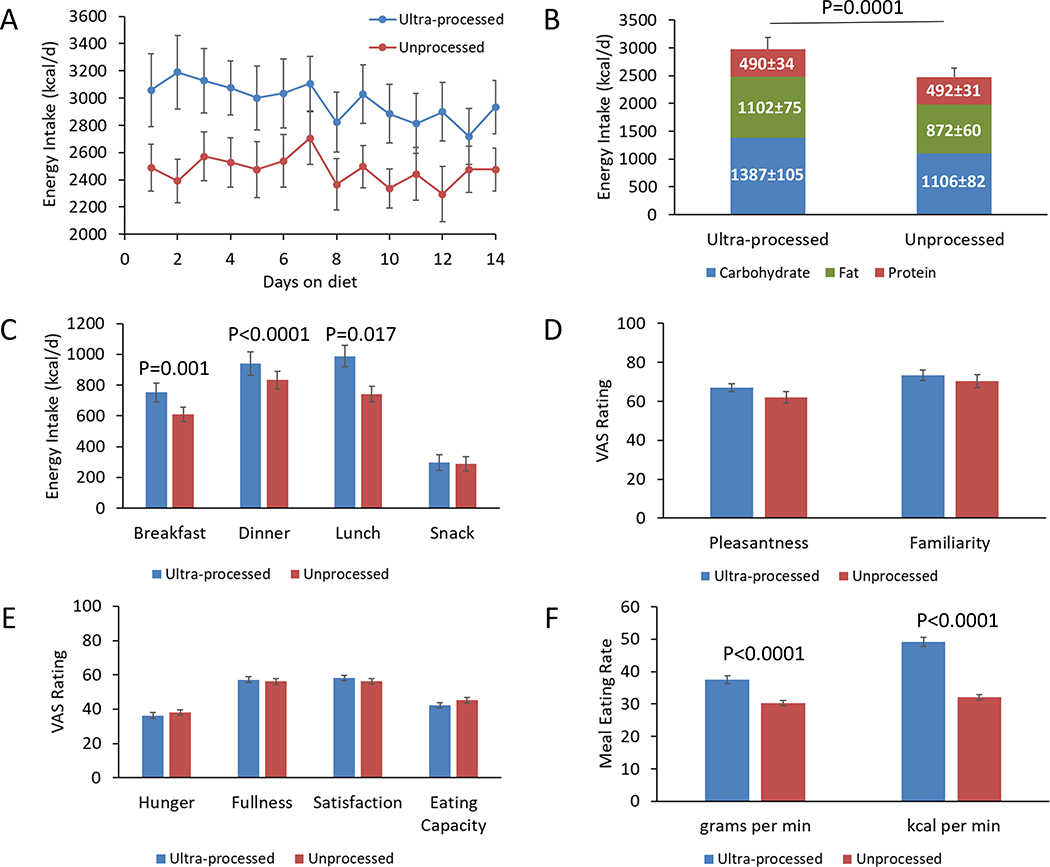
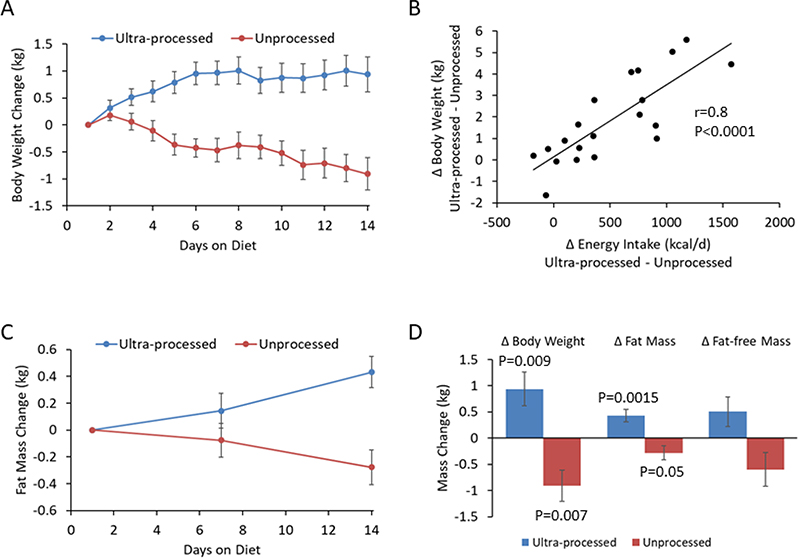
We investigated whether ultra-processed foods affect energy intake in 20 weight-stable adults, aged (mean ± SE) 31.2 ± 1.6 years and BMI = 27 ± 1.5 kg/m2. Subjects were admitted to the NIH Clinical Center and randomized to receive either ultra-processed or unprocessed diets for 2 weeks immediately followed by the alternate diet for 2 weeks. Meals were designed to be matched for presented calories, energy density, macronutrients, sugar, sodium, and fiber. Subjects were instructed to consume as much or as little as desired. Energy intake was greater during the ultra-processed diet (508 ± 106 kcal/day; p = 0.0001), with increased consumption of carbohydrate (280 ± 54 kcal/day; p < 0.0001) and fat (230 ± 53 kcal/day; p = 0.0004), but not protein (-2 ± 12 kcal/day; p = 0.85). Weight changes were highly correlated with energy intake (r = 0.8, p < 0.0001), with participants gaining 0.9 ± 0.3 kg (p = 0.009) during the ultra-processed diet and losing 0.9 ± 0.3 kg (p = 0.007) during the unprocessed diet. Limiting consumption of ultra-processed foods may be an effective strategy for obesity prevention and treatment.
Trial registration: ClinicalTrials.gov NCT03407053.
Keywords: diet quality; energy balance; energy intake; processed food; weight gain; weight loss.
Published by Elsevier Inc.
Conflict of interest statement
Declaration of Interests
CG Forde has received reimbursement for speaking at conferences sponsored by companies selling nutritional products, serves on the scientific advisory council for Kerry Taste and Nutrition, and is part of an academic consortium that has received research funding from Abbott Nutrition, Nestec, and Danone. The other authors have no conflicts of interest.
Figures

Comment in
-
Freshly Prepared Meals and Not Ultra-Processed Foods.Cell Metab. 2019 Jul 2;30(1):5-6. doi: 10.1016/j.cmet.2019.06.006. Epub 2019 Jun 20. Cell Metab. 2019. PMID: 31230986 No abstract available.
-
Ultra-Processed Food and Obesity: The Pitfalls of Extrapolation from Short Studies.Cell Metab. 2019 Jul 2;30(1):3-4. doi: 10.1016/j.cmet.2019.06.004. Epub 2019 Jun 20. Cell Metab. 2019. PMID: 31230987 No abstract available.
-
Challenges Interpreting Inpatient and Outpatient Human Nutrition Studies.Cell Metab. 2019 Aug 6;30(2):227-228. doi: 10.1016/j.cmet.2019.06.015. Epub 2019 Jul 1. Cell Metab. 2019. PMID: 31272848 No abstract available.
References
-
- Baer DJ, Rumpler WV, Miles CW, and Fahey GC Jr. (1997). Dietary fiber decreases the metabolizable energy content and nutrient digestibility of mixed diets fed to humans. J Nutr 127, 579–586. - PubMed
-
- Black AE, and Cole TJ (2000). Within- and between-subject variation in energy expenditure measured by the doubly-labelled water technique: implications for validating reported dietary energy intake. Eur J Clin Nutr 54, 386–394. - PubMed
-
- Blatt H (2008). America’s food: What you don’t know about what you eat. (Cambridge: The MIT press; ).
Publication types
MeSH terms
Substances
Associated data
Grants and funding
LinkOut - more resources
Full Text Sources
Other Literature Sources
Medical
