


Habit Reversal Therapy in Obsessive Compulsive Related Disorders: A Systematic Review of the Evidence and CONSORT Evaluation of Randomized Controlled Trials
- PMID: 31105537
- PMCID: PMC6491945
- DOI: 10.3389/fnbeh.2019.00079
Habit Reversal Therapy in Obsessive Compulsive Related Disorders: A Systematic Review of the Evidence and CONSORT Evaluation of Randomized Controlled Trials
Abstract
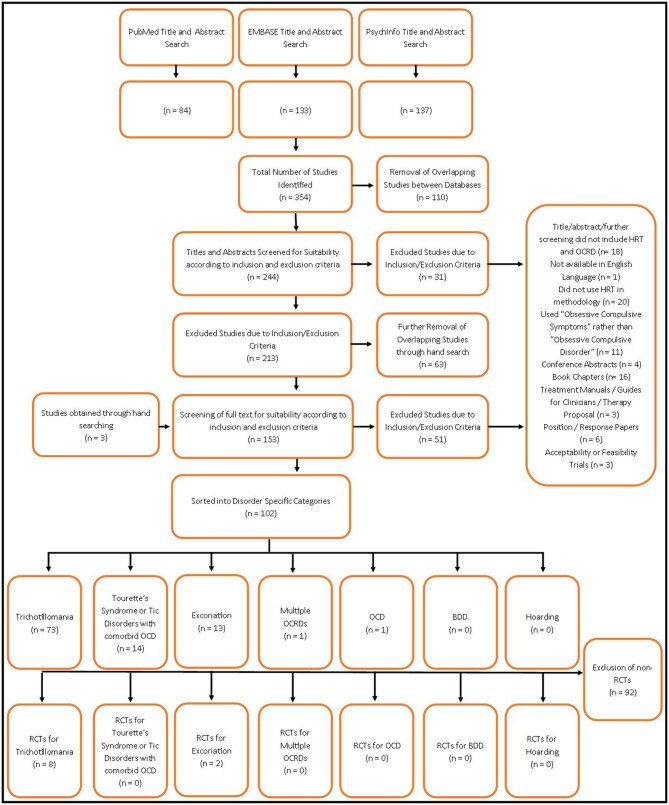
Background: Habit Reversal Therapy (HRT) has long been used in the treatment of Tourette Syndrome and Tic Disorders. It has more recently been used to treat Trichotillomania and skin picking behaviors, both considered as Obsessive Compulsive Related Disorders (OCRD). Objectives: This literature review sought to establish and quality assess the existing randomized controlled trial evidence supporting the use of HRT in the DSM-5 family of OCRDs. Search Methods: EMBASE, PsycINFO, PubMed, and Cochrane databases were searched for key terms relating to each OCRD (as classified in the DSM-5), and HRT. Selection Criteria: Titles and abstracts were screened, and any literature matching pre-specified criteria were then selected to be reviewed further. Of these, 8 Randomized Controlled Trials (RCT) relating to Trichotillomania, and 2 RCTs relating to Excoriation Disorder, were extracted and reviewed against the 2010 Consolidating Standards of Reporting Trials (CONSORT) statement. Results: The review identified 10 RCTs of HRT, but these were limited to patients with a primary diagnosis of Trichotillomania or "excoriation behavior," only. There were some reports of the use of HRT in Tourette Syndrome or Tic Disorder with secondary OCD, but the OCD symptoms were not reliably reported on. Conclusion: There is a gap in the current literature regarding the use of HRT in the DSM-5 OCRDs. In those RCTs that have been reported, the quality of study methodology was questionable as evaluated by CONSORT criteria. The implications of these findings are discussed, and suggestions are made for future research.
Keywords: HRT; RCT; habit; habit reversal therapy; obsessive compulsive and related disorders; randomized controlled trial.
References
-
- American Psychiatric Association (2013). Diagnostic and Statistical Manual of Mental Disorders, 5th Edn. Washington, DC: American Psychiatric Association; 10.1176/appi.books.9780890425596 - DOI
-
- *. Azrin N. H., Nunn R. G., Frantz S. E. (1980). Treatment of hairpulling (trichotillomania): a comparative study of habit reversal and negative practice training. J. Behav. Ther. Exp. Psychiatry 11, 13–20. 10.1016/0005-7916(80)90045-2 - DOI
Publication types
LinkOut - more resources
Full Text Sources
Miscellaneous
