


Saliva cotinine concentrations in pregnant women who smoke and use nicotine patches
- PMID: 31106486
- PMCID: PMC6771792
- DOI: 10.1111/add.14662
Saliva cotinine concentrations in pregnant women who smoke and use nicotine patches
Abstract
Background and aims: Due to concerns about increased exposure to nicotine, pregnant women using nicotine replacement therapy (NRT) to stop smoking are usually advised to stop using NRT if they relapse to smoking. This study investigated whether this is justified. We compared changes in saliva cotinine from baseline to 2 weeks post-target quit date pregnant smokers who relapsed to smoking and continued to use their patches having been assigned to use nicotine patches or placebo.
Design and setting: Controlled pre-post design stratified by intervention condition from the 'Study of Nicotine Patch in Pregnancy', a randomized, placebo-controlled trial.
Participants: A sample of 268 pregnant women, assigned placebo (n = 122) or nicotine (n = 146) patches, who returned for further supplies of patches and who reported any smoking in the week prior to a visit at 2 weeks after their target quit date.
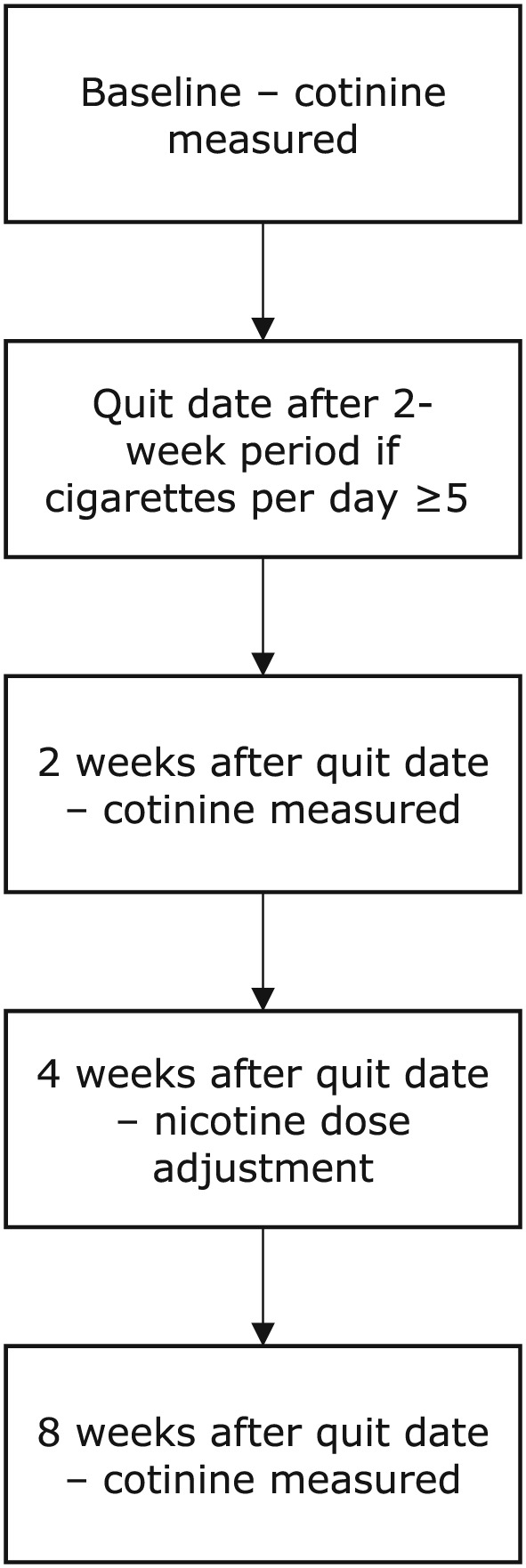
Measurements: Saliva cotinine concentrations were measured at baseline and 2 weeks after participants' target quit dates. Any smoking in the previous week was assessed by self-report, validated by expired air carbon monoxide (CO).
Findings: There was no change in saliva cotinine concentrations between baseline and 2 weeks post-target quit date in saliva cotinine concentration in the nicotine patch group [ratio of geometric means = 0.94, 95% confidence interval (CI) = 0.83 to 1.07; P = 0.37, Bayes factor = 0.15]. However, there was a reduction in reported number of cigarettes smoked/day (mean difference -6, 95% CIs -7 to -5, P < 0.001) and in CO concentrations (mean difference -3.0 parts per million, 95% CIs -4.2 to -1.9, P < 0.001). These changes were not significantly different from changes in the placebo group except for cigarette consumption, which reduced more in the nicotine group (P = 0.046).
Conclusions: In women trying to stop smoking with the aid of a nicotine patch but having smoked at 2 weeks post-target quit, their nicotine concentration did not change from baseline, but they reported smoking fewer cigarettes and had lower carbon monoxide concentrations.
Keywords: Cotinine; nicotine; nicotine replacement therapy; pregnancy; smoking; smoking cessation.
© 2019 The Authors. Addiction published by John Wiley & Sons Ltd on behalf of Society for the Study of Addiction.
Figures
References
-
- Flenady V., Wojcieszek A. M., Middleton P., Ellwood D., Erwich J. J., Coory M. et al Stillbirths: recall to action in high‐income countries. Lancet 2016; 387: 691–702. - PubMed
-
- Department of Health (DoH) Towards a Smokefree Generation In: A Tobacco Control Plan for England. London: DoH; 2017. (Archived at http://www.webcitation.org/78l5xLiiQ on accessed 30 May 2019).
-
- McAndrew F., Thompson J., Fellows L., Large A., Speed M., Renfrew M. J. Infant Feeding Survey 2010. Leeds: Health and Social Care Information Centre; 2012. (Archived at http://www.webcitation.org/78l6dgvNw on accessed 30 May 2019).
-
- Tong V. T., Dietz P. M., Morrow B., D’Angelo D. V., Farr S. L., Rockhill K. M., et al. Trends in smoking before, during, and after pregnancy—Pregnancy Risk Assessment Monitoring System, United States, 40 sites, 2000–2010. Morbidity and Mortality Weekly Report: Surveillance Summaries. 2013;62(6):1–19. - PubMed
Publication types
MeSH terms
Substances
LinkOut - more resources
Full Text Sources
Medical
