


The carboxy-terminus, a key regulator of protein function
- PMID: 31106589
- PMCID: PMC6568268
- DOI: 10.1080/10409238.2019.1586828
The carboxy-terminus, a key regulator of protein function
Abstract
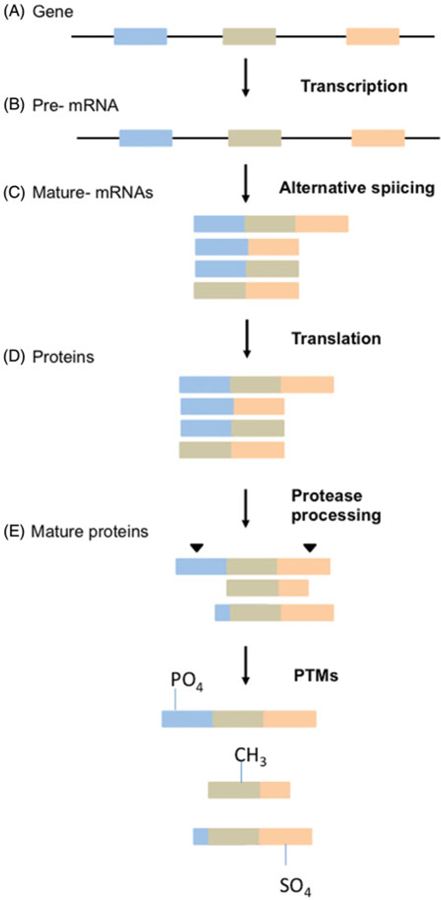
All proteins end with a carboxyl terminus that has unique biophysical properties and is often disordered. Although there are examples of important C-termini functions, a more global role for the C-terminus is not yet established. In this review, we summarize research on C-termini, a unique region in proteins that cells exploit. Alternative splicing and proteolysis increase the diversity of proteins and peptides in cells with unique C-termini. The C-termini of proteins contain minimotifs, short peptides with an encoded function generally characterized as binding, posttranslational modifications, and trafficking. Many of these activities are specific to minimotifs on the C-terminus. Approximately 13% of C-termini in the human proteome have a known minimotif, and the majority, if not all of the remaining termini have conserved motifs inferring a function that remains to be discovered. C-termini, their predictions, and their functions are collated in the C-terminome, Proteus, and Terminus Oriented Protein Function INferred Database (TopFIND) database/web systems. Many C-termini are well conserved, and some have a known role in health and disease. We envision that this summary of C-termini will guide future investigation of their biochemical and physiological significance.
Keywords: C-terminal minimotifs; C-terminome; C-terminus; minimotifs; posttranslational modification; short linear motifs; trafficking.
Conflict of interest statement
Disclosure statement
No potential conflict of interest was reported by the authors.
Figures
References
-
- Ahmad M, Zhang Y, Zhang Y, Papharalambus C, Alexander RW. 2002. Role of isoprenylcysteine carboxyl methyltransferase in tumor necrosis factor-alpha stimulation of expression of vascular cell adhesion molecule-1 in endothelial cells. Arter Thromb Vasc Biol 22:759–764. - PubMed
-
- Asami-Odaka A, Obayashi-Adachi Y, Matsumoto Y, Takahashi H, Fukumoto H, Horiguchi T, Suzuki N, Shoji M. 2005. Passive immunization of the Abeta42(43) C-terminalspecific antibody BC05 in a mouse model of Alzheimer’s disease. Neurodegener Dis 2:36–43. - PubMed
-
- Attwood TK, Avison H, Beck ME, Bewley M, Bleasby AJ, Brewster F, Cooper P, Degtyarenko K, Geddes AJ, Flower DR, et al. 1997. The PRINTS database of protein fingerprints: a novel information resource for computational molecular biology. J Chem Inf Comput Sci 37:417–424. - PubMed
Publication types
MeSH terms
Substances
Grants and funding
LinkOut - more resources
Full Text Sources
