. 2019 May 17;20(10):2441.
doi: 10.3390/ijms20102441.

Protective Effects of Caffeic Acid Phenethyl Ester (CAPE) and Novel Cape Analogue as Inducers of Heme Oxygenase-1 in Streptozotocin-Induced Type 1 Diabetic Rats

Affiliations

Protective Effects of Caffeic Acid Phenethyl Ester (CAPE) and Novel Cape Analogue as Inducers of Heme Oxygenase-1 in Streptozotocin-Induced Type 1 Diabetic Rats

Valeria Sorrenti et al. Int J Mol Sci. .

Abstract

Type 1 diabetes mellitus (T1D) is a chronic autoimmune disease resulting in the destruction of insulin producing β-cells of the pancreas, with consequent insulin deficiency and excessive glucose production. Hyperglycemia results in increased levels of reactive oxygen species (ROS) and nitrogen species (RNS) with consequent oxidative/nitrosative stress and tissue damage. Oxidative damage of the pancreatic tissue may contribute to endothelial dysfunction associated with diabetes. The aim of the present study was to investigate if the potentially protective effects of phenethyl ester of caffeic acid (CAPE), a natural phenolic compound occurring in a variety of plants and derived from honeybee hive propolis, and of a novel CAPE analogue, as heme oxygenase-1 (HO-1) inducers, could reduce pancreatic oxidative damage induced by excessive amount of glucose, affecting the nitric oxide synthase/dimethylarginine dimethylaminohydrolase (NOS/DDAH) pathway in streptozotocin-induced type 1 diabetic rats. Our data demonstrated that inducible nitric oxide synthase/gamma-Glutamyl-cysteine ligase (iNOS/GGCL) and DDAH dysregulation may play a key role in high glucose mediated oxidative stress, whereas HO-1 inducers such as CAPE or its more potent derivatives may be useful in diabetes and other stress-induced pathological conditions.

Keywords: Caffeic acid phenethyl ester (CAPE); Dimethylarginine dimethylaminohydrolase-1 (DDAH-1); Gamma-Glutamyl-Cysteine Ligase (GGCL); Heme oxygenase-1 (HO-1) inducers; Inducible nitric oxide synthase (iNOS); Pancreatic oxidative damage; Reactive oxygen species (ROS); Type 1 diabetes mellitus (T1D).


Conflict of interest statement

The authors declare no conflict of interest.

Figures
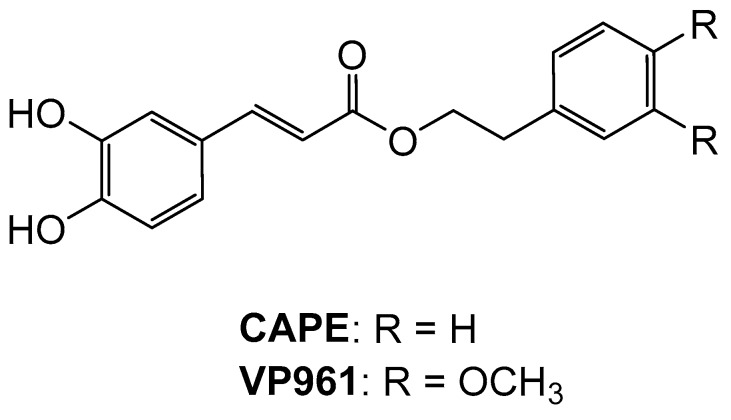
Figure 1
Figure 1
Chemical structure of caffeic acid phenethyl ester (CAPE) and VP961-CAPE derivative.
Figure 2
Figure 2
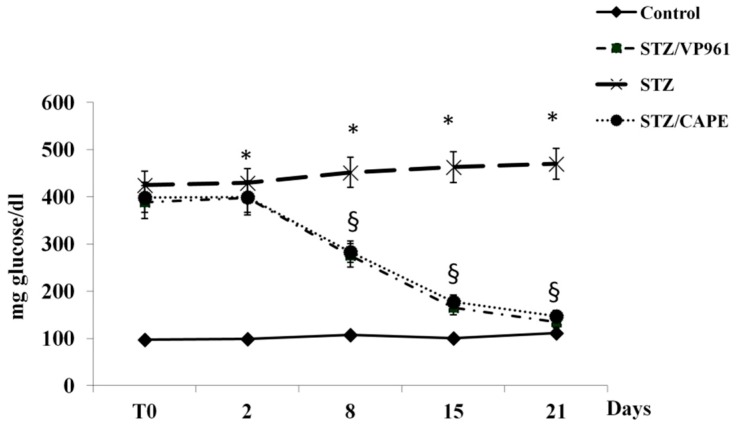
Effects of CAPE and VP961 on blood glucose content during the experimental period. Values are mean ± standard deviation (S.D.) of three independent experiments performed in triplicate. * p < 0.05 vs. normal control rats; § p < 0.05 vs. diabetic control rats (STZ).
Figure 3
Figure 3
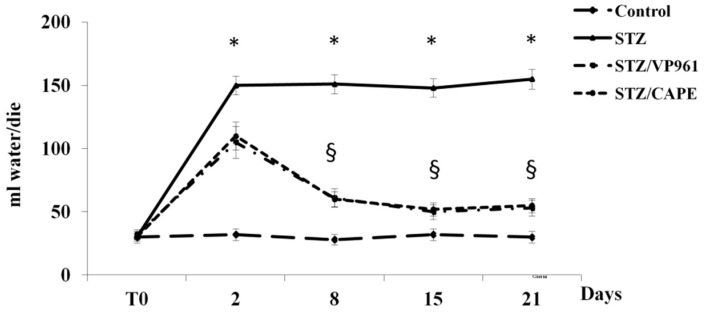
Effects of CAPE and VP961 on water intake during the experimental period. Values are mean ± standard deviation (S.D.) of three independent experiments performed in triplicate. * p < 0.05 vs. normal control rats; § p < 0.05 vs. diabetic control rats (STZ).
Figure 4
Figure 4
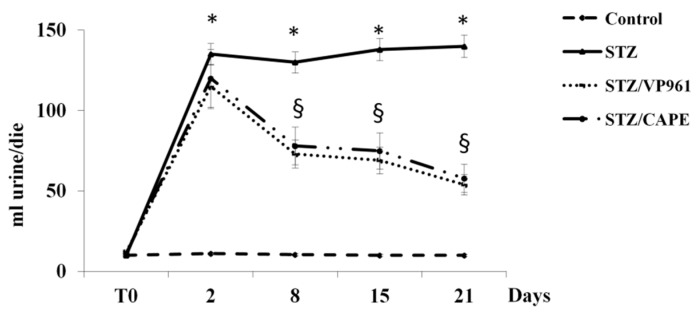
Effects of CAPE and VP961 on volume of urine excreted during the experimental period. Values are mean ± standard deviation (S.D.) of three independent experiments performed in triplicate. * p < 0.05 vs. normal control rats; § p < 0.05 vs. diabetic control rats (STZ).
Figure 5
Figure 5
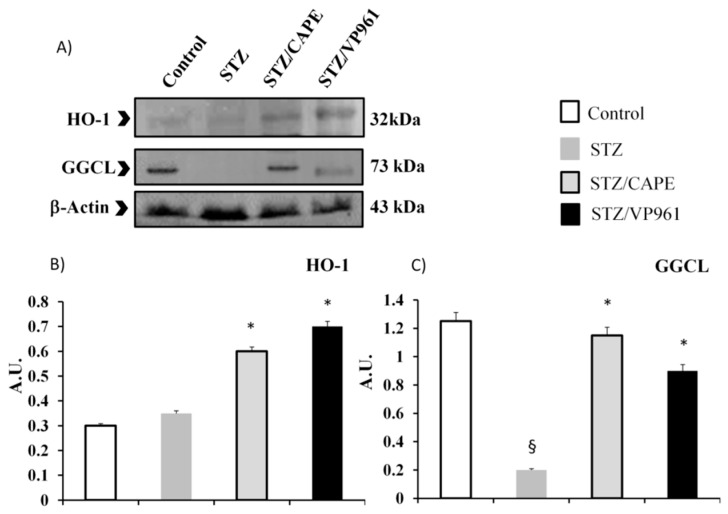
Representative Western blotting of HO-1 and GGCL protein expressions (Panel A). Densitometric quantification of HO-1 and GGCL protein expressions in the pancreas of non-STZ rats (control), STZ rats, and CAPE- or VP961-treated STZ rats (CAPE/STZ; VP961/STZ) (Panel B,C). Values are mean ± standard deviation (S.D.) of three independent experiments performed in triplicate. * p < 0.05 vs. diabetic control rats (STZ); § p < 0.05 vs. normal control rats.
Figure 6
Figure 6
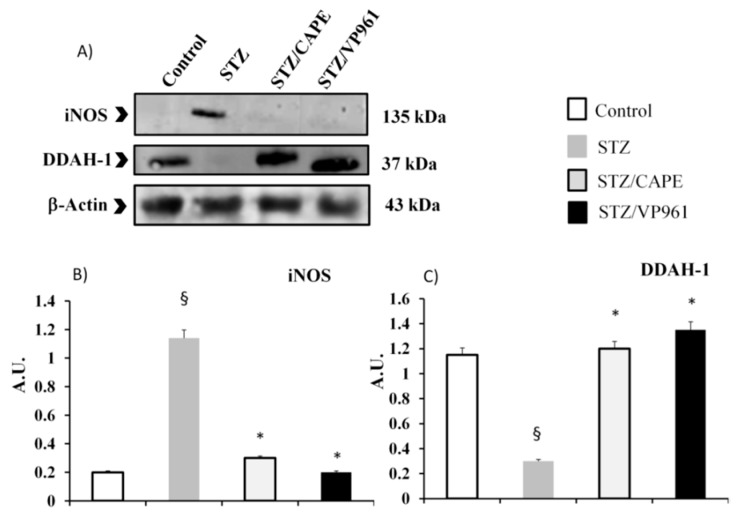
Representative Western blotting of iNOS and DDAH-1 protein expressions (Panel A). Densitometric quantification of iNOS and DDAH-1 protein expressions in the pancreas of non-STZ rats (control), STZ rats, and CAPE- or VP961-treated STZ rats (CAPE/STZ; VP961/STZ) (Panel B,C). Values are mean ± standard deviation (S.D.) of three independent experiments performed in triplicate. * p < 0.05 vs. diabetic control rats (STZ); § p < 0.05 vs. normal control rats.

References

    1. Pinto A., Tuttolomondo A., Di Raimondo D., Fernández P., La Placa S., Di Gati M., Licata G. Cardiovascular risk profile and morbidity in subjects affected by type 2 diabetes mellitus with and without diabetic foot. Metab. Clin. Exp. 2008;57:676–682. doi: 10.1016/j.metabol.2008.01.004. - DOI - PubMed
    1. Hermans M.P. Diabetes and the Endothelium. Acta Clin. Belg. 2007;62:97–101. doi: 10.1179/acb.2007.017. - DOI - PubMed
    1. Butler A.E., Janson J., Bonner-Weir S., Ritzel R., Rizza R.A., Butler P.C. Beta-cell deficit and increased beta-cell apoptosis in humans with type 2 diabetes. Diabetes. 2003;52:102–110. doi: 10.2337/diabetes.52.1.102. - DOI - PubMed
    1. Sobrevia L., Mann G. Dysfunction of the endothelial nitric oxide signalling pathway in diabetes and hyperglycaemia. Exp. Physiol. 1997;82:423–452. doi: 10.1113/expphysiol.1997.sp004038. - DOI - PubMed
    1. Lorenzi M., Cagliero E., Toledo S. Glucose Toxicity for Human Endothelial Cells in Culture: Delayed Replication, Disturbed Cell Cycle, and Accelerated Death. Diabetes. 1985;34:621–627. doi: 10.2337/diab.34.7.621. - DOI - PubMed

MeSH terms