


Neutrophil-to-Lymphocyte Ratio in Rectal Cancer-Novel Biomarker of Tumor Immunogenicity During Radiotherapy or Confounding Variable?
- PMID: 31108935
- PMCID: PMC6566677
- DOI: 10.3390/ijms20102448
Neutrophil-to-Lymphocyte Ratio in Rectal Cancer-Novel Biomarker of Tumor Immunogenicity During Radiotherapy or Confounding Variable?
Abstract
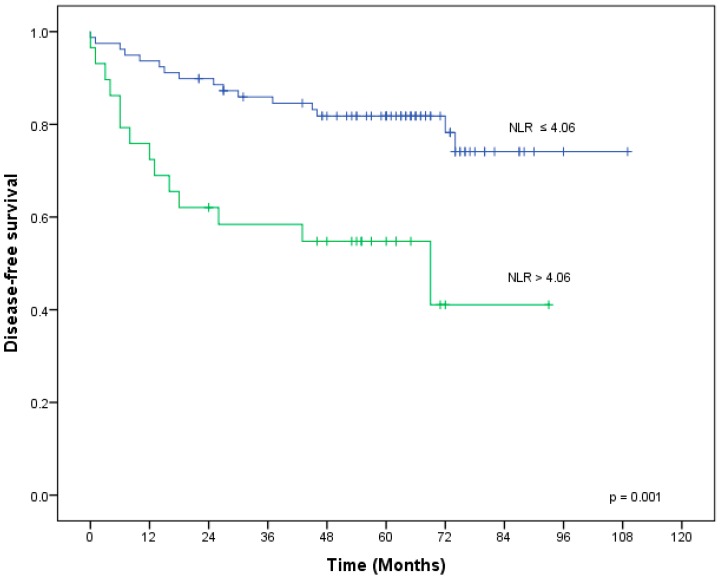
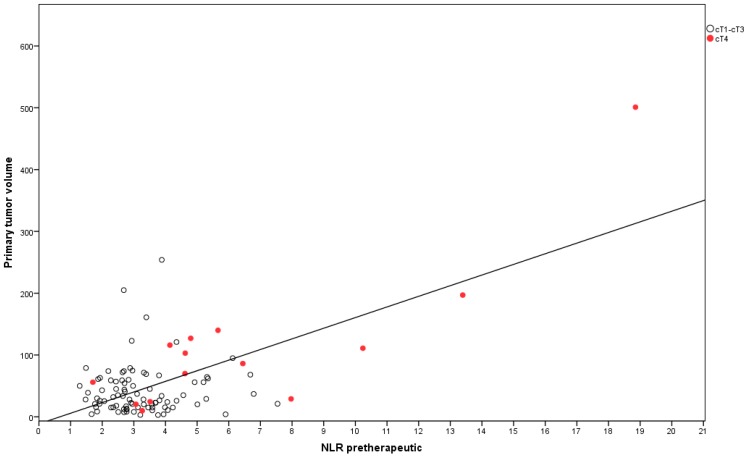
The aim of this study was to investigate the predictive value of blood-derived makers of local and systemic inflammatory responses on early and long-term oncological outcomes. A retrospective analysis of patients with locally advanced rectal cancer treated with preoperative long-course 5-fluorouracil-based radiochemotherapy was performed. Differential blood counts before neoadjuvant treatment were extracted from the patients' electronic charts. Optimal cut-off values for neutrophil-to-lymphocyte ratio (NLR), platelet-to-lymphocyte ratio (PLR), and lymphocyte-to-monocyte ratio (LMR) were determined. Potential clinical and hematological prognostic factors for disease-free survival (DFS) were studied using uni- and multivariate analysis. A total of 220 patients were included in the analysis. Median follow-up was 67 months. Five-year DFS and overall survival (OS) were 70% and 85%, respectively. NLR with a cut-off value of 4.06 was identified as optimal to predict DFS events. In multivariate analysis, only tumor volume (HR 0.33, 95% CI (0.14-0.83), p = 0.017) and NLR (HR 0.3, 95% CI (0.11-0.81), p = 0.017) remained significant predictors of DFS. Patients with a good histological response (Dworak 3 and 4) to radiotherapy also had a lower NLR than patients with less pronounced tumor regression (3.0 vs. 4.2, p = 0.015). A strong correlation between primary tumor volume and NLR was seen (Pearson's r = 0.64, p < 0.001). Moreover, patients with T4 tumors had a significantly higher NLR than patients with T1-T3 tumors (6.6 vs. 3.3, p < 0.001). An elevated pretherapeutic NLR was associated with higher T stage, inferior DFS, and poor pathological response to neoadjuvant radiochemotherapy. A strong correlation between NLR and primary tumor volume was seen. This association is important for the interpretation of study results and for the design of translational studies which are warranted.
Keywords: inflammation; leukocytosis; neoadjuvant radiotherapy; neutrophil-to-lymphocyte ratio; pathologic response; rectal cancer; tumor volume.
Conflict of interest statement
The department of Radiation Oncology Tübingen receives financial and technical support from Elekta AB (Stockholm, Sweden) under a research agreement, and financial support for educational events from Sennewald GmbH, Munich, Germany. C.G. and D.Z. have received travel grants from Elekta AB (Stockholm, Sweden).
Figures
References
-
- Mendenhall W.M., Bland K.I., Copeland E.M., Summers G.E., Pfaff W.W., Souba W.W., Million R.R. Does preoperative radiation therapy enhance the probability of local control and survival in high-risk distal rectal cancer? Ann. Surg. 1992;215:696–705. doi: 10.1097/00000658-199206000-00017. discussion 705–706. - DOI - PMC - PubMed
-
- Rödel C., Graeven U., Fietkau R., Hohenberger W., Hothorn T., Arnold D., Hofheinz R.-D., Ghadimi M., Wolff H.A., Lang-Welzenbach M., et al. Oxaliplatin added to fluorouracil-based preoperative chemoradiotherapy and postoperative chemotherapy of locally advanced rectal cancer (the German CAO/ARO/AIO-04 study): final results of the multicentre, open-label, randomised, phase 3 trial. Lancet. Oncol. 2015;16:979–989. doi: 10.1016/S1470-2045(15)00159-X. - DOI - PubMed
-
- Maas M., Nelemans P.J., Valentini V., Das P., Rödel C., Kuo L.-J., Calvo F.A., García-Aguilar J., Glynne-Jones R., Haustermans K., et al. Long-term outcome in patients with a pathological complete response after chemoradiation for rectal cancer: a pooled analysis of individual patient data. Lancet Oncol. 2010;11:835–844. doi: 10.1016/S1470-2045(10)70172-8. - DOI - PubMed
MeSH terms
Substances
LinkOut - more resources
Full Text Sources
