


Effects and Mechanisms of Tea Regulating Blood Pressure: Evidences and Promises
- PMID: 31109113
- PMCID: PMC6567086
- DOI: 10.3390/nu11051115
Effects and Mechanisms of Tea Regulating Blood Pressure: Evidences and Promises
Abstract
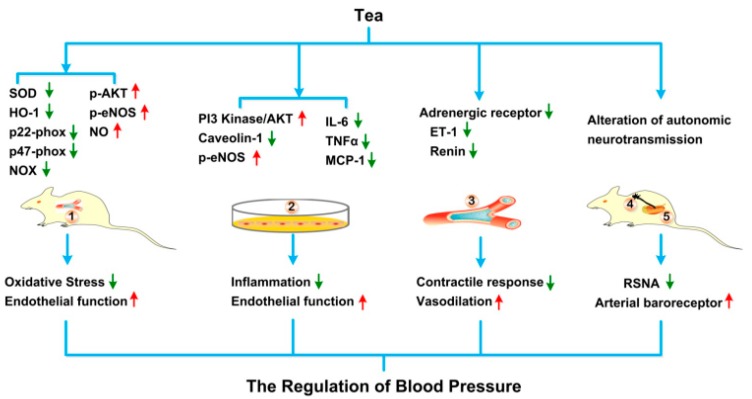
Cardiovascular diseases have overtaken cancers as the number one cause of death. Hypertension is the most dangerous factor linked to deaths caused by cardiovascular diseases. Many researchers have reported that tea has anti-hypertensive effects in animals and humans. The aim of this review is to update the information on the anti-hypertensive effects of tea in human interventions and animal studies, and to summarize the underlying mechanisms, based on ex-vivo tissue and cell culture data. During recent years, an increasing number of human population studies have confirmed the beneficial effects of tea on hypertension. However, the optimal dose has not yet been established owing to differences in the extent of hypertension, and complicated social and genetic backgrounds of populations. Therefore, further large-scale investigations with longer terms of observation and tighter controls are needed to define optimal doses in subjects with varying degrees of hypertensive risk factors, and to determine differences in beneficial effects amongst diverse populations. Moreover, data from laboratory studies have shown that tea and its secondary metabolites have important roles in relaxing smooth muscle contraction, enhancing endothelial nitric oxide synthase activity, reducing vascular inflammation, inhibiting rennin activity, and anti-vascular oxidative stress. However, the exact molecular mechanisms of these activities remain to be elucidated.
Keywords: endothelial function; hypertension; inflammation; tea secondary metabolites.
Conflict of interest statement
The authors declare no conflicts of interest.
Figures
References
-
- Mendis S., Puska P., Norrving B. Global Atlas on Cardiovascular Disease Prevention and Control. Geneva World Health Organizationn; Geneva, Switzerland: 2011.
-
- Lim S.S., Vos T., Flaxman A.D. A comparative risk assessment of burden of disease and injury attributable to 67 risk factor clusters in 21 regions, 1990–2010: A systematic analysis for the global Burden of Disease Study 2010. Lancet. 2012;380:2224–2260. doi: 10.1016/S0140-6736(12)61766-8. - DOI - PMC - PubMed
-
- Conti C.R. Diabetes, hypertension, and cardiovascular disease. Clin. Cardiol. 2001;24:1. - PubMed
-
- Horst-Meyer H.Z. Report on the World Health Organization Global Observatory for eHealth Strategic Planning Workshop. Meth. Inf. Med. 2008;47:381–387. - PubMed
Publication types
MeSH terms
Substances
Grants and funding
LinkOut - more resources
Full Text Sources
